Roof Tent vs Ground Tent UK | Which Camping Setup Is Better?

Last Updated on 2 months ago by admin
Roof Tent vs Ground Tent: Which Is Better for UK Camping?
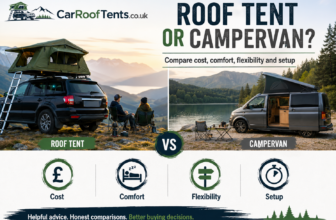
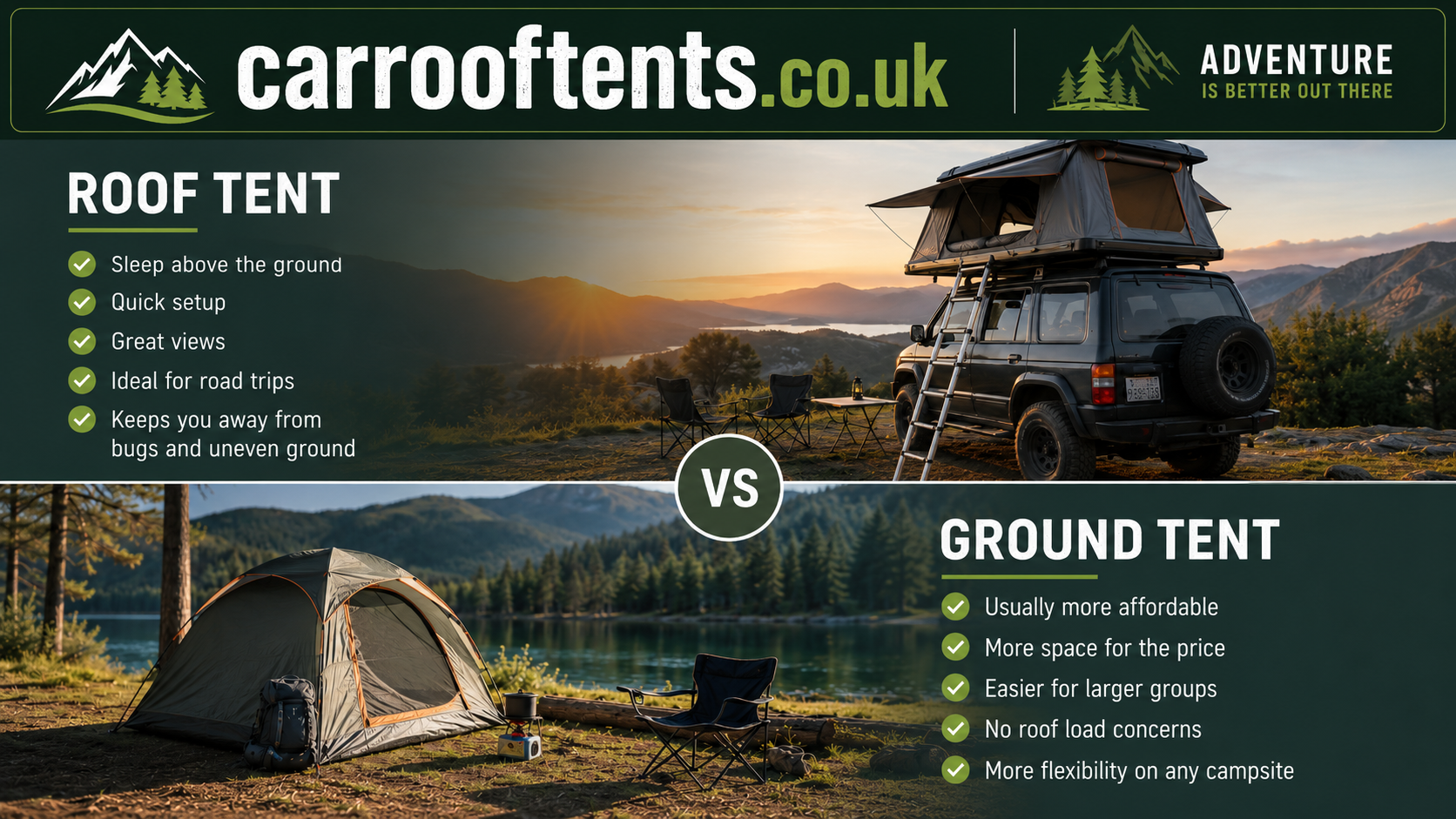
A roof tent and a ground tent can both give you brilliant camping experiences, but they suit different people, vehicles, budgets and trips, here we take a look at the Roof Tent vs Ground Tent debate,
A roof tent mounts to suitable roof bars or a roof rack on top of your vehicle. You sleep above the ground on an integrated mattress, usually with faster setup than many traditional tents.
A ground tent is pitched directly on the campsite floor. It is usually cheaper, easier to store, available in far more sizes and does not require a compatible vehicle or roof bar system.
Neither option is automatically better.
The best choice depends on how you camp, who you camp with, what vehicle you drive, how much you want to spend, where you plan to stay and how much comfort or convenience you expect.
This guide compares roof tents and ground tents in plain English so you can choose the setup that actually suits your camping life.
Quick Answer: Is a Roof Tent Better Than a Ground Tent?
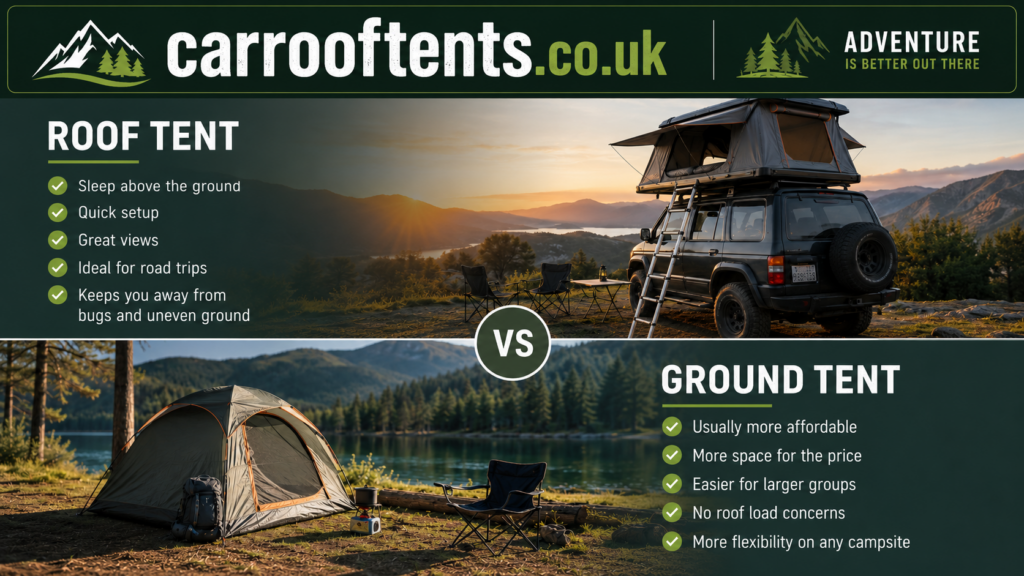
When asking about a roof tent vs ground tent, A roof tent is usually better if you want faster setup, a raised sleeping position, a built-in mattress and a more road-trip-friendly camping setup.
A ground tent is usually better if you want lower cost, more living space, easier storage, family flexibility and the ability to camp without worrying about vehicle roof load limits.
Choose a roof tent if:
- You already have a suitable car, SUV, van, pickup or 4×4.
- You want to sleep off the ground.
- You like weekend road trips.
- You move campsite regularly.
- You want a built-in mattress.
- You do not mind climbing a ladder.
- You are happy to invest in suitable roof bars or a rack.
- You want a camping setup that feels quicker and more adventurous.
Choose a ground tent if:
- You want the cheapest practical camping setup.
- You need lots of space for a family.
- You want standing room, bedrooms or a large living area.
- You drive a car that may not suit a roof tent.
- You want to leave the tent pitched while driving away.
- You need easier storage at home.
- You camp with young children, dogs or lots of kit.
- You do not want to worry about roof load limits.
Simple verdict
For road trips and quick weekends, a roof tent can be excellent.
For families, longer campsite stays and lower budgets, a ground tent is usually more practical.
For small-car owners, a ground tent may be safer and simpler unless your vehicle is confirmed suitable for a lightweight roof tent.
For frequent touring, a roof tent may be worth the extra cost.
Roof Tent vs Ground Tent: Quick Comparison
| Feature | Roof Tent | Ground Tent |
|---|---|---|
| Upfront cost | Usually higher | Usually lower |
| Setup speed | Often faster | Varies widely |
| Sleeping comfort | Built-in mattress | Depends on mattress/camp bed |
| Sleeping position | Raised off the ground | On or near the ground |
| Vehicle requirements | Needs suitable car and roof bars | Works with almost any car |
| Roof load checks | Essential | Not needed |
| Family space | Limited unless large model | Much better choice |
| Living space | Usually limited | Excellent in larger tents |
| Storage at home | Bulky and heavy | Easier |
| Bad weather living | Limited unless using awning | Better in larger tents |
| Campsite flexibility | May need roof-tent-friendly pitch | Very widely accepted |
| Cost of accessories | Roof bars, locks, awning, fitting | Pegs, carpet, airbeds, stove, etc. |
| Best for | Road trips, couples, quick stops | Families, longer stays, budget camping |
What Is a Roof Tent?
Roof tent vs ground tent, A roof tent is a tent that fixes to suitable roof bars or a roof rack on top of your vehicle. It usually folds out, pops up or opens using gas struts.
Most roof tents include:
- Built-in mattress
- Ladder
- Fabric sleeping area
- Windows and ventilation
- Travel cover or hard shell
- Mounting hardware
Roof tents are popular with people who like road trips, weekend camping, overlanding, festivals and touring holidays.
However, a roof tent is not suitable for every car. You must check your vehicle handbook, dynamic roof load limit, roof bar rating and the roof tent manufacturer’s fitting guidance before buying. The RAC advises drivers to understand car roof weight limits and safe roof rack use, while the Camping and Caravanning Club notes that roof tent buyers should check both static and dynamic limits and include the weight of roof bars or racks in their calculations. (RAC)
What Is a Ground Tent?
A ground tent is the traditional camping tent most people are familiar with. It pitches on the ground using poles, air beams, pegs, guy lines or a pop-up structure.
Ground tents can be tiny one-person backpacking tents or large family tents with multiple bedrooms, standing-height living space, porches, awnings and storage areas.
Ground tents are popular because they are:
- Affordable
- Flexible
- Available in many sizes
- Easy to transport
- Easy to store
- Suitable for most campsites
- Good for families
- Independent of vehicle roof load limits
A ground tent may take longer to pitch than a roof tent, but it can offer far more space once set up.
Cost: Roof Tent vs Ground Tent
Cost is one of the biggest differences.
A ground tent is usually much cheaper than a roof tent. You can buy a usable weekend tent for relatively little money, and even good family tents are often cheaper than many roof tent setups.
A roof tent costs more because you are buying a specialist structure that mounts to a vehicle and often includes a built-in mattress, ladder, shell or travel cover and mounting hardware.
Typical roof tent setup costs
| Item | Typical Cost Range |
|---|---|
| Budget roof tent | £700–£1,200 |
| Mid-range roof tent | £1,200–£2,000 |
| Premium roof tent | £2,000–£4,000+ |
| Roof bars or roof rack | £150–£1,000+ |
| Locks, fitting and accessories | £100–£800+ |
Typical ground tent setup costs
| Item | Typical Cost Range |
|---|---|
| Basic weekend tent | £50–£200 |
| Better 2–4 person tent | £150–£500 |
| Large family tent | £400–£1,500+ |
| Sleeping mats, airbeds or camp beds | £30–£300+ |
| Footprint, carpet, pump and accessories | £50–£300+ |
Cost verdict
Roof Tent vs Ground Tent
A ground tent is almost always cheaper.
A roof tent can be worth the extra money if you camp often, value quick setup and already own a suitable vehicle.
Setup Time and Pack-Away
Roof tents are often quicker to set up than traditional ground tents, especially hard shell models. Some open in seconds or a few minutes.
Ground tents vary massively. A small pop-up tent can be very quick. A large air-beam family tent can still be manageable. A traditional poled family tent may take much longer, especially in wind or rain.
Roof tent setup advantages
- No groundsheet to lay out.
- No pegging required for the main sleeping area.
- Built-in mattress is already in place.
- Some hard shells open very quickly.
- Useful for late arrivals.
Roof tent setup disadvantages
- You must position the vehicle carefully.
- You may still need to deploy ladder, windows or awnings.
- Soft shell roof tents can take longer to pack away.
- You cannot drive away without closing the tent.
Ground tent setup advantages
- Can be left pitched while you drive away.
- Can offer more space once set up.
- No need for roof bars.
- Easier to move around the pitch.
- Can be pitched away from the vehicle.
Ground tent setup disadvantages
- Pegging can be difficult on hard ground.
- Wet grass and mud make setup less pleasant.
- Larger tents can take time.
- Bedding and mattresses are usually separate.
Setup verdict
For quick overnight stops, a roof tent often wins.
For longer campsite stays, a ground tent can be better because it gives more space and can stay pitched while you use the car.
Comfort: Which Is Better to Sleep In?
Roof tents often feel comfortable because many include a built-in foam mattress and keep you off wet, uneven or stony ground.
Ground tents can be just as comfortable, but you need to choose your own sleeping mat, airbed, SIM mat or camp bed. The advantage is flexibility: you can create a sleeping setup that suits your exact comfort level.
Roof tent comfort pros
- Raised sleeping position
- Built-in mattress
- Away from uneven ground
- Less risk of puddles under the sleeping area
- Good views and ventilation
- Less crawling around on the floor
Roof tent comfort cons
- Ladder access
- Limited headroom in some models
- Less floor space
- Night-time toilet trips are awkward
- Not ideal for everyone with mobility issues
- Mattress size is fixed
Ground tent comfort pros
- More space
- Easier access
- Better for children and dogs
- More choice of bed setup
- Can have standing-height bedrooms
- Better for changing clothes
Ground tent comfort cons
- More affected by uneven ground
- Can feel damp without good groundsheet and ventilation
- Airbeds can deflate
- More setup needed
- More gear to pack
Comfort verdict
A roof tent is often better for simple sleeping comfort.
A ground tent is usually better for overall living comfort, especially on longer trips or with a family.
UK Weather: Roof Tent or Ground Tent?
Roof tent vs ground tent, Both roof tents and ground tents can work well in UK weather if they are well designed, correctly pitched and properly maintained.
The difference is how much space you have when the weather turns bad.
The Camping and Caravanning Club says roof tents are built to stand against the UK’s varying weather, but also notes that you are more exposed in a roof tent and may need to strike camp if very strong winds are forecast. (campingandcaravanningclub.co.uk)
Roof tent in bad weather
A roof tent keeps you raised above mud and standing water, which can be a real advantage on wet campsites. However, you have less indoor space to sit, cook, change or keep wet clothing away from bedding.
A roof tent works better in bad weather if you also have:
- Awning
- Annex
- Tarp shelter
- Good ventilation
- Anti-condensation mat
- Drying plan at home
Ground tent in bad weather
A larger ground tent can be far more comfortable in rain because it may have a living area, porch, separate bedroom and space for wet gear.
However, ground tents are more affected by:
- Mud
- Flooding
- Poor drainage
- Uneven pitches
- Pegging problems
- Wet groundsheet
Weather verdict
For muddy or uneven pitches, a roof tent can be excellent.
For rainy family camping and sitting indoors, a larger ground tent is usually better.
Roof Load and Vehicle Compatibility
This is the most important safety difference.
A ground tent does not care what car you drive. A roof tent does.
Before buying a roof tent, you must check:
- Vehicle dynamic roof load limit
- Vehicle static roof load guidance
- Roof bar or roof rack rating
- Roof tent weight
- Roof bar/rack weight
- Mounting hardware weight
- Roof type
- Panoramic roof restrictions
- Manufacturer fitting guidance
The basic calculation is:
Roof tent weight + roof bars/rack weight + mounting hardware = total roof load while driving
Dynamic roof load refers to the weight your vehicle can carry on the roof while driving. Static roof load refers to the weight supported when the vehicle is parked. Dometic’s roof tent guide explains the same distinction: dynamic load is while driving, static load is when parked, including the tent and occupants. (dometic.com)
Compatibility verdict
If you do not want to think about vehicle roof load, choose a ground tent.
If you want a roof tent, start with your vehicle handbook before choosing a model.
Family Camping: Roof Tent vs Ground Tent
For families, a ground tent is usually the more practical choice.
That does not mean families cannot use roof tents. Many do. But family roof tents need careful planning around weight, sleeping space, ladder access, changing space, wet shoes, storage and children’s nighttime toilet trips.
Roof tents can work for families if:
- The vehicle can safely carry the tent.
- The roof tent has genuine family sleeping space.
- Children are confident using the ladder.
- You use an awning or annex.
- You mostly camp for weekends or short trips.
- You pack light.
Ground tents are better for families if:
- You need multiple bedrooms.
- You want a living area.
- You camp for a week or more.
- Children are young.
- You need room for toys, bags and wet clothes.
- You want easier bedtime routines.
- You bring dogs.
Family verdict
For most families, a ground tent is cheaper, larger and more practical.
A family roof tent is better for families who travel light, use suitable vehicles and prefer quick touring-style trips.
Couples and Solo Campers
Roof tents are especially appealing for couples and solo campers.
You need less space than a family, you can pack lighter and the built-in mattress can make weekend trips feel much easier.
Roof tent works well for:
- Solo campers
- Couples
- Weekend trips
- Road trips
- Festivals
- Touring holidays
- People who like quick setup
Ground tent works well for:
- Budget solo campers
- Backpackers
- Couples wanting more living space
- Campers who want to leave camp set up
- People who do not want roof bars or heavy lifting
Couples verdict
For couples with a suitable vehicle, a roof tent can be a brilliant upgrade from a basic ground tent.
For couples on a tight budget, a good ground tent still makes more financial sense.
Small Cars: Roof Tent or Ground Tent?
Small-car owners need to be careful with roof tents.
Some small cars can carry lightweight roof tents, but not all are suitable. Vehicle roof load limits, roof bar ratings and roof type all matter.
A ground tent avoids this problem completely. You can carry the tent in the boot and camp without adding heavy roof loads.
Choose a lightweight roof tent if:
- Your car is confirmed suitable.
- The tent is within the dynamic roof load limit.
- Your roof bars are rated correctly.
- You want quick setup.
- You mostly camp solo or as a couple.
Choose a ground tent if:
- You cannot confirm roof load limits.
- Your car has a panoramic roof restriction.
- Your roof bars are unsuitable.
- You need family space.
- You want the cheapest option.
Small-car verdict
For many small cars, a ground tent is the simplest and safest choice.
A lightweight roof tent can work, but only after proper compatibility checks.
Campsites and Pitch Rules in the UK
Ground tents are widely understood by campsites. You usually book a tent pitch, choose electric or non-electric, and pitch your tent.
Roof tents can be less straightforward. Some campsites treat them like tents, while others may place them on campervan or hardstanding pitches. Booking platforms such as Pitchup now list roof tent-friendly campsites as a specific category, which is useful, but you should still check pitch rules directly with the campsite before booking. (Pitchup.com)
Ask the campsite:
- Do you accept roof tents?
- Should I book a tent pitch or campervan pitch?
- Can the car stay on the pitch?
- Is hardstanding required?
- Are awnings or annexes allowed?
- Is electric hookup available?
- Are there height restrictions?
- Can I arrive late?
Campsite verdict
Ground tents are simpler to book.
Roof tents are increasingly accepted, but it is still worth checking before you travel.
Wild Camping and Off-Grid Camping
This is an area where buyers need to be careful.
A roof tent may look ideal for wild camping, but because it is attached to a vehicle, it is not the same as lightweight backpacking with a small tent.
The Camping and Caravanning Club explains that wild camping is generally not permitted in England, Wales and Northern Ireland without permission, while Scotland has more access rights but still requires responsible camping. (campingandcaravanningclub.co.uk)
The Scottish Outdoor Access Code gives guidance on responsible lightweight camping, but vehicle access and parking are separate considerations. (Outdoor Access Scotland)
Practical advice
For both roof tents and ground tents:
- Get permission where required.
- Use official campsites where possible.
- Do not block gateways or tracks.
- Leave no trace.
- Avoid fires where not permitted.
- Respect local rules.
- Do not assume “remote” means legal.
Wild camping verdict
A lightweight ground tent is usually more suitable for traditional wild camping.
A roof tent is better treated as a campsite or permitted-vehicle-camping setup unless you have clear permission.
Storage at Home
Ground tents are usually much easier to store.
Even a large family tent can usually be packed into bags and stored in a garage, loft, cupboard or shed. You still need to dry it properly, but it is easier to handle than a roof tent.
Roof tents are bulky and heavy. Many require two people to lift. Some owners use garage hoists, wall brackets or storage stands.
Roof tent storage issues
- Heavy to remove
- Needs dry storage
- May need a hoist
- Takes up garage space
- Awkward to move alone
- Needs airing after wet trips
Ground tent storage issues
- Must be dried properly
- Poles and bags can be bulky
- Large family tents still take space
- Damp storage can cause mould
Storage verdict
Ground tents are much easier to store.
Roof tents need more planning, especially if you remove them between trips.
Driving and Everyday Use
A roof tent affects the vehicle while it is fitted.
It can increase:
- Vehicle height
- Wind noise
- Fuel use
- Roof weight
- Crosswind sensitivity
- Car park restrictions
A ground tent sits in the boot while travelling. Once pitched, it does not affect the car. You can also drive away from the campsite while leaving your tent set up.
Driving verdict
A ground tent is better if you need your car during the trip.
A roof tent is better if you are touring and do not need to leave camp set up.
Security
A ground tent is not especially secure. You should not leave valuables inside.
A roof tent is also not secure for valuables, but it is harder to casually walk away with than a normal tent. However, the tent itself can be a theft target when fitted to the vehicle.
Roof tent security tips
- Use security nuts or locking mounts.
- Do not leave expensive gear inside.
- Remove the tent when not needed.
- Store it securely at home.
- Tell your insurer if required.
Ground tent security tips
- Keep valuables in the car or with you.
- Use campsite lockers if available.
- Do not rely on small zip locks.
- Pitch in sensible areas.
- Keep expensive gear out of sight.
Security verdict
Neither setup should be treated as secure storage.
A roof tent may feel more substantial, but a car, roof rack or tent theft risk still exists.
Pros and Cons of Roof Tents
Roof tent pros
- Raised off the ground
- Built-in mattress
- Often quick to set up
- Good for road trips
- Less affected by uneven ground
- Useful on muddy campsites
- Can feel more comfortable than basic tent camping
- Great for couples and solo campers
- Adventure appeal
- Some models can store bedding inside
Roof tent cons
- Expensive
- Needs suitable vehicle and roof bars
- Roof load limits matter
- Bulky to store
- Heavy to lift
- Ladder access can be awkward
- Less living space
- Not ideal for all families
- You must close it before driving
- Can increase fuel use and wind noise
Pros and Cons of Ground Tents
Ground tent pros
- Much cheaper
- Huge choice of sizes
- Better for families
- More living space
- Easier to store
- No roof load concerns
- Can be left pitched while driving away
- Better for dogs and young children
- Easier entry and exit
- More flexible pitch position
Ground tent cons
- Can take longer to pitch
- More affected by wet ground
- More bedding and mattress gear needed
- Pegging can be difficult
- Less convenient for quick touring
- Airbeds or mats may be less comfortable
- Mud and condensation can be more noticeable
- Large tents can be heavy and bulky too
Roof Tent vs Ground Tent by Buyer Type
| Buyer Type | Better Starting Point | Why |
|---|---|---|
| First-time camper | Ground tent | Lower cost and less commitment |
| Couple doing weekends | Roof tent | Quick, comfortable and road-trip friendly |
| Family with young children | Ground tent | More space and easier access |
| Family touring lightly | Roof tent plus awning | Can work if vehicle is suitable |
| Small-car owner | Ground tent or lightweight roof tent | Depends on roof load limit |
| Festival camper | Ground tent | Cheaper and less vehicle-dependent |
| Road tripper | Roof tent | Faster for multi-stop travel |
| Long-stay campsite camper | Ground tent | More living space |
| Dog owner | Ground tent | Easier access and more floor space |
| Premium comfort buyer | Roof tent or large air tent | Depends on budget and vehicle |
| Budget buyer | Ground tent | Far cheaper overall |
Common Mistakes When Choosing Between a Roof Tent and Ground Tent
Mistake 1: Thinking a roof tent fits any car
It does not. You need to check vehicle roof load, roof bars and tent weight.
Mistake 2: Buying a ground tent that is too big
Large family tents are spacious but can be heavy, slow to pitch and difficult to dry.
Mistake 3: Ignoring pack-away
A tent that is easy to pitch but hard to pack away can become frustrating quickly.
Mistake 4: Forgetting storage
Roof tents need dry, secure storage. Ground tents need drying space and proper packing.
Mistake 5: Choosing by photos rather than real use
Ask how you will actually camp: quick weekends, family holidays, festivals, road trips or long campsite stays.
Mistake 6: Not considering UK weather
Rain changes everything. Living space, drying space and shelter matter.
Mistake 7: Overbuying too early
A premium roof tent may be unnecessary if you only camp once or twice per year.
When a Roof Tent Is the Better Choice
A roof tent is probably better if:
- You already own a suitable vehicle.
- You camp as a couple or solo.
- You like quick weekend trips.
- You move around often.
- You want a built-in mattress.
- You want to sleep off the ground.
- You do not need much living space.
- You are happy to invest in roof bars and fitting.
- You want something more convenient than a basic ground tent.
When a Ground Tent Is the Better Choice
A ground tent is probably better if:
- You are on a lower budget.
- You camp with children or dogs.
- You want bedrooms and living space.
- You stay on campsites for several nights.
- Your car is not roof-tent suitable.
- You want to drive away during the day.
- You need easy storage at home.
- You want the simplest, safest first camping setup.
Final Verdict: Roof Tent or Ground Tent?
There is no single winner.
A roof tent is best if you want quick setup, a raised sleeping position, a built-in mattress and a camping setup that suits road trips and weekends away.
A ground tent is best if you want lower cost, more space, easier storage, family practicality and fewer vehicle compatibility concerns.
For many UK buyers, the sensible choice is:
- Couples and solo road trippers: roof tent
- Families and long-stay campers: ground tent
- Small-car owners: ground tent unless a lightweight roof tent is confirmed suitable
- Budget buyers: ground tent
- Frequent weekend campers: roof tent may be worth it
- First-time campers: start with a ground tent before spending roof tent money
The most important advice is simple:
Choose the setup that fits your actual trips, not the one that looks best on Instagram.
Suggested Internal Links
Add these once the pages are live:
- Complete Roof Tent Buying Guide UK
- Best Roof Tents UK
- Can You Put a Roof Tent on Any Car?
- Roof Tent Weight Limits Explained
- Best Roof Tents for Small Cars UK
- Best Roof Tents for Families UK
- Best Budget Roof Tents UK
- Best Premium Roof Tents UK
- Hard Shell vs Soft Shell Roof Tents
- Used Roof Tents Guide UK
- Roof Tent vs Campervan
- Roof Tent FAQ
FAQ Section
Is a roof tent better than a ground tent?
A roof tent is better for quick setup, road trips and sleeping off the ground. A ground tent is better for cost, space, families and longer campsite stays.
Is a roof tent warmer than a ground tent?
Not always. Warmth depends on tent design, insulation, mattress, bedding and weather. Roof tents keep you off the cold ground, but they can still be exposed to wind.
Is a roof tent safer than a ground tent?
A roof tent can feel more secure because you sleep above the ground, but safety depends on correct fitting, suitable roof bars, ladder use and weather conditions. Ground tents avoid roof load risks entirely.
Are roof tents good in rain?
Good roof tents can handle rain, but you still need ventilation, drying space and careful pack-away. A larger ground tent may be more comfortable in rain because it offers living space.
Are roof tents good for families?
Some family roof tents work well, but ground tents are usually more practical for families because they offer more space, easier access and better storage.
Do campsites allow roof tents?
Many campsites do, but not all classify them the same way. Some treat roof tents as tents, others as campervan-style pitches. Always check before booking.
Is a roof tent worth it for occasional camping?
Usually only if you value convenience and will use it enough. For occasional camping on a tight budget, a ground tent is normally better value.
Can I wild camp in a roof tent?
Do not assume you can wild camp just because you have a roof tent. UK wild camping rules vary and vehicle-based camping is more restricted. Use official campsites or get permission where required.
Which is cheaper, a roof tent or ground tent?
A ground tent is usually much cheaper. A roof tent also needs suitable roof bars or a roof rack, which adds to the total cost.
Still Deciding Between a Roof Tent and a Ground Tent?
Start with your camping style.
For quick road trips and weekend adventures, compare suitable models in Best Roof Tents UK.
For safety checks, read Can You Put a Roof Tent on Any Car? and Roof Tent Weight Limits Explained before buying.