Used Roof Tents Guide UK | How to Buy a Second-Hand Roof Tent Safely
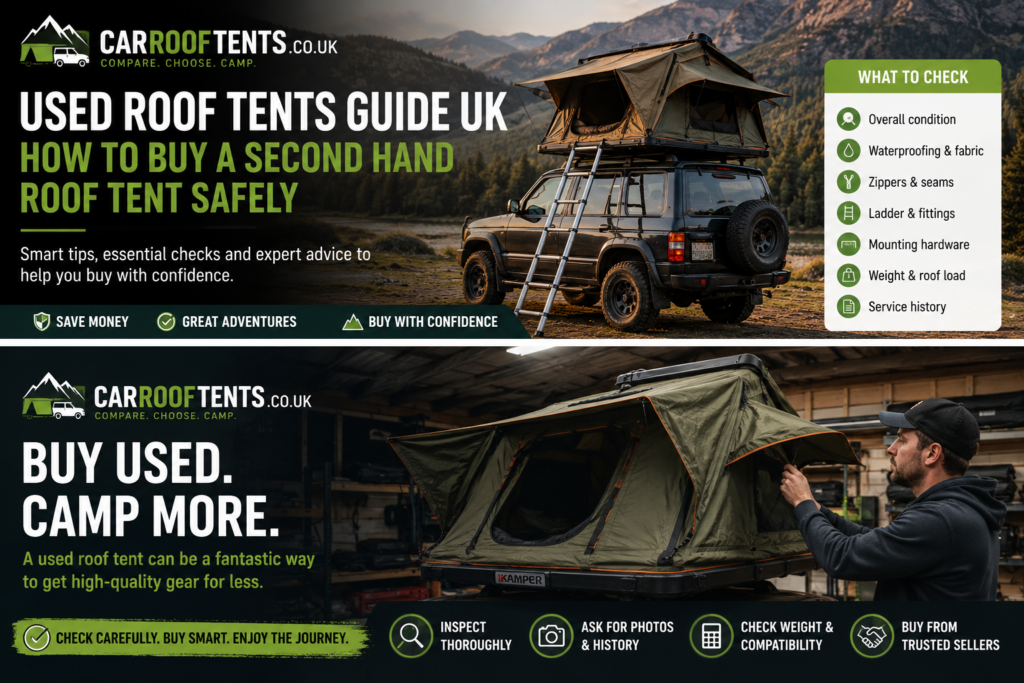
Used Roof Tents Guide UK
Buying a used roof tent can be a smart way to save money, especially if you are new to roof tent camping and do not want to spend £1,000–£3,000+ on your first setup.
But a second-hand roof tent is not like buying a used camping chair or a basic ground tent. It is a large, heavy item that mounts to your vehicle, relies on strong fabric, hinges, ladders, fixings, bars and waterproofing, and may already have been exposed to rain, mud, UV, salt, storage damp and repeated packing away.
A good used roof tent can be a bargain.
A bad one can be expensive, unsafe, mouldy, incomplete or completely wrong for your car.
This guide explains how to buy a used roof tent in the UK, what to check before viewing, how to inspect one properly, what questions to ask the seller and when to walk away.
Quick Answer: Is Buying a Used Roof Tent a Good Idea?
Yes, buying a used roof tent can be a good idea if:
- The tent is from a known brand.
- It has been stored dry.
- The fabric, shell, mattress, ladder, hinges and mounting parts are in good condition.
- It comes with the correct brackets and fixings.
- It suits your vehicle and roof bars.
- The price reflects its age and condition.
- You can inspect it in person before paying.
However, you should avoid a used roof tent if:
- It smells damp or mouldy.
- The seller cannot show it fully opened.
- Key mounting parts are missing.
- The shell is cracked.
- The ladder is damaged.
- The fabric is torn, perished or badly faded.
- The tent has been stored wet.
- The seller pressures you to pay before viewing.
- You cannot confirm whether it will fit your vehicle.
The most important rule is simple:
Do not buy a used roof tent until you have checked both the tent condition and your vehicle compatibility.
Before Looking at Used Roof Tents: Check Your Car First
Before searching Facebook Marketplace, eBay, Gumtree or roof tent groups, check whether your car can actually carry a roof tent.
A roof tent must be suitable for:
- Your vehicle roof load limit
- Your roof bars or roof rack
- Your vehicle roof type
- Your roof bar spacing
- Your insurance position
- Your ability to lift, fit, store and remove it
Thule explains that roof tent compatibility depends on roof load capacity, vehicle roof design and roof rack compatibility, and that the tent plus roof racks must stay within the vehicle’s dynamic roof load limit while driving. (Thule)
The RAC also advises drivers to understand vehicle roof weight limits and follow manufacturer guidance when carrying roof loads. (RAC)
Basic Used Roof Tent Compatibility Formula
Use this before buying:
Used roof tent weight + roof bars/rack weight + mounting hardware = total roof load while driving
Then compare that total with:
- Your vehicle dynamic roof load limit
- Your roof bar or roof rack rating
- The roof tent manufacturer’s fitting guidance
If you cannot confirm the weight of the used tent, be cautious. Older models may not have obvious specification labels, and sellers may guess.
Where to Buy Used Roof Tents in the UK
Used roof tents commonly appear on:
- Facebook Marketplace
- eBay
- Gumtree
- Specialist camping groups
- Overlanding forums
- Roof tent Facebook groups
- Campervan and 4×4 groups
- Local classified ads
- Occasionally from dealers selling ex-display or returned stock
The safest used purchase is usually from a reputable retailer selling an ex-display, refurbished or returned tent with some form of written description, invoice and return policy.
Private sales can offer better prices, but they usually carry more risk. Second-hand private sale rights are more limited than buying from a trader; private sellers are generally expected to make sure the item matches the description, but you do not usually get the same protection as when buying from a business. (Saga)
Used Roof Tent Buyer’s Checklist
Before arranging a viewing, ask the seller for:
- Brand and model
- Approximate age
- Original purchase receipt, if available
- Reason for sale
- Current photos, not old catalogue images
- Photos of the tent open and closed
- Photos of the mattress
- Photos of the underside
- Photos of the mounting rails
- Photos of brackets, bolts and fixings
- Confirmation that the ladder is included
- Confirmation that the travel cover or hard shell is intact
- Confirmation of any damage, repairs or leaks
- Confirmation of how it has been stored
- Confirmation of whether it smells damp or mouldy
- Tent weight
- Packed dimensions
- Whether fitting instructions are included
- Whether keys are included, if it has locks
If the seller is vague, evasive or refuses to show detailed photos, move on.
Questions to Ask Before Viewing
Ask these questions before travelling:
About the tent
- What brand and model is it?
- How old is it?
- Are you the original owner?
- Do you have the receipt?
- Has it ever leaked?
- Has it ever been repaired?
- Has it ever been stored wet?
- Is there any mould or damp smell?
- Are there any tears, cracks or broken parts?
- Are all brackets, bolts and mounting rails included?
About use and storage
- How many times has it been used?
- Was it mainly used in summer or year-round?
- Has it been used near the coast?
- Has it been kept on the vehicle permanently?
- Has it been stored in a garage, shed, loft or outside?
- Has it been cleaned and dried before storage?
About fitting
- What vehicle was it fitted to?
- What roof bars or rack was it fitted to?
- Are the original mounting brackets included?
- Do you have the fitting instructions?
- Can it be opened during viewing?
- Can you help load it if I buy it?
About payment
- Will you accept payment after inspection?
- Can I collect from your home address?
- Can you provide a written receipt?
- Is the item fully paid for and owned by you?
Citizens Advice recommends viewing used items such as cars in daylight and, where possible, meeting a private seller at their home so you have a record of the address if something goes wrong. That same practical caution is sensible when buying a high-value used roof tent. (Citizens Advice)
What to Inspect When Buying a Used Roof Tent
Always inspect a used roof tent fully opened and fully closed.
Do not buy one from photos alone unless it is from a trusted business seller with clear returns and written condition notes.
1. Smell Test
This is one of the quickest checks.
Open the tent and smell the fabric, mattress and interior.
Walk away if it smells strongly of:
- Damp
- Mould
- Mildew
- Rot
- Stale water
- Chemical masking sprays
A little camping smell is normal. A deep damp smell is not.
Mould can be difficult to remove and may indicate the tent was packed away wet or stored badly.
2. Canvas and Fabric Check
Inspect the fabric carefully.
Look for:
- Tears
- Pinholes
- Heavy fading
- Stretched seams
- Frayed edges
- Mould spots
- Black staining
- UV damage
- Worn corners
- Damaged windows
- Broken mesh
- Failed waterproof coating
Pay close attention to corners, seams and areas that fold repeatedly. These areas take the most stress.
Minor marks may be acceptable on a used tent. Torn fabric, failed seams or widespread mould should reduce the price heavily or make it a no-buy.
3. Waterproofing and Seams
Ask whether the tent has ever leaked.
Then inspect:
- Main roof seams
- Window stitching
- Door stitching
- Corners
- Zip covers
- Awning sections
- Floor edges
- Any previous repair patches
Signs of water staining inside the tent may suggest leaks or poor storage.
A used roof tent may need reproofing, but it should not be actively leaking, rotten or badly stained.
4. Mattress Check
The mattress is easy to overlook, but it matters.
Check for:
- Damp smell
- Mould spots
- Staining
- Sagging
- Tears in the cover
- Compressed foam
- Missing anti-condensation mat
- Signs of pets or smoke
A replacement mattress or anti-condensation mat may be possible, but factor that into the price.
If the mattress smells damp, assume the inside of the tent may also have been stored badly.
5. Ladder Check
The ladder is a safety-critical part of the roof tent.
Check:
- All rungs are secure
- It extends and retracts properly
- Locking clips work
- Feet are not badly worn
- Hinges are secure
- There are no cracks or bends
- It attaches correctly to the tent
- It is the correct ladder for that model
Do not ignore ladder damage. A roof tent ladder is not just an accessory; it supports entry, exit and stability when in use.
6. Hinges, Struts and Opening Mechanism
For hard shell and pop-up roof tents, check:
- Gas struts
- Hinges
- Shell alignment
- Latches
- Locks
- Handles
- Internal frame
- Rivets and fixings
- Opening speed
- Closing resistance
The tent should open smoothly and close properly without forcing.
If one side lifts unevenly, the shell does not align, or the struts feel weak, budget for repair or walk away.
7. Hard Shell Condition
For hard shell roof tents, inspect the outer shell carefully.
Look for:
- Cracks
- Deep scratches
- Impact damage
- Warping
- Poor repairs
- Loose seals
- Broken latches
- Damaged locks
- Water trapped inside the shell
- Separation around edges
A scratched hard shell may be cosmetic. A cracked or warped shell can be much more serious.
8. Soft Shell Cover Condition
For soft shell roof tents, the travel cover is very important.
Check:
- Zip condition
- Buckles
- Straps
- PVC cracking
- Holes
- UV damage
- Loose stitching
- Fit around the tent
- Whether water can enter while driving
A damaged travel cover can let water into the packed tent, especially during motorway driving in rain.
9. Mounting Rails and Brackets
This is one of the most important checks.
Look underneath the tent and check:
- Mounting rails are straight
- Rails are not cracked or badly corroded
- Bolts are not rounded
- Brackets are included
- Plates are included
- Nuts and washers are included
- Rubber protection pieces are included, if required
- Threads are not stripped
- There are no signs of bodged drilling
If mounting parts are missing, the tent may still be usable, but only if replacements are available from the manufacturer.
Do not improvise unsafe mounting hardware just to save money.
10. Zips, Windows and Mesh
Open and close every zip.
Check:
- Door zips
- Window zips
- Mesh panels
- Rainfly zips
- Cover zips
- Zip pulls
- Stitching around zip tracks
A broken zip can be annoying, expensive and difficult to repair.
If one zip is stiff, it may need cleaning or lubrication. If teeth are missing or the zip separates, negotiate hard or walk away.
Used Roof Tent Red Flags
Walk away if you notice any of the following:
- Seller refuses to open the tent
- Seller only uses catalogue photos
- Strong mould or damp smell
- Missing mounting brackets
- Cracked hard shell
- Bent ladder
- Rotten fabric
- Heavy seam damage
- Large unrepaired tears
- Seller wants a deposit before viewing
- Seller will not provide an address
- Price seems suspiciously low
- Seller cannot explain where it came from
- The tent appears much older than described
- Locks are missing and seller has no keys
- The brand/model cannot be identified
- The tent does not match the advert
A bargain is only a bargain if it is complete, safe and suitable for your vehicle.
How Much Should You Pay for a Used Roof Tent?
Used roof tent prices vary depending on brand, age, condition, season and demand.
As a rough guide:
| Condition | Sensible Used Price Guide |
|---|---|
| Nearly new, excellent condition | 70–85% of current new price |
| Good condition, lightly used | 55–70% of current new price |
| Average condition, visible use | 40–55% of current new price |
| Needs cleaning, parts or reproofing | 25–40% of current new price |
| Mouldy, damaged or incomplete | Usually avoid unless very cheap and repairable |
A used tent is not automatically worth 80% of its original price just because the seller says it has “only been used twice”.
Check:
- Current new price
- Current sale price
- Warranty transferability
- Condition
- Missing accessories
- Age
- Brand support
- Replacement part availability
- Whether you need roof bars as well
If a new version is on sale for £1,200, paying £1,000 for a used one may make little sense.
The Best Time to Buy a Used Roof Tent
Used roof tent prices often depend on season.
You may find better deals:
- Late autumn
- Winter
- After summer holidays
- After festival season
- When people sell unused lockdown-era camping gear
- When owners change vehicles
- When families upgrade to a larger tent
Prices are usually stronger in:
- Spring
- Early summer
- Before bank holidays
- Before school holidays
- During heatwaves
- Before major camping season
If you are not in a rush, buying out of season can save money.
Should You Buy Used from a Private Seller or Retailer?
Private Seller
Advantages
- Usually cheaper
- More room to negotiate
- Local collection may be possible
- Some tents have barely been used
Disadvantages
- Fewer buyer protections
- No warranty in many cases
- Harder to return
- More risk of missing parts
- More risk if condition is misdescribed
Retailer, Dealer or Ex-Display Sale
Advantages
- Clearer condition description
- Possible warranty
- Possible return policy
- Better paperwork
- May include fitting advice
- Less risk than a private sale
Disadvantages
- Usually more expensive
- Less room to negotiate
- Limited stock
- May still have display wear
Consumer rights are generally stronger when buying from a trader than from a private seller. The Consumer Rights Act includes rights around goods being of satisfactory quality, fit for purpose and as described when supplied by traders. (Legislation.gov.uk)
Payment Safety Tips
When buying a used roof tent privately:
- Inspect before paying.
- Avoid paying large deposits to strangers.
- Be wary of courier-only sales.
- Avoid bank transfer before viewing.
- Keep screenshots of the advert.
- Keep messages with the seller.
- Ask for a written receipt.
- Record the seller’s name and address.
- Check the tent matches the description.
- Do not be rushed.
A simple receipt should include:
- Date of sale
- Seller name
- Buyer name
- Brand and model
- Serial number, if available
- Price paid
- Condition notes
- List of included parts
- Seller signature
Used Roof Tent Viewing Checklist
Take this with you.
Bring
- Tape measure
- Torch
- Phone camera
- Notepad
- Gloves
- Roof bar measurements
- Vehicle roof load information
- A second person to help lift
- Screenshots of the advert
- List of included parts
Check Open
- Smell inside
- Inspect mattress
- Inspect fabric
- Check seams
- Check windows
- Check mesh
- Check zips
- Check ladder
- Check hinges
- Check struts
- Check signs of leaks
- Check mould
- Check internal frame
Check Closed
- Travel cover or hard shell condition
- Straps and buckles
- Latches and locks
- Shell alignment
- Packed size
- Mounting rails
- Brackets and bolts
- Signs of corrosion
- Signs of poor repairs
Confirm Before Paying
- Brand and model
- Tent weight
- Age
- Receipt or proof of purchase
- All parts included
- No hidden damage
- Suitable for your vehicle
- Seller provides receipt
What Missing Parts Matter Most?
Some missing parts are minor. Others are serious.
Usually manageable if replacements are available
- Mattress cover
- Storage bag
- Pegs
- Guy ropes
- Internal LED light
- Shoe bag
- Minor trim pieces
More serious
- Ladder
- Mounting brackets
- Mounting rails
- Locking keys
- Travel cover
- Gas struts
- Hinges
- Hard shell latches
- Main mattress
- Rainfly poles
- Manufacturer-specific bolts
Before buying an incomplete tent, check whether the manufacturer still sells spares.
If the brand no longer exists or parts are unavailable, be cautious.
Should You Buy a Used Roof Tent Without Roof Bars?
Yes, but only if you budget for suitable new roof bars or a rack.
In many cases, buying the tent separately and fitting new vehicle-specific bars is safer than trying to reuse the seller’s old roof bars.
Roof bars must suit:
- Your exact vehicle
- Your roof type
- Your roof load limit
- The tent mounting system
- The required bar spacing
- The total weight being carried
Thule explains that roof racks create the secure interface between the vehicle and rooftop tent, and that rack systems must match the roof type, support the combined weight and provide proper spacing and stability. (Thule)
Can You Reproof a Used Roof Tent?
Yes, many fabric roof tents can be cleaned and reproofed, depending on condition.
A used roof tent may benefit from:
- Gentle cleaning
- Drying fully
- Seam inspection
- Fabric reproofing
- Zip cleaning
- Mould treatment
- Mattress airing
- Anti-condensation mat
- Replacement cover
- New bolts or fixings
But reproofing is not a cure for everything.
Avoid buying if the fabric is rotten, heavily mouldy, badly torn or structurally damaged.
Should You Buy a Used Hard Shell or Soft Shell Roof Tent?
Used Hard Shell Roof Tents
Advantages
- Usually quicker to open
- Hard shell may protect the tent better while travelling
- Often premium models
- Good for regular use
Risks
- Cracked shells can be expensive
- Gas struts may weaken
- Hinges and latches can wear
- Repairs may be more specialist
- Usually heavier and more expensive
Used Soft Shell Roof Tents
Advantages
- Often cheaper
- More choice used
- Larger sleeping area for the money
- Easier to inspect fabric condition
- Good for families and occasional campers
Risks
- Travel covers can crack or leak
- Fabric may suffer if stored wet
- Zips and seams take more stress
- Pack-away wear is common
- More risk of mould if badly stored
For first-time used buyers, a clean, complete, lightweight soft shell from a known brand may be the safest route. For regular road trippers, a well-kept hard shell may justify the extra cost.
Used Roof Tent Negotiation Tips
Use facts, not awkward haggling.
Good reasons to negotiate:
- No receipt
- Out of warranty
- Missing brackets
- Damaged travel cover
- Weak gas struts
- Stained mattress
- Needs reproofing
- Older model
- Current new price has dropped
- You need to buy new roof bars
- Seller cannot confirm exact weight
- Minor repairs needed
Example phrase:
“It looks like a good tent, but I’ll need to buy new mounting hardware and reproof it, so I’d be comfortable at £___.”
Do not insult the seller. Just explain the real costs.
After Buying: What to Do Before Your First Trip
Before sleeping in a used roof tent:
- Clean it properly.
- Air it fully.
- Dry it completely.
- Check every bolt.
- Check the ladder.
- Check the zips.
- Reproof if needed.
- Test open and close at home.
- Fit it in daylight.
- Recheck all mountings after the first drive.
- Check your vehicle height.
- Tell your insurer if required.
- Try one local overnight trip before a long journey.
The first trip should be a test, not a remote adventure.
Used Roof Tent Final Verdict
A used roof tent can be an excellent buy if you choose carefully.
The best second-hand roof tent is:
- Clean
- Dry
- Complete
- Structurally sound
- From a known brand
- Still supported with spare parts
- Correctly priced
- Suitable for your vehicle
- Supplied with proper mounting hardware
- Inspected fully before payment
The worst used roof tent is:
- Mouldy
- Incomplete
- Too heavy for your car
- Badly stored
- Missing brackets
- Cracked or leaking
- Sold by someone who refuses proper inspection
If in doubt, walk away. There will always be another used roof tent.
Suggested Internal Links
Add these once the pages are live:
- Complete Roof Tent Buying Guide UK
- Can You Put a Roof Tent on Any Car?
- Roof Tent Weight Limits Explained
- Best Roof Tents UK
- Best Roof Tents for Small Cars
- Best Budget Roof Tents UK
- Hard Shell vs Soft Shell Roof Tents
- Best Roof Bars for Roof Tents
- Roof Tent Insurance UK
- Roof Tent FAQ
FAQ Section
Is it worth buying a used roof tent?
Yes, a used roof tent can be worth buying if it is clean, dry, complete, fairly priced and suitable for your vehicle. Avoid used tents with mould, missing brackets, cracked shells, damaged ladders or unclear history.
What should I check when buying a second-hand roof tent?
Check the fabric, mattress, ladder, zips, hinges, shell, travel cover, mounting rails, brackets, bolts, smell, signs of leaks and whether the tent can be opened fully before payment.
How much should I pay for a used roof tent?
A good used roof tent may sell for around 55–70% of its current new price, while nearly new examples may be higher. Tents needing cleaning, reproofing or parts should be much cheaper.
Should I buy a used roof tent from Facebook Marketplace?
You can, but inspect it in person before paying and be cautious. Private sales usually offer fewer protections than buying from a business, so keep screenshots, ask questions and get a written receipt.
Can a used roof tent leak?
Yes. Used roof tents can leak if seams, fabric, covers or shells are damaged. Always inspect for water staining, damp smells, mould and previous repairs.
Is mould in a roof tent a deal-breaker?
Heavy mould is usually a deal-breaker. Light surface marks may sometimes be cleaned, but strong damp smells or black mould suggest poor storage and possible deeper problems.
Can I use my old roof bars with a used roof tent?
Only if the bars are suitable for your exact vehicle and rated for the tent setup. You must include the weight of the tent, bars and mounting hardware when checking roof load.
Do used roof tents come with warranties?
Sometimes, but not always. Private-sale tents may have no transferable warranty. Retailer ex-display or refurbished tents may come with some form of written warranty or return policy.
Should I tell my insurer about a used roof tent?
Yes, it is sensible to contact your insurer before fitting any roof tent, whether new or used. Ask whether the roof tent, bars or rack need to be declared and whether theft or damage is covered.
Thinking of Buying a Used Roof Tent?
Start with compatibility first.
Check your vehicle roof load limit, roof bar rating and tent weight before arranging a viewing. Then use this inspection checklist to make sure the tent is clean, complete, safe and worth the money.