Roof Tent Insurance UK | What to Check Before Fitting a Roof Tent

Last Updated on 2 months ago by admin
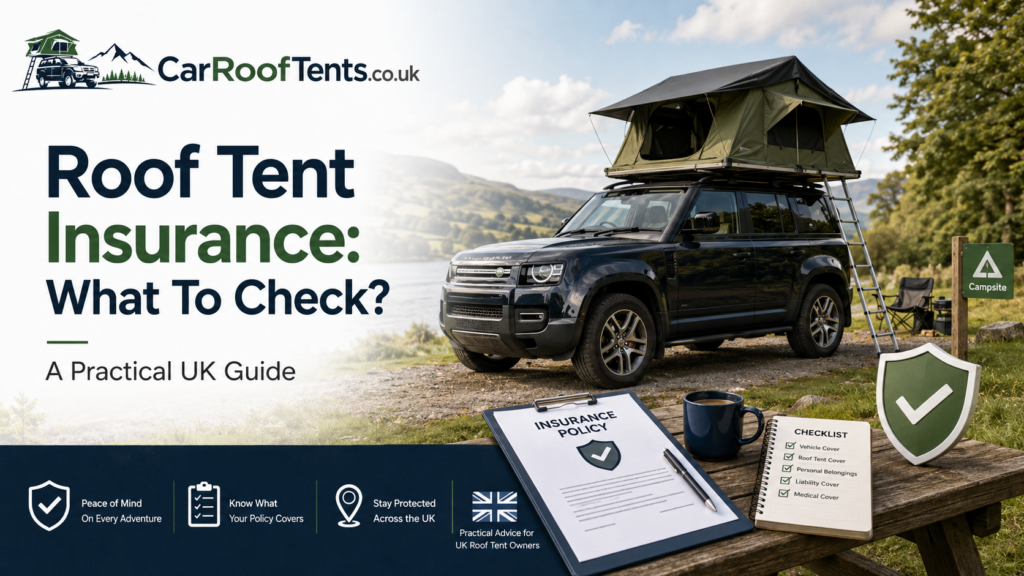
Roof Tent Insurance: What to Check Before Fitting a Roof Tent
A roof tent can be a brilliant upgrade for UK camping, but before you fit one to your car, SUV, van, pickup or 4×4, you should check how it affects your insurance.
A roof tent is not just ordinary camping gear. It is a large, valuable item mounted to your vehicle. It may use roof bars, a roof rack, mounting brackets, locks, ladders and sometimes additional accessories such as awnings or annexes. It can also affect vehicle height, weight, handling, wind resistance and theft risk.
That means one simple rule should guide every buyer:
Tell your insurer before fitting a roof tent, roof bars or roof rack.
MoneyHelper says motorists need to give insurers accurate, up-to-date details about themselves and their car, and warns that failing to do so could mean the policy is not valid and claims may not be paid. Its list of changes to tell insurers about includes modifying your car. (MaPS)
This guide explains what UK roof tent buyers should check with their insurer before fitting a roof tent.
Quick Answer: Do You Need to Tell Your Insurer About a Roof Tent?
Yes, you should tell your insurer before fitting a roof tent.
Your insurer may want to know about:
- The roof tent itself
- Roof bars or roof rack
- Any mounting brackets
- Whether it is permanently or temporarily fitted
- The value of the tent
- Whether it changes vehicle height
- Whether it affects where the car is parked
- Whether the roof tent is covered for theft or damage
- Whether the contents inside the tent are covered
- Whether the setup affects your premium
Even temporary exterior accessories can matter. Churchill says that adding accessories to the outside of a car, even only a few times a year or as a temporary fit, may still be considered a modification, so drivers should check with their insurer. (churchill.com)
Why Roof Tent Insurance Matters
A roof tent creates several insurance questions.
It may affect:
- Vehicle modification status
- Accident claims
- Theft claims
- Damage claims
- Personal belongings cover
- Roof bar or rack cover
- Public liability
- European travel cover
- Business or hire use
- Vehicle value
- Repair costs
- Where the car can be parked safely
The Financial Ombudsman Service says car modifications can affect insurance, and that not declaring significant changes can have serious consequences if the insurer says the vehicle was at higher theft risk, would have cost more to insure, or would not have been covered at all if the modification had been known. (Financial Ombudsman)
The safest approach is to treat a roof tent as something your insurer needs to know about, even if it is removable.
Is a Roof Tent Classed as a Modification?
Different insurers may use different wording, but a roof tent, roof bars or roof rack could be treated as a vehicle modification or accessory because they alter the vehicle from standard.
Quotezone warned in 2025 that roof racks and roof boxes can be classed as modifications, and that failing to declare them could void cover if a claim is made. It also notes that roof racks are not standard equipment and may affect weight distribution and handling. (Quotezone)
A roof tent is usually larger, heavier and more valuable than a roof box, so it is sensible to declare it rather than assume it is covered automatically.
What to Tell Your Car Insurer
When contacting your insurer, give clear information.
Tell them:
- Brand and model of roof tent
- Type: hard shell, soft shell or hybrid
- Approximate weight
- Purchase price or replacement value
- Whether it is new or used
- Whether it will stay fitted all year or only for trips
- Whether roof bars or a roof rack are fitted
- Brand and type of roof bars or rack
- Whether it has security locks or anti-theft fixings
- Whether bedding or gear will be stored inside
- Where the vehicle is parked overnight
- Whether the roof tent will be used abroad
- Whether the vehicle is used for commuting, business, hire or social use only
Ask the insurer to confirm the answer in writing, by email, online chat transcript or policy note.
Questions to Ask Your Car Insurer
Use this checklist when speaking to your insurer.
Modification and policy validity
Ask:
- Do I need to declare a roof tent?
- Do I need to declare roof bars or a roof rack?
- Is the roof tent treated as a modification or accessory?
- Will fitting it affect my premium?
- Will fitting it affect my excess?
- Will fitting it affect my policy terms?
- Will fitting it affect my ability to claim?
- Are there any restrictions on how long it can stay fitted?
Theft and damage cover
Ask:
- Is the roof tent covered if stolen from the vehicle?
- Is it covered if damaged in an accident?
- Is it covered if damaged while parked?
- Is it covered if damaged by wind, storm or falling branches?
- Is it covered while fitted at a campsite?
- Is it covered while stored in a garage or shed?
- Is there a single-item value limit?
- Is there a maximum accessory value limit?
Contents and camping gear
Ask:
- Are bedding and camping accessories inside the roof tent covered?
- Are personal belongings covered while inside the tent?
- Are valuables excluded?
- Are contents covered at campsites?
- Are contents covered overnight?
- Is there a separate personal possessions limit?
Fitting and safety
Ask:
- Does the roof tent need to be professionally fitted?
- Do you need proof of fitting?
- Do you need proof that my roof bars are suitable?
- Would a claim be affected if the tent was overloaded or incorrectly fitted?
- Do you require security locks or anti-theft fixings?
- Do you require the tent to be removed when not in use?
Travel and use
Ask:
- Am I covered for UK-only use?
- Am I covered in Europe?
- Are there limits on trip length?
- Am I covered on ferries?
- Am I covered on campsites?
- Am I covered on private land?
- Am I covered for green lanes or off-road driving?
- Am I covered if I rent out the tent or vehicle?
Does Car Insurance Cover the Roof Tent Itself?
Not always.
Some car insurance policies may cover accessories fitted to the vehicle. Others may only cover standard vehicle parts. Some may cover the vehicle but not the roof tent. Some may accept the roof tent as a declared accessory but apply a value limit.
Do not assume comprehensive car insurance automatically covers the roof tent.
Ask specifically:
“If the roof tent is stolen or damaged while fitted to the vehicle, is the tent itself covered, and up to what value?”
This matters because a roof tent may cost £700, £1,500, £3,000 or more. A premium hard shell roof tent can be one of the most valuable items attached to the vehicle.
Does Home Insurance Cover a Roof Tent?
Possibly, but you need to check.
Some home insurance policies cover personal possessions or items away from home, but there may be exclusions for vehicle accessories, camping equipment, high-value items, outdoor storage, business use or items left unattended.
TentBox advises contacting your vehicle insurance provider to ask whether the roof tent can be covered, and also suggests contacting your home insurance provider because some home policies cover items taken out of the home. (TentBox)
Ask your home insurer:
- Is a roof tent covered as a personal possession?
- Is it covered away from home?
- Is it covered while attached to a vehicle?
- Is it covered while stored in a garage or shed?
- Is it covered while camping?
- Is theft from a vehicle excluded?
- Is storm damage covered?
- Is accidental damage covered?
- Is there a single-item limit?
- Do I need to list it as a specified item?
Should You Consider Camping Equipment Insurance?
Some buyers may want separate camping equipment insurance, especially if the roof tent, awning and camping gear are worth a lot of money.
Specialist camping policies can cover tents, camping equipment and personal effects, depending on the provider and policy wording. Club Care Insurance, for example, says its camping insurance can cover up to four tents, with agreed value cover available for individual tents valued over £300 and within two years old if bought from a recognised UK dealer. (Club Care Insurance)
Separate camping insurance may be worth exploring if:
- Your car insurer will not cover the tent
- Your home insurer excludes it
- You have expensive camping equipment
- You travel often
- You use premium roof tent accessories
- You want cover away from home
- You want cover for camping equipment, not just the vehicle
Always read the exclusions carefully.
Roof Bars, Roof Racks and Insurance
Roof bars and roof racks matter for both safety and insurance.
They are not just supports. They may be treated as vehicle accessories or modifications, and they affect how the roof tent is fitted.
Churchill says exterior accessories such as roof boxes, racks and tow bars should be fitted according to instructions, fastenings and locks should be checked before and after journeys, and roof-mounted accessories can affect vehicle movement in high winds and on motorways. (churchill.com)
When speaking to your insurer, mention:
- Roof bars
- Roof rack
- Platform rack
- Load bed rack
- Pickup canopy rack
- Security fixings
- Any awning brackets
- Any extra roof-mounted accessories
Do not only declare the roof tent and forget the mounting system.
What If the Roof Tent Is Only Fitted Temporarily?
You should still ask your insurer.
Many roof tent owners only fit the tent for holidays, weekends or summer trips. But temporary does not always mean irrelevant.
Churchill specifically notes that adding exterior accessories only a few times a year or as a temporary fit may still be considered a modification. (churchill.com)
Ask your insurer:
- Do I need to tell you every time it is fitted?
- Can it be noted permanently on the policy?
- Is it covered only when declared as fitted?
- Does the premium change seasonally?
- Does temporary fitting affect theft or damage cover?
Get the answer recorded clearly.
What If You Buy a Used Roof Tent?
A used roof tent can still need to be declared.
Your insurer may ask for:
- Purchase price
- Replacement value
- Proof of purchase
- Photos
- Brand and model
- Condition
- Whether you have a receipt
- Whether it has locks or security fittings
Used roof tents can also create extra issues because you may not have proof of original purchase, warranty or replacement value.
When buying used, get a written receipt from the seller showing:
- Date of sale
- Seller name
- Buyer name
- Roof tent brand and model
- Price paid
- Included accessories
- Any known damage
- Serial number, if available
This can help if you later need to prove ownership or value.
What If You Hire or Rent a Roof Tent?
If you hire a roof tent or rent a vehicle with one fitted, do not assume your normal car insurance covers everything.
Check:
- Rental company insurance terms
- Your own car insurance
- Damage excess
- Theft excess
- Roof tent damage liability
- Whether incorrect fitting is covered
- Whether European travel is allowed
- Campsite use restrictions
- Off-road restrictions
- Breakdown cover
Get clear written terms before collecting the equipment.
Roof Tent Insurance and Vehicle Weight Limits
Insurance and safety are linked.
If a roof tent is too heavy for your car or bars, or if it is fitted incorrectly, an insurer may question a claim if the setup contributed to damage, an accident or loss.
Before buying, check:
- Vehicle dynamic roof load limit
- Vehicle static roof load guidance
- Roof bar or rack rating
- Roof tent weight
- Mounting hardware
- Bedding or accessories stored inside
- Manufacturer fitting instructions
Use the basic formula:
Roof tent weight + roof bars/rack weight + mounting hardware = total roof load while driving
If you are unsure, read: Roof Tent Weight Limits Explained
What Happens If You Do Not Declare a Roof Tent?
The risk is that your insurer may:
- Refuse a claim
- Reduce a payout
- Cancel the policy
- Treat the policy as invalid
- Decline to cover the tent itself
- Increase future insurance costs
- Ask why the vehicle was not accurately described
MoneyHelper warns that failing to give accurate, up-to-date details may result in a policy not being valid, no payout on claims, and insurance becoming harder or more expensive in future. (MaPS)
The Financial Ombudsman Service also says it is unlikely to uphold a complaint where someone did not tell their insurer about significant modifications and the policy clearly required disclosure. (Financial Ombudsman)
The safest route is to tell the insurer before fitting the roof tent.
Will Declaring a Roof Tent Increase Your Insurance Premium?
Possibly, but not always.
Insurers price risk differently. One insurer may accept a roof tent with no change, another may charge extra, and another may decline cover.
Aviva says modifications can affect insurance in different ways, but not all changes will increase premiums; it recommends discussing changes with your insurer before making them. (Aviva)
Factors that may affect the premium include:
- Tent value
- Vehicle value
- Whether the tent is permanently fitted
- Where the vehicle is parked
- Theft risk
- Added vehicle height
- Weight and handling changes
- Whether it is professionally fitted
- Security locks
- Mileage
- European use
- Off-road use
- Claims history
Even if the premium increases slightly, that may be much better than discovering the tent was not covered after a theft or accident.
What Documents Should You Keep?
Keep a simple insurance and fitting folder.
Include:
- Roof tent receipt
- Roof tent model and serial number
- Photos of the tent fitted
- Roof bar/rack receipt
- Roof bar/rack fitting instructions
- Proof of professional fitting, if used
- Emails or chat transcripts from insurer
- Policy documents
- Any agreed accessory cover
- Home insurance confirmation, if relevant
- Camping insurance documents, if relevant
- Photos of security locks
- Used roof tent receipt, if bought second-hand
This makes life easier if you need to claim.
Roof Tent Insurance Checklist
Before fitting a roof tent, check:
- Have you told your car insurer?
- Have you declared roof bars or roof rack?
- Has the insurer confirmed whether it is a modification?
- Is the roof tent covered for theft?
- Is the roof tent covered for accident damage?
- Is the roof tent covered while parked at home?
- Is the roof tent covered at campsites?
- Are contents inside the tent covered?
- Is there a single-item limit?
- Is there an accessory value limit?
- Is professional fitting required?
- Are security locks required?
- Is European travel covered?
- Does home insurance cover it away from home?
- Would camping equipment insurance be useful?
- Do you have written confirmation?
Example Email to Send Your Insurer
Subject: Roof tent and roof bars declaration
Hello,
I am planning to fit a roof tent to my vehicle and would like to check how this affects my car insurance policy.
The details are:
- Vehicle: [make, model, registration]
- Roof tent brand/model: [brand/model]
- Roof tent type: [hard shell/soft shell/hybrid]
- Roof tent weight: [kg]
- Approximate value: [£]
- Roof bars/rack: [brand/model]
- Fitting method: [self-fitted/professional fitting]
- Use: [occasional camping / seasonal / permanently fitted]
- Storage/parking: [driveway/garage/street/etc.]
- Travel: [UK only / UK and Europe]
Please confirm:
- Whether the roof tent, roof bars or rack need to be declared as modifications or accessories.
- Whether the vehicle remains covered while the roof tent is fitted.
- Whether the roof tent itself is covered for theft, accident damage and storm damage.
- Whether any policy terms, premium or excess change.
- Whether you require professional fitting, security locks or any other conditions.
Please confirm this in writing so I can keep it with my policy documents.
Kind regards,
[Your name]
Common Roof Tent Insurance Mistakes
Mistake 1: Assuming removable means not declarable
Temporary accessories may still need to be disclosed. Ask your insurer.
Mistake 2: Declaring the tent but not the roof rack
The mounting system matters too. Declare roof bars, racks and accessory brackets.
Mistake 3: Assuming comprehensive cover includes the tent
Comprehensive vehicle cover does not automatically mean the roof tent itself is covered.
Mistake 4: Forgetting contents
Bedding, electronics, cooking gear and camping equipment may be excluded or limited.
Mistake 5: Not getting written confirmation
Phone calls are useful, but written confirmation is safer.
Mistake 6: Ignoring home insurance
Your car insurer may not cover the tent fully, but your home or camping equipment policy might help.
Mistake 7: Not checking European cover
If you plan to travel abroad, check before you go.
Mistake 8: Buying used without proof
A used roof tent without a receipt, photos or model details can be harder to claim for.
Is Roof Tent Insurance Expensive?
There is no single answer.
Cost depends on:
- Insurer
- Vehicle
- Tent value
- Where you live
- Where the vehicle is parked
- Security
- Driving history
- Claims history
- Whether the tent is fitted permanently
- Whether the insurer covers accessories
- Whether you need separate camping equipment insurance
Some buyers may see no change. Some may pay more. Some may need a different insurer.
The important thing is not whether the premium changes; it is whether you are properly covered.
Final Verdict: What Should Roof Tent Buyers Check?
Before fitting a roof tent in the UK, check three types of cover:
- Car insurance — does fitting the roof tent, bars or rack affect your policy, and is the tent itself covered?
- Home insurance — is the roof tent covered as a personal possession, at home or away from home?
- Camping equipment insurance — would a specialist camping policy give better protection for the tent and gear?
The safest advice is simple:
Declare the roof tent, roof bars and roof rack before fitting them. Get the insurer’s answer in writing.
A roof tent is too expensive, too visible and too connected to vehicle safety to leave insurance to guesswork.
Suggested Internal Links
Add these once the pages are live:
- Complete Roof Tent Buying Guide UK
- Best Roof Tents UK
- Can You Put a Roof Tent on Any Car?
- Roof Tent Weight Limits Explained
- Best Roof Bars for Roof Tents
- Used Roof Tents Guide UK
- Best Budget Roof Tents UK
- Best Premium Roof Tents UK
- Hard Shell vs Soft Shell Roof Tents
- Roof Tent FAQ
FAQ Section
Do I need to tell my insurer about a roof tent?
Yes, you should tell your insurer before fitting a roof tent. It may be treated as an accessory or modification, and you need to know whether the vehicle and tent are covered.
Do I need to declare roof bars or a roof rack?
Yes, you should ask your insurer. Roof bars and racks may be treated as exterior accessories or modifications, especially if they are left fitted to the vehicle.
Does comprehensive car insurance cover a roof tent?
Not automatically. Comprehensive cover may protect the vehicle, but the roof tent itself may be excluded, limited or treated as an accessory. Ask your insurer directly.
Is a roof tent covered if stolen?
Only if your policy says so. Ask whether theft from the vehicle is covered, whether security locks are required and whether there is a maximum payout limit.
Does home insurance cover a roof tent?
Possibly, but not always. Ask whether the roof tent is covered at home, away from home, while attached to a vehicle and while camping.
Will a roof tent increase my insurance premium?
It might, but not always. Insurers price risk differently. The key is to disclose it so your cover remains valid.
Do I need professional fitting for insurance?
Some insurers may ask how the tent is fitted. Even if professional fitting is not required, it can be useful to keep proof that the roof bars and tent were fitted correctly.
Should I insure a used roof tent?
Yes, if it is valuable. Keep a receipt, photos and model details so you can prove ownership and value if needed.
Is this page insurance advice?
No. This page is general information for UK roof tent buyers. Always check your own policy documents and speak directly to your insurer before fitting a roof tent.
Before You Fit a Roof Tent
Check your vehicle, check your roof bars and check your insurance.
Start with Roof Tent Weight Limits Explained, then read Can You Put a Roof Tent on Any Car? before choosing and fitting your roof tent.