Roof Tent Brands UK
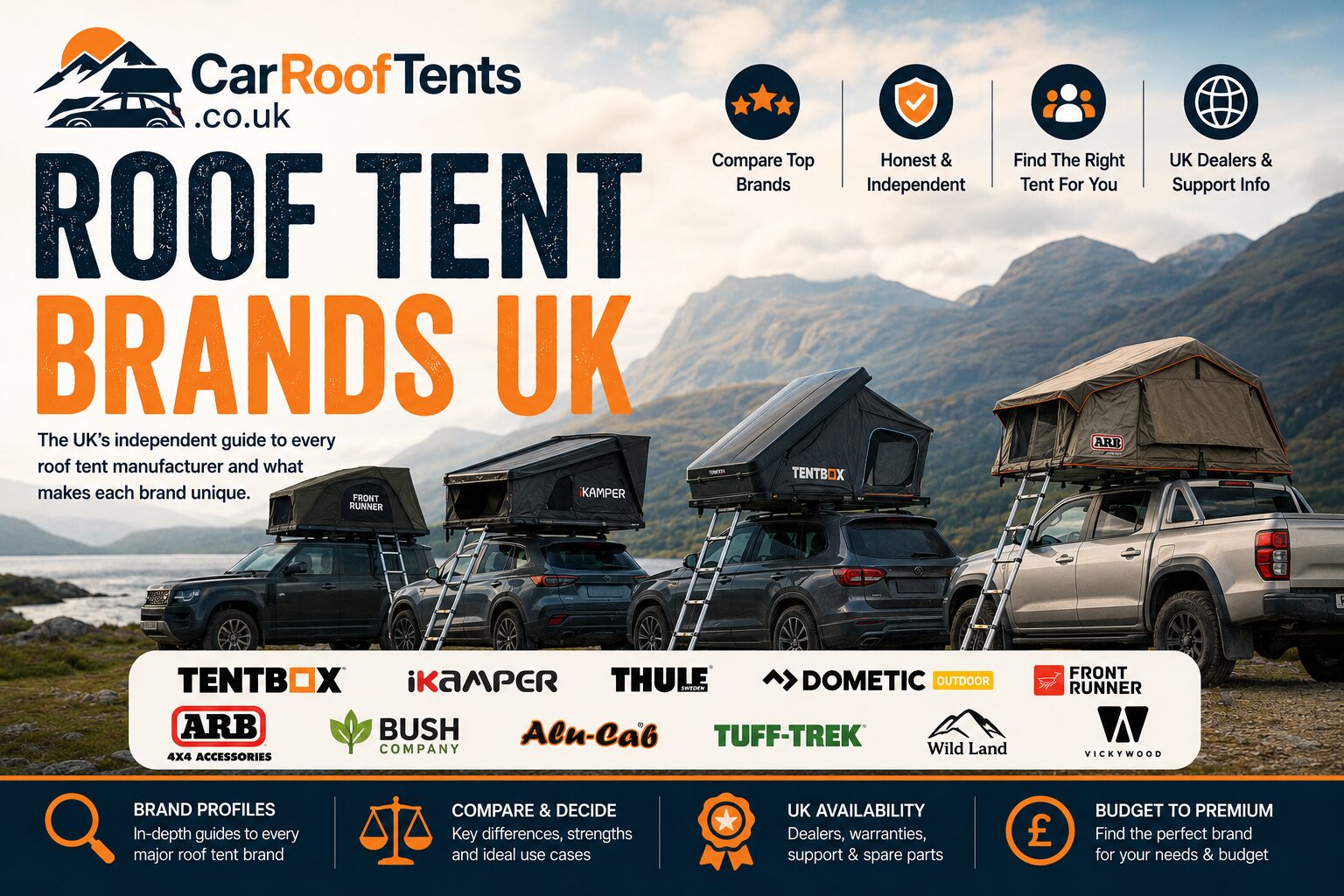
Choosing a roof tent brand is about far more than recognising a logo or finding the lowest price. The manufacturer can affect the design, weight, fitting system, warranty, replacement-parts availability, UK support and how easy the tent is to own several years after purchase.
The UK roof tent market now includes British consumer brands, long-established European manufacturers, global outdoor-equipment companies, South African overlanding specialists, Australian 4×4 brands and newer factory-direct suppliers. Some focus on lightweight weekend camping, while others build tents for families, frequent touring or demanding expedition use.
This independent guide introduces the main roof tent brands UK buyers are likely to encounter, explains the differences between them and shows what to investigate before choosing a manufacturer. It is designed to complement our UK roof tent comparison tool, where individual models can be compared by weight, capacity, dimensions and price.
Availability notice: models, prices, warranties and UK distributors can change. A brand appearing in this guide does not guarantee that every model is currently stocked in Britain. Always confirm current specifications, delivery arrangements, warranty administration and vehicle compatibility before ordering.
Roof Tent Brands UK: Quick Comparison
This table is a broad starting point rather than a substitute for comparing individual models. Brand ranges can include tents in more than one category.
| Brand | Common focus | Typical tent styles | UK buying route | Most likely to suit |
|---|---|---|---|---|
| TentBox | Mainstream UK leisure camping | Soft-shell, fold-out and hard-shell | Direct and showroom partners | First-time buyers, couples and families |
| iKamper | Premium family and touring tents | Hard-shell and hybrid fold-out | Specialist dealers and importers | Families and premium buyers |
| Thule | Integrated vehicle and outdoor systems | Soft-shell and hard-shell | UK retailers and Thule network | Buyers wanting established rack compatibility |
| Dometic / Front Runner | Vehicle-based touring and overlanding | Low-profile soft-shell and related systems | Official UK store and dealers | Tourers and rack-system users |
| James Baroud | Premium hard-shell touring | Pop-up and wedge hard-shell | Specialist UK dealers | Frequent users prioritising quick setup |
| ARB | 4×4 touring and off-road equipment | Soft-shell and hard-shell | ARB UK stockists | 4×4 and overland users |
| Alu-Cab | Premium aluminium expedition equipment | Wedge hard-shell | Specialist UK distributors | Frequent touring and expedition builds |
| Autohome | Long-established European roof tents | Hard-shell, crank and fabric-folding designs | Specialist dealers and European supply | Buyers seeking established designs |
| RoofBunk | UK-focused consumer roof tents | Hard-shell and fold-out designs | Direct UK sales | Value-conscious UK buyers |
| Tuff-Trek | UK overland and specialist supply | Multiple designs and partner brands | Direct and specialist fitting | Buyers wanting advice and installation |
| Wild Land | Broad global roof tent range | Soft-shell, hard-shell and automated designs | UK and European resellers | Buyers comparing design variety |
| Vickywood | European leisure and overland market | Hard-shell and fold-out tents | Specialist European and UK supply | Style-conscious touring buyers |
Why the Roof Tent Manufacturer Matters
Two roof tents may appear similar in photographs but differ considerably once they are fitted and used. Brand selection can influence:
- the accuracy and clarity of published specifications;
- the mounting system and roof-bar compatibility;
- fabric, shell, hinge and base construction;
- mattress quality and condensation management;
- replacement ladders, covers, gas struts and fittings;
- technical support before purchase;
- warranty administration after purchase;
- the availability of UK fitting centres;
- resale value and buyer recognition;
- how quickly faults can be resolved.
A well-known brand is not automatically the best choice for every owner. Equally, a lesser-known brand is not automatically poor. The key is whether the actual tent, support structure and aftersales provision suit your vehicle and intended use.
Before comparing manufacturers, establish what your car can safely carry using our roof tent vehicle compatibility guide. Then review the wider buying process in the Complete Roof Tent Buying Guide UK.
How We Classify Roof Tent Brands
This guide avoids declaring one universal “best” brand. Instead, manufacturers are considered across several practical areas:
- Range: the number and variety of tents offered.
- Vehicle suitability: whether lightweight and compact choices are available.
- Support: access to knowledgeable UK assistance.
- Parts: availability of covers, ladders, mattresses, struts and mounting kits.
- Warranty: clarity, duration, exclusions and administration route.
- Installation: availability of fitting guidance or professional installation.
- Transparency: clear weights, dimensions, load requirements and user manuals.
- Value: the complete ownership proposition rather than price alone.
Brand descriptions below are deliberately neutral. Official links are provided so readers can verify current ranges and policies directly.
Complete UK Roof Tent Brand Directory
The following sections cover major established brands and other manufacturers that may be available to UK buyers. Inclusion does not represent endorsement, and availability may be direct, dealer-based or through specialist importers.
TentBox
TentBox is one of the most visible roof tent brands in the British consumer market. The company describes its tents as designed in the UK and sells through its own website as well as showroom and sales partners.
What TentBox is known for
- a clear consumer-focused range;
- models aimed at couples and families;
- strong UK social presence and owner community;
- direct delivery and showroom partners;
- soft-shell, fold-out and hard-shell choices;
- accessible fitting and usage guidance.
Who should consider TentBox?
TentBox is likely to appeal to first-time roof tent buyers who value UK-facing support, simple product positioning and an active community. The range includes compact and lightweight-oriented options as well as larger family tents, although every buyer must still verify the precise vehicle and bar requirements.
Points to check
- the current weight of the exact model and version;
- minimum roof-bar load rating;
- folded footprint and storage requirements;
- whether bedding can remain inside;
- current warranty terms and exclusions;
- installation requirements for the vehicle.
Official resources: TentBox roof tent range and TentBox FAQs.
iKamper
iKamper is a premium roof tent and outdoor-equipment brand best known for the Skycamp family of hard-shell fold-out tents. Its larger designs are frequently considered by couples who want more space and families seeking a broad sleeping platform.
What iKamper is known for
- premium hard-shell and hybrid designs;
- large fold-out sleeping platforms;
- family-oriented Skycamp models;
- compact “Mini” variants in parts of the range;
- accessories and sleep-system products;
- dealer-based support in many markets.
Who should consider iKamper?
iKamper is likely to suit buyers prioritising space, refined design and established premium-brand support. Larger models may be too heavy or physically unsuitable for some small vehicles, so comparison should begin with vehicle load limits rather than sleeping capacity.
Points to check
- UK dealer or importer arrangements;
- model weight and closed dimensions;
- bar spacing and clamp compatibility;
- availability of model-specific accessories;
- local warranty and replacement-parts handling.
Official resources: iKamper rooftop tents and iKamper dealer locator.
Thule
Thule is a major global vehicle-accessory and outdoor-equipment company. Its roof tent range sits alongside roof bars, racks, boxes, cycle carriers and other transport products.
What Thule is known for
- an established vehicle-fit ecosystem;
- soft-shell and hard-shell designs;
- UK retail and dealer availability;
- detailed product documentation;
- related roof-bar and rack products;
- a broad international support network.
Who should consider Thule?
Thule may suit buyers who want to purchase the roof bars and tent through an established vehicle-accessory network. This does not remove the need to check every load and fitting requirement: a Thule-branded tent is not automatically compatible with every Thule bar or every car.
Points to check
- the exact vehicle fit recommended by Thule;
- roof-bar capacity and tent compatibility;
- model-specific adapter requirements;
- the availability of demonstration stock;
- current UK product range and parts support.
Official resource: Thule’s complete rooftop tent guide.
Dometic and Front Runner
Dometic offers vehicle-camping products, while Front Runner Dometic combines roof racks, storage, camping and overland equipment within a broader vehicle-based system.
What the brands are known for
- integrated roof-rack and touring equipment;
- vehicle-based camping products;
- low-profile and lightweight-oriented tent designs;
- accessories for touring and overlanding;
- official UK product channels.
Who should consider them?
These ranges may appeal to buyers building a complete touring system rather than purchasing a tent in isolation. A Front Runner rack owner may value system integration, while general campers may consider Dometic’s wider shelter range.
Points to check
- whether the tent requires or merely recommends a particular rack;
- total rack-and-tent weight;
- accessory compatibility;
- current branding and model naming;
- UK stock and installation support.
James Baroud
James Baroud is associated with premium hard-shell roof tents aimed at touring and overland users. Its ranges commonly use pop-up or wedge-style opening systems designed for relatively fast deployment.
What James Baroud is known for
- premium hard-shell tents;
- quick-opening designs;
- touring and expedition positioning;
- specialist dealer sales;
- accessories designed around long-distance travel.
Who should consider James Baroud?
It may suit frequent campers who place high value on fast setup, a solid travelling shell and specialist product support. The purchase cost and physical size can make careful pre-purchase inspection particularly important.
Points to check
- current UK distributor and warranty route;
- shell and mattress dimensions;
- replacement fabric, struts and fittings;
- vehicle and rack requirements;
- installation and removal weight.
ARB
ARB is an established 4×4 accessory brand with a UK operation and stockist network. Its camping ranges sit alongside roof racks, recovery products, storage and vehicle accessories.
What ARB is known for
- 4×4 and off-road heritage;
- soft-shell and hard-shell roof tent products;
- integration with broader touring equipment;
- UK stockist support;
- equipment for demanding travel environments.
Who should consider ARB?
ARB is likely to appeal to 4×4 owners and overland users who want a tent supported by a broader vehicle-equipment network. Owners of ordinary road cars should not assume that products developed around 4×4 use will be suitable for their vehicle.
Points to check
- rack compatibility outside the ARB ecosystem;
- tent and accessory weight;
- current UK model availability;
- dealer installation options;
- replacement cover and hardware supply.
Alu-Cab
Alu-Cab is a South African overland-equipment company known for aluminium canopies, awnings and premium hard-shell roof tents.
What Alu-Cab is known for
- aluminium hard-shell construction;
- wedge-opening expedition designs;
- integration with canopies and overland accessories;
- premium touring positioning;
- specialist distributors and installers.
Who should consider Alu-Cab?
Alu-Cab is likely to suit buyers planning regular touring or a dedicated overland vehicle build. Its products can be excessive in cost, weight or complexity for an occasional camper seeking a lightweight weekend tent.
Points to check
- UK distributor support;
- rack and load requirements;
- closed height and garage clearance;
- accessory loads on shell rails;
- availability of replacement parts.
Autohome
Autohome is one of the longest-established names associated with vehicle roof tents. The Italian company is known for product families including Maggiolina, Columbus and Air-Camping designs.
What Autohome is known for
- a long history in roof tents;
- crank-operated, gas-assisted and fabric-folding designs;
- European production and brand heritage;
- multiple sizes and shell formats;
- specialist touring use.
Who should consider Autohome?
Autohome may appeal to buyers who value established designs, European heritage and a wide choice of opening systems. UK purchase and support arrangements should be confirmed before ordering, particularly where the tent is supplied from continental Europe.
Points to check
- current UK dealer availability;
- import, delivery and returns arrangements;
- model-specific opening mechanism;
- replacement shell and fabric components;
- warranty administration location.
RoofBunk
RoofBunk is a UK-facing roof tent company offering tents directly to British consumers. Its range has included hard-shell and fold-out designs intended for leisure camping.
What RoofBunk is known for
- direct UK sales;
- consumer-focused pricing;
- hard-shell and fold-out choices;
- UK delivery and support;
- products aimed at mainstream camping.
Who should consider RoofBunk?
RoofBunk may appeal to value-conscious buyers who want to deal with a UK-facing supplier. As with any direct-sale brand, investigate the depth of long-term parts provision as well as the initial specification.
Points to check
- current product and warranty details;
- showroom or demonstration opportunities;
- installation support;
- replacement cover, ladder and strut availability;
- vehicle compatibility confirmation.
Tuff-Trek
Tuff-Trek is a UK specialist in roof tents and overland equipment. It sells its own products and has also supplied established international brands through its specialist operation.
What Tuff-Trek is known for
- specialist UK roof tent knowledge;
- showroom and fitting support;
- overland and 4×4 equipment;
- access to multiple roof tent brands;
- installation and security options.
Who should consider Tuff-Trek?
Tuff-Trek may suit buyers who value specialist advice, physical product inspection and professional fitting. Because the business may offer both own-brand and distributed products, confirm exactly who manufactures, warrants and supports the selected tent.
Points to check
- whether the tent is Tuff-Trek branded or from a partner brand;
- current warranty provider;
- fitting package and security options;
- replacement-part stocking;
- vehicle-specific recommendations.
Wild Land
Wild Land is a large international outdoor-equipment manufacturer with a broad roof tent range. Its products have appeared through distributors and retailers in multiple countries, including European markets.
What Wild Land is known for
- a broad variety of roof tent formats;
- hard-shell and soft-shell products;
- compact and automated concepts in parts of the range;
- international manufacturing scale;
- products sold under global distribution arrangements.
Who should consider Wild Land?
Wild Land may suit buyers comparing a broad range of layouts and price points. The UK retailer or importer is especially important because local support can differ depending on where the tent is purchased.
Points to check
- identity of the authorised UK seller;
- who administers warranty claims;
- availability of exact-model parts;
- electrical support for automated models;
- published weights and mounting requirements.
Vickywood
Vickywood is a European-market outdoor brand offering roof tents, awnings and related camping accessories. Its tents are visible through specialist European retailers and selected UK supply routes.
What Vickywood is known for
- modern leisure and overland styling;
- hard-shell and fold-out models;
- multiple sizes and colour choices;
- European distribution;
- coordinated awnings and accessories.
Who should consider Vickywood?
Vickywood may appeal to buyers wanting a contemporary tent with a broad accessory range. Confirm whether the purchase is covered by a UK company or requires cross-border warranty and returns handling.
Other Roof Tent Brands UK Buyers May Encounter
The market is wider than the principal brands above. The following manufacturers may be stocked by specialist UK suppliers, imported from Europe or encountered on the second-hand market.
The Bush Company
The Bush Company is associated with premium aluminium hard-shell tents and expedition equipment. It is most likely to interest dedicated touring and overland users.
Bundutec
Bundutec produces overland camping equipment and electrically opening roof tent designs. UK support should be confirmed through the supplying specialist.
Eezi-Awn
Eezi-Awn is a South African manufacturer with a long association with roof tents, awnings and expedition equipment.
Howling Moon
Howling Moon is another South African outdoor-equipment name associated with expedition tents and awnings.
Gordigear
Gordigear supplies roof tents, annexes and touring equipment through international markets.
CAMPWERK
CAMPWERK has a UK-facing website and supplies roof tents and trailer-tent systems, including access to iKamper products in parts of its operation.
Yakima
Yakima is primarily known for vehicle carrying systems and has offered rooftop tents in international markets. Confirm current UK tent availability separately from roof-rack availability.
Darche
Darche is an Australian outdoor and 4×4 camping brand with roof tents and shelters. UK availability may depend on specialist importers.
Ironman 4×4
Ironman 4×4 offers touring and off-road products, including roof tents in some markets.
Roofnest
Roofnest is a North American hard-shell roof tent brand. UK buyers should investigate shipping, tax, fitting standards, warranty and parts before importing.
FSR
FSR, or Freespirit Recreation, is a North American outdoor brand offering roof tents and related camping products. Direct UK support may be limited.
Overland Vehicle Systems
Overland Vehicle Systems supplies roof tents and overland products primarily in North America. Import costs and support arrangements require careful checking.
Go Overland
Go Overland is a UK-facing supplier associated with roof tents and overland camping equipment. Review the current range and model-specific support directly.
Latitude
Latitude roof tents have appeared in UK retail and review roundups. Confirm the current official supplier, product documentation and aftersales route before purchase.
SkyPod
SkyPod has appeared in UK roof tent listings and specialist retail channels. Buyers should confirm current company details, model support and replacement-part availability.
Naturehike and NatureNest-style marketplace brands
Large online marketplaces may list tents under names such as Naturehike, Naturnest or similar factory-direct labels. Some can offer attractive specifications, but buyers should examine seller identity, verified weight, instructions, certification, returns and long-term parts support particularly carefully.
Roof Tent Brands by Tent Type and Intended Use
Brands with broad mainstream UK visibility
TentBox, Thule, RoofBunk and selected Dometic or Front Runner products are among the names buyers may encounter through direct UK websites, established retail networks or specialist dealers.
Premium hard-shell specialists
James Baroud, Alu-Cab, iKamper, Autohome and The Bush Company are frequently considered by buyers looking at premium shells, fast deployment and frequent touring.
4×4 and expedition-oriented brands
ARB, Alu-Cab, Front Runner, Eezi-Awn, Howling Moon, Bundutec and The Bush Company have strong associations with 4×4 travel and overlanding.
Family-oriented brands
TentBox, iKamper, Thule, Wild Land and Autohome have offered larger or fold-out layouts that may suit families. Always compare actual mattress dimensions and occupant limits rather than relying on labels such as “XL”.
Lightweight-oriented choices
Lightweight tents may be found across TentBox, Front Runner, Thule and other ranges. The lightest model from one brand may still be heavier than a particular car can carry, so verify the complete dynamic load.
Budget and factory-direct brands
Direct-sale and marketplace brands may reduce the initial price by limiting showrooms or dealer networks. The trade-off may involve less product inspection, fewer model-specific parts or more complicated warranty handling.
Before selecting a tent type, read our Roof Tent Safety Guide and check the full model data in the comparison tool.
Where Are Roof Tents Designed and Manufactured?
Roof tent branding, design, assembly and manufacturing may occur in different countries. A British company may design tents in the UK and manufacture them overseas. A European brand may source fabric, shells or hardware internationally before final assembly.
Countries strongly associated with roof tent brands include:
- United Kingdom: consumer-facing brands, specialist suppliers and overland retailers.
- Italy: long-established hard-shell and touring-tent heritage.
- Sweden: global vehicle-accessory and outdoor-system design.
- South Korea: premium hard-shell and hybrid roof tent development.
- South Africa: expedition, canopy and overland-equipment specialists.
- Australia: 4×4 touring and harsh-condition camping brands.
- Germany and wider Europe: leisure, trailer and overland distributors.
- China: large-scale manufacturing for both recognised brands and factory-direct products.
- United States: premium hard-shell and overland lifestyle brands.
Does country of manufacture determine quality?
No. Manufacturing country alone is a poor shortcut for judging quality. More useful questions include:
- Who designed and specified the product?
- What quality-control process is used?
- Are weights and dimensions independently credible?
- Are structural components traceable?
- Can replacement parts be purchased?
- Who is legally responsible for the warranty?
- Does the supplier understand UK vehicles and consumer law?
UK Dealers, Direct Sales and Customer Support
Roof tent brands commonly reach UK buyers through three routes.
Direct from the brand
The brand sells through its own UK website and may offer delivery, fitting partners or showrooms. This can simplify communication, but buyers should still confirm where repairs and returns are handled.
Authorised dealer network
A dealer may provide demonstrations, vehicle advice, installation and aftersales support. Ask whether the dealer is authorised to approve warranty repairs or must refer every case to the manufacturer.
Independent importer or marketplace seller
This may make unusual brands accessible, but support depends heavily on the seller. Confirm the business identity, physical address, returns process, warranty responsibility and availability of parts.
Questions to ask a dealer
- Is this tent approved for my exact vehicle and roof-bar system?
- Who is responsible if the fitting advice proves incorrect?
- Who handles warranty claims?
- Which replacement parts are stocked in the UK?
- How long are parts expected to remain available?
- Can the tent be inspected before purchase?
- Is professional fitting available?
- What happens if the delivered tent is damaged?
- Are returns collected or must I transport the tent?
- Is the warranty transferable to a second owner?
How to Compare Roof Tent Warranties
A headline warranty length tells only part of the story. Read the current policy before buying and save a copy.
| Warranty question | Why it matters |
|---|---|
| Who provides the warranty? | The manufacturer, UK distributor and retailer may have different responsibilities. |
| When does cover begin? | It may begin on purchase, delivery or registration. |
| Must the product be registered? | Some extended cover depends on registration. |
| Are fabric, shell and hardware covered equally? | Different components may have different periods. |
| Is commercial use excluded? | Hire or business use may receive reduced cover. |
| Is installation covered? | Incorrect fitting may invalidate claims. |
| Who pays transport? | A roof tent can be expensive and difficult to return. |
| Is water ingress automatically covered? | Maintenance, weathering and condensation exclusions may apply. |
| Is the warranty transferable? | This can affect resale value. |
| Are spare parts supplied after warranty? | Repairability matters after free cover ends. |
Warranty terms change, so this page deliberately does not publish a permanent warranty-length league table without a dated verification system.
Spare Parts and Long-Term Roof Tent Ownership
A roof tent is exposed to weather, vibration and repeated use. Parts availability may become more important than a small difference in the original purchase price.
Parts worth checking before purchase
- travel covers;
- ladders and ladder brackets;
- mounting clamps and channel hardware;
- gas struts;
- hinges and latches;
- mattresses and covers;
- fabric bodies or replacement panels;
- clear windows and insect mesh;
- support poles;
- locks and keys;
- shell seals;
- electrical components for powered tents.
Questions about replacement parts
- Are parts model-specific?
- Are they stocked in Britain?
- Can owners fit them?
- Are repair instructions available?
- Will the supplier repair a tent outside warranty?
- Can fabric or shell damage be assessed?
Whatever brand you choose, follow the care schedule in our Roof Tent Maintenance Guide UK.
How to Choose the Right Roof Tent Brand
1. Begin with your vehicle
Confirm the dynamic roof-load limit, roof design and available bar systems. Eliminate tents that are too heavy or physically unsuitable.
2. Decide how the tent will be used
A tent for two summer weekends a year has different requirements from one used for monthly touring, winter camping or remote travel.
3. Compare individual models, not brand reputation alone
A manufacturer may produce one lightweight tent and several much heavier models. Use exact figures.
4. Investigate the UK support route
Know who will answer technical questions, supply parts and process a warranty claim.
5. Inspect the tent where possible
Open it, close it, climb the ladder, lie on the mattress and examine the shell, stitching, latches and mounting system.
6. Read the instructions before ordering
Good brands normally provide enough technical detail for compatibility to be assessed before money changes hands.
7. Price the complete setup
Include roof bars, adapters, fitting, locks, delivery, anti-condensation mat, annex and storage equipment.
8. Consider removal and storage
A large premium tent may be unsuitable if it cannot be lifted or stored safely at home.
9. Check insurance
Ask the motor insurer about the tent, rack and modification status. Also investigate theft, accidental damage and camping-equipment cover.
10. Use independent comparisons
Manufacturer websites explain what their products are designed to do. Independent comparison is needed to understand trade-offs between brands and models.
Which Brand May Suit Different Buyers?
| Buyer type | Brands commonly worth researching | Main priority |
|---|---|---|
| First-time UK buyer | TentBox, RoofBunk, Thule | Clear support, fitting guidance and accessible demonstrations |
| Family | iKamper, TentBox, Thule, Autohome, Wild Land | Mattress size, occupancy and vehicle capacity |
| Small-car owner | Lightweight models across TentBox, Thule, Front Runner and others | Verified total dynamic load |
| Frequent touring couple | James Baroud, iKamper, Alu-Cab, Autohome | Fast setup, weather protection and parts |
| 4×4 or expedition user | ARB, Alu-Cab, Front Runner, Eezi-Awn, The Bush Company | Rack integration, durability and field repair |
| Budget-conscious buyer | UK direct-sale and selected retailer brands | Support and parts, not price alone |
| Second-hand buyer | Established brands with parts support | Condition, mounting kit and warranty transfer |
These are research starting points, not fixed recommendations. Use our Used Roof Tents Guide UK before buying any pre-owned model.
Common Roof Tent Brand Misconceptions
“The most expensive brand must be the best”
Premium materials and support can justify a higher price, but a heavy expedition tent may be a worse choice for a small car or occasional camper.
“All roof tents come from the same factory”
Some tents may share manufacturing origins or components, but specification, quality control, materials, testing, warranty and support can differ.
“Made in China means poor quality”
Country of manufacture alone does not determine quality. Product specification, oversight, testing and aftersales support matter more.
“A British brand means the tent is made in Britain”
Brand location, design location and manufacturing location are separate facts. Check the company’s own current information.
“A 4×4 brand is always stronger”
Expedition positioning does not remove vehicle load limits or guarantee that a product suits ordinary road use.
“A long warranty means every problem is covered”
Warranty exclusions, maintenance requirements and transport costs can be as important as duration.
“A well-known brand fits every car”
No brand name overrides the vehicle roof-load limit, roof-bar rating or model-specific fitting rules.
“Online reviews prove long-term durability”
Many reviews are written shortly after purchase. Look for long-term ownership evidence and clear disclosure of supplied products or affiliate relationships.
Roof Tent Brands UK Frequently Asked Questions
Which is the best roof tent brand in the UK?
There is no single best brand for every buyer. The right choice depends on vehicle capacity, budget, sleeping space, tent weight, support and intended use.
Which roof tent brands are British?
The UK market includes British-founded or UK-facing brands and specialist suppliers such as TentBox, RoofBunk, Tuff-Trek and Go Overland. Design and manufacturing locations should be verified separately.
Which brands have the strongest UK presence?
TentBox has strong direct UK visibility, while Thule, Dometic, Front Runner and ARB benefit from established retail or vehicle-accessory networks. Specialist dealers support additional premium brands.
Which roof tent brands are best for families?
Brands offering larger fold-out sleeping areas include iKamper, TentBox, Thule, Autohome and Wild Land. Check exact mattress dimensions and vehicle limits.
Which brands make lightweight roof tents?
Lightweight-oriented models appear across TentBox, Front Runner, Thule and other ranges. Compare actual weight including bars and accessories.
Which brands specialise in hard-shell roof tents?
James Baroud, Alu-Cab, Autohome, iKamper and The Bush Company are strongly associated with hard-shell products, although ranges evolve.
Which brands make soft-shell roof tents?
TentBox, Thule, ARB, Front Runner, Wild Land, Eezi-Awn and other manufacturers have offered soft-shell or fabric-folding designs.
Are TentBox roof tents made in the UK?
TentBox describes its tents as designed in the UK. Buyers should use the company’s current published information for model-specific manufacturing details.
Is iKamper worth the money?
iKamper may justify its price for buyers who value premium design, space and dealer support. It is not automatically the best value for a small vehicle or occasional user.
Are Thule roof tents good?
Thule offers an established product and support ecosystem. Suitability still depends on the individual tent, vehicle and roof-bar combination.
Are James Baroud tents suitable for UK weather?
They are designed as touring tents, but every owner should follow model-specific wind, rain and maintenance guidance. No roof tent is suitable for every condition.
Which brands are suitable for Land Rovers?
Many brands offer models that may suit particular Land Rover vehicles, including ARB, Alu-Cab, Front Runner, James Baroud and iKamper. Compatibility must be checked for the exact vehicle, roof and rack.
Which brand is best for a small car?
Choose by verified tent weight, packed size and bar requirements rather than brand alone. Several brands offer lighter models.
Which roof tent brands have UK dealers?
Dealer arrangements change. Thule, ARB, Dometic, Front Runner, TentBox and several premium specialist brands have UK sales routes. Confirm current authorised status directly.
Can I import a roof tent brand not sold in Britain?
Yes, but calculate freight, VAT, duty, returns, warranty, mounting compatibility and replacement-part availability before ordering.
Do all brands use the same mounting brackets?
No. Mounting channels, clamps, bolt dimensions and bar-clearance requirements vary.
Can I fit one brand’s tent to another brand’s roof bars?
Possibly, but both manufacturers must permit the combination and every load, profile and spacing requirement must be met.
Do premium brands hold their value better?
Recognised brands with good parts support may be easier to resell, but condition, age, documentation and completeness remain important.
Which brands provide replacement parts?
Many established brands and UK specialists provide at least some parts, but availability varies by model and age. Ask before purchasing.
Are marketplace roof tent brands safe?
A marketplace listing alone does not establish safety or quality. Verify the seller, specifications, instructions, mounting system, warranty and compliance before purchase.
Should I buy from the manufacturer or a dealer?
Direct purchase may simplify pricing, while a specialist dealer may add fitting, demonstrations and local support. Compare the complete service.
Can a dealer confirm whether a roof tent fits my car?
A knowledgeable dealer can help, but the vehicle, roof-bar and tent manufacturers remain essential sources. Obtain important compatibility advice in writing.
Does a roof tent brand warranty cover the vehicle roof?
Usually not automatically. Read the tent, roof-bar and vehicle terms, and check insurance arrangements.
Which brand is best for winter camping?
Look for a model with appropriate weather guidance, ventilation, insulation options and support. Brand reputation alone is insufficient.
How often should this brand guide be updated?
At least twice a year, with additional updates after major launches, distributor changes, business closures or warranty revisions.
How CarRoofTents.co.uk Will Develop This Brand Hub
This pillar page is designed to support a growing library of independent brand and model resources. Future development should include:
- dedicated pages for every major manufacturer;
- dated warranty and support checks;
- verified model lists;
- UK dealer and showroom information;
- manufacturer interviews;
- factory and design background where verifiable;
- hands-on installations and long-term tests;
- owner surveys;
- replacement-parts audits;
- brand update logs;
- clear disclosure of loan products and commercial relationships.
Researched brand profiles should remain separate from hands-on reviews. A manufacturer providing a loan tent should never be allowed to approve or control the final editorial conclusion.
Independent Editorial Notice
CarRoofTents.co.uk is being developed as an independent UK research and comparison resource. Inclusion in this guide is not an endorsement, and omission does not imply that a manufacturer is unsuitable.
Brand ranges, specifications, warranties, ownership and distributor arrangements can change. Readers should verify all important information using the manufacturer and supplying retailer before purchase.
Where affiliate links or commercial relationships are introduced in the future, they should be disclosed clearly and should not determine brand inclusion, comparison results or editorial conclusions.