Best Roof Tent Accessories UK
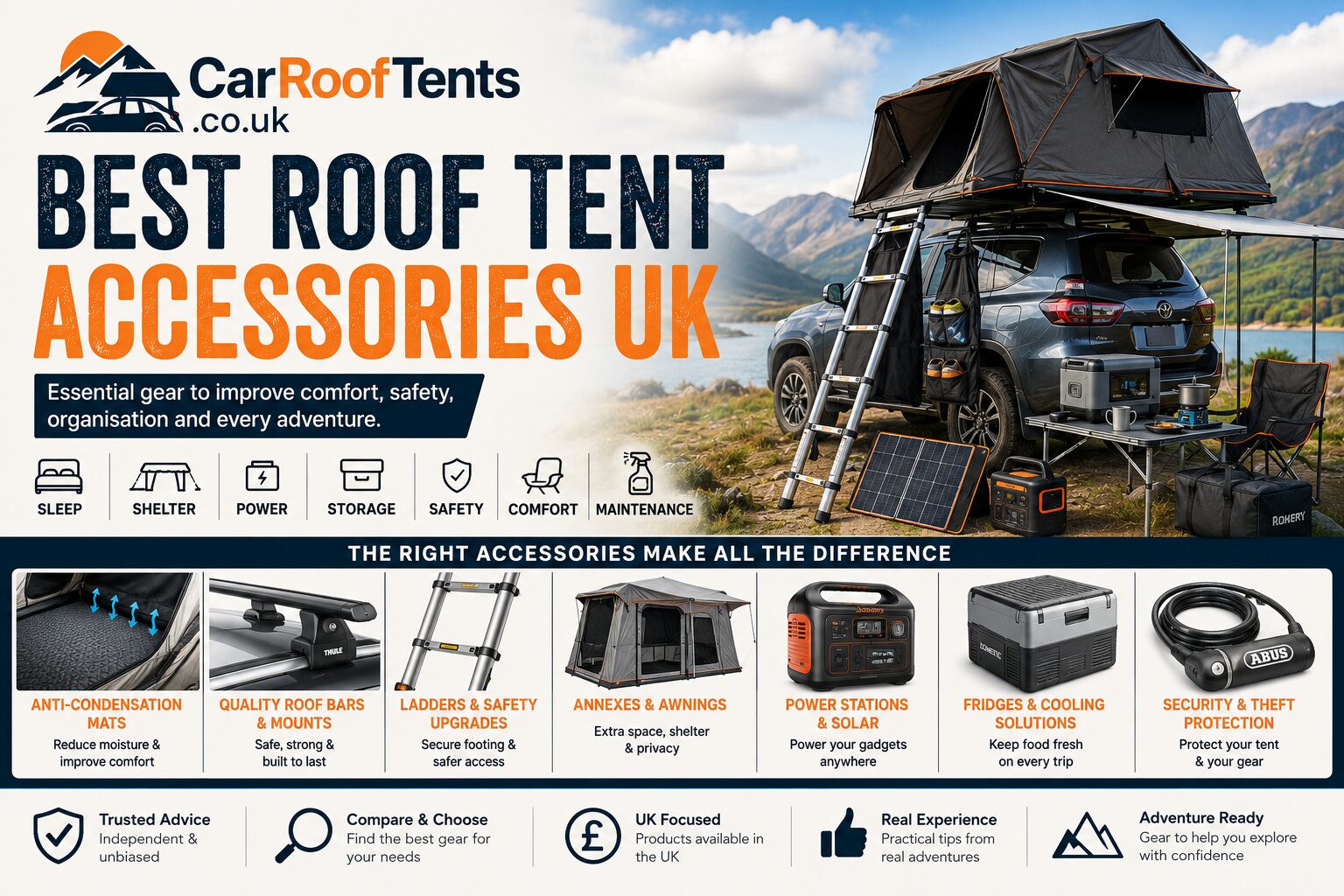
Buying the roof tent is only the beginning. The right accessories can make roof tent camping more comfortable, organised, secure and practical, but it is also easy to spend hundreds of pounds on equipment that adds weight, occupies valuable storage space and rarely gets used.
This independent guide explains the best roof tent accessories for UK camping, which products are genuinely useful, which should be purchased with the tent and which are better added only after a few real trips.
It covers roof-tent-specific equipment such as anti-condensation mats, annex rooms, ladders, mounting hardware and security locks, alongside wider camping equipment including lighting, portable power, fridges, water storage, cooking shelters and safety gear.
Before adding equipment to the vehicle roof or tent shell, confirm that the extra weight and mounting method are permitted by the vehicle, roof-bar and roof-tent manufacturers. Start with our roof tent vehicle compatibility guide and the Complete Roof Tent Buying Guide UK if you have not yet selected your tent.
Best Roof Tent Accessories UK: Quick Checklist
This table separates equipment required for a safe basic setup from products that mainly improve comfort or convenience.
| Accessory | Priority | Best for | When to buy |
|---|---|---|---|
| Suitable roof bars or rack | Essential | Every owner | Before the tent |
| Correct mounting hardware | Essential | Every owner | With the tent |
| Anti-condensation mat | Highly recommended | Most UK campers | With the tent or after the first damp trip |
| Stable ladder feet or ground mat | Highly recommended | Soft or uneven pitches | Before the first trip |
| First-aid kit and torch | Essential camping equipment | Every trip | Before the first trip |
| Shoe bags | Very useful | Wet and muddy campsites | Early purchase |
| Security locks | Useful | Tents left fitted regularly | With the tent |
| Mattress topper | Comfort upgrade | Owners unhappy with the mattress | After testing the tent |
| Annex room | Situation-dependent | Families, dogs and longer stays | After confirming the need |
| Vehicle awning | Very useful for some | Cooking and wet-weather trips | After assessing weight and space |
| Portable power station | Optional | Off-grid power and fridges | After calculating power needs |
| Compressor fridge | Optional premium upgrade | Longer tours | After planning power and storage |
| Thermal liner | Seasonal | Cold-weather campers | Before autumn or winter use |
| Portable shower or toilet | Situation-dependent | Remote camping and families | Only when facilities are limited |
What Roof Tent Accessories Should You Buy First?
Priority 1: Compatibility and secure fitting
This includes correctly rated roof bars, mounting rails, approved brackets, suitable fasteners and any vehicle-specific adapters. Without these, the rest of the equipment does not matter.
Priority 2: Safety
Basic safety equipment includes a suitable ladder setup, torch, first-aid kit, weather information, safe cooking arrangements and the ability to contact help. Read our Roof Tent Safety Guide UK before the first trip.
Priority 3: Dryness and sleep quality
An anti-condensation layer, suitable bedding, ventilation and somewhere to keep wet shoes can improve the experience more than decorative gadgets.
Priority 4: Convenience and lifestyle
Awnings, annex rooms, fridges, power stations and luxury furniture can be excellent additions, but only when they solve a genuine problem for the way you camp.
Suitable Roof Bars, Roof Racks and Mounting Hardware
Roof bars are not an optional extra. They are the structural connection between the vehicle and the roof tent.
The bars or rack must be approved for the exact vehicle, rated for the complete dynamic load, compatible with roof tent use, correctly spaced for the mounting rails and installed according to the manufacturer’s instructions.
Do not assume that bars used for bicycles or a roof box are automatically suitable. Roof tents are relatively heavy, create a large aerodynamic load and become an occupied sleeping platform while the vehicle is parked.
Thule states that a rooftop tent and rack must remain within the vehicle’s roof-load capacity, while ARB says its rooftop tents require a suitable rack or appropriately load-rated bars. See the official Thule rooftop tent centre and ARB UK rooftop tent range.
For a fuller explanation, read our Roof Bars for Roof Tents Guide.
Anti-Condensation Mats and Mesh
Condensation is one of the most common roof tent ownership issues in the UK. Moisture from breathing can collect on cool surfaces and beneath the mattress, especially during cold or humid nights.
An anti-condensation mat creates an air gap between the mattress and base. It improves airflow beneath the mattress and reduces direct contact with a cold platform.
Who benefits most?
- spring, autumn and winter campers;
- couples and families producing more overnight moisture;
- tents with solid aluminium or composite bases;
- owners who leave bedding inside;
- anyone camping regularly in wet UK conditions.
Check the internal floor dimensions, packed thickness and whether a manufacturer-specific mat is required. Anti-condensation mats do not replace ventilation, and the tent still needs to be dried after use.
Thule lists model-specific products among its official rooftop tent accessories. For drying and mould prevention, see the Roof Tent Maintenance Guide UK.
Roof Tent Ladder Accessories and Levelling Equipment
The ladder is both the entrance and, on some fold-out tents, part of the structural support system. It should never be treated as a minor accessory.
- wide ladder feet for soft ground;
- a firm rubber or protective ground mat;
- manufacturer-approved extensions for tall vehicles;
- replacement brackets and fasteners;
- reflective markers or low-level lighting;
- vehicle levelling blocks where permitted.
The ladder should stand on stable ground at the angle specified by the manufacturer. Do not improvise extensions, place unstable objects beneath the feet or use an accessory that prevents the ladder from supporting the tent correctly.
Roof Tent Security and Anti-Theft Accessories
A roof tent can be valuable, visible and difficult to hide once stolen. Security accessories cannot guarantee protection, but they can make unauthorised removal slower and less attractive.
- locking mounting-bracket covers;
- security nuts or specialist bolts;
- lockable quick-release mounts;
- vehicle trackers;
- serial-number records and photographs;
- secure home storage;
- insurance that specifically covers the tent.
Security hardware must not weaken the original mounting system. Ask the manufacturer which locking solution is approved, and tell your insurer about the tent before fitting it.
Roof Tent Annex Rooms
An annex attaches below or beside a roof tent to create enclosed ground-level space. It can be extremely useful, but it also adds cost, weight, setup time and wet fabric.
Advantages
- private changing space;
- protected shoe and bag storage;
- extra shelter for children or dogs;
- a weather-protected entrance;
- ground-level living space on longer stays.
Disadvantages
- slower setup and pack-away;
- more material to dry;
- greater dependence on a level pitch;
- possible campsite footprint restrictions;
- model-specific fit;
- vehicle height can affect ground contact.
An annex is most valuable for families, pets and multi-night stays. Solo travellers moving every day may find it unnecessary.
Never use a fuel-burning appliance inside an enclosed annex unless both the appliance and shelter manufacturers expressly permit that exact use.
Vehicle Awnings and Weather Shelters
A useful awning can provide more day-to-day value than many tent-specific gadgets. It creates shelter for cooking, seating and equipment without filling the sleeping area.
Side awnings
Relatively quick to deploy and useful for shade or rain cover beside the vehicle.
270-degree awnings
Offer a larger protected area but are heavier, more expensive and better suited to strong rack systems and larger vehicles.
Rear awnings
Useful for vehicles with a tailgate kitchen or rear storage system.
Freestanding shelters
Do not add roof weight and can remain pitched if the car leaves the campsite.
Check wind ratings, guy-line arrangements and rack limits. Examples can be researched through the official Dometic outdoor range, ARB UK camping range and Tuff-Trek.
Mattress Toppers, Bedding and Sleep Accessories
Test the standard mattress before spending money on an upgrade. A topper can soften a firm mattress, but it may absorb moisture, add packed thickness and prevent the tent closing correctly.
Possible upgrades
- thin memory-foam topper;
- self-inflating sleep mat;
- breathable mattress protector;
- model-specific fitted sheet;
- season-rated sleeping bag;
- compressible pillows;
- washable blanket.
Sleeping bags are compact and temperature-rated. Duvets feel familiar but use more space and can be difficult to dry. Never force the tent closed over excessive bedding.
Roof Tent Insulation and Winter Accessories
Thermal liners attach inside some roof tents to reduce drafts and create an additional air layer. They improve comfort but do not turn a roof tent into an all-weather building.
- model-specific thermal liner;
- anti-condensation mat;
- season-appropriate sleeping bags;
- dry night clothing and hats;
- safe non-combustion warming products;
- dry bags for wet clothing;
- low-temperature-rated power equipment.
Do not use gas, petrol, diesel, charcoal or other combustion heaters inside a roof tent. NHS guidance explains the risks and symptoms of carbon monoxide poisoning.
Roof Tent Storage and Organisation Accessories
Good organisation reduces the number of ladder trips and helps keep the sleeping area dry.
Shoe bags
One of the cheapest and most useful accessories for wet UK campsites.
Internal organisers
Useful for phones, glasses, torches and small clothing items, provided they do not obstruct vents or closing mechanisms.
Gear lofts
Can use otherwise wasted space, but avoid storing hard or heavy objects above sleepers.
Vehicle storage boxes
Keep cooking, electrical and recovery equipment separated and secured inside the vehicle.
Dry bags
Useful for wet clothes and emergency bedding, but damp items should not remain sealed for long periods.
Best Lighting for Roof Tent Camping
- rechargeable warm-white lantern;
- head torch for setup and climbing;
- small low-level ladder light;
- portable cooking-area light;
- red-light mode for low-impact night use;
- backup torch in the vehicle.
Warm, dimmable lighting is usually more comfortable than very bright cool-white LEDs. Do not route cables across ladder steps, entrances or moving tent mechanisms.
Portable Power Stations and Solar Panels
A portable power station can charge phones, cameras, laptops, lights and compatible fridges without running the vehicle engine. For a basic weekend using only phones and lanterns, ordinary power banks may be lighter and cheaper.
How to choose capacity
- List every device.
- Find its power consumption in watts.
- Estimate daily operating hours.
- Allow for conversion losses.
- Check that the output can start the appliance.
Capacity is commonly expressed in watt-hours, but the full labelled capacity is not normally available through every output because conversion and operating losses occur.
Official brand resources
These links are specification sources rather than blanket recommendations. Compare battery chemistry, usable capacity, output, charging speed, temperature limits, warranty and UK support.
A folding solar panel can extend off-grid use, but output varies with angle, cloud, shade, season and temperature. Keep electrical equipment protected from rain and follow charging instructions.
Camping Fridges and Electric Cool Boxes
A 12-volt compressor fridge offers controlled cooling but adds cost, weight and continuous power demand.
Advantages
- active temperature control;
- good warm-weather performance;
- no melting ice;
- some models can freeze.
Points to check
- internal capacity and external size;
- startup and average power use;
- ventilation;
- secure vehicle mounting;
- battery protection;
- night-time noise;
- loaded weight.
See official ranges from Dometic mobile cooling and ARB UK fridges. A passive cool box may be simpler for short weekends.
Roof Tent Camping Cooking Equipment
- stable outdoor stove;
- approved fuel stored correctly;
- heat-resistant table;
- water container;
- basic pan and utensils;
- food-storage box;
- fire blanket where appropriate;
- waste and washing-up containers.
Never cook inside the roof tent. Avoid cooking immediately below open tent fabric or close to fuel containers. Follow campsite fire rules and appliance instructions.
A simple folding table is enough for many campers. Slide-out vehicle kitchens are convenient for frequent touring but consume storage and add weight.
Water Storage, Portable Showers and Toilets
Use food-safe water containers that can be cleaned and secured while driving. One litre of water weighs approximately one kilogram, so large quantities affect payload.
Gravity bags, pump showers and rechargeable shower heads can be useful for remote trips. Consider privacy, wastewater, temperature and campsite rules.
A freestanding privacy shelter can serve as a changing room, shower area or toilet enclosure. Portable toilets are useful only if you have a legal disposal plan and enough storage.
Essential Roof Tent Safety Accessories
- well-stocked first-aid kit;
- head torch and backup torch;
- charged phone and power bank;
- weatherproof emergency contact details;
- high-visibility vest;
- warning triangle where appropriate;
- vehicle breakdown equipment;
- fire blanket or suitable extinguisher;
- carbon monoxide alarm where fuel-burning equipment is used nearby;
- basic approved tool kit;
- manufacturer instructions in print and digital form.
Wheel chocks and levelling blocks can help on appropriate surfaces but cannot make a dangerous slope suitable. Check forecasts and warnings through the Met Office weather service.
Recovery Equipment for 4×4 and Overland Camping
Recovery equipment is relevant only where the vehicle and journey require it. Equipment does not replace training or route planning.
- tyre-pressure gauge;
- portable compressor;
- approved recovery points;
- recovery boards;
- rated straps and shackles;
- shovel;
- puncture repair equipment;
- vehicle-specific jack base;
- work gloves.
Never use a tow ball or unapproved point for recovery. See integrated equipment ranges from ARB UK and Front Runner Dometic.
Maintenance Accessories and Spare Parts
- soft brush;
- microfibre cloths;
- manufacturer-approved mild cleaner;
- suitable zip lubricant;
- small torque wrench where a torque value is specified;
- approved spare mounting fasteners;
- fabric repair tape or model-specific repair kit;
- spare guy line and pegs;
- replacement ladder feet;
- spare lock keys.
Do not apply a generic waterproofing chemical without checking fabric compatibility. Hard-shell gas struts, hinges and latches may be model-specific; fitting a stronger strut can damage the shell or opening mechanism.
Follow the schedule in our Roof Tent Maintenance Guide UK.
Best Roof Tent Accessories for Families
- annex or privacy shelter;
- large shoe organiser;
- labelled clothing bags;
- low-level night lighting;
- safe ladder routine and supervision;
- weather shelter and compact table;
- first-aid and medicines pouch;
- portable toilet for young children where appropriate;
- quiet games and activities;
- child-appropriate sleeping bags.
Never add makeshift ladder barriers or internal restraints without manufacturer approval. Supervision and a clear family routine are more reliable than improvised modifications.
Roof Tent Accessories by Camping Style
Weekend campsite camping
Prioritise suitable bars, anti-condensation protection, bedding, shoe bags, a torch, chairs and a simple cooking kit.
Family holidays
An annex, privacy shelter, organised storage and larger weather shelter may provide more benefit than premium electronics.
Solo touring
Choose lightweight equipment that can be handled alone. Fast setup, compact power banks and secure storage matter most.
Festival camping
Focus on security, charging, water, lighting, ear protection and a simple shelter. Check event rules.
Winter camping
Prioritise sleeping bags, thermal liner, anti-condensation mat, dry clothing storage and conservative weather planning.
Overlanding
Water, recovery equipment, power management, fridge capacity, spares and field repair may justify more complex systems.
Camping with dogs
An annex, washable mat, ground-level bed, towel, secure lead arrangement and water bowl may be more practical than expecting a dog to climb the ladder.
Roof Tent Accessories by Budget
Under £25
- shoe bag;
- head torch;
- microfibre towels;
- dry bags;
- reflective guy-line markers.
Under £50
- rechargeable lantern;
- ladder ground mat;
- compact table;
- power bank;
- mattress protector;
- water container.
£50–£150
- anti-condensation mat;
- quality sleeping bag;
- compact topper;
- security mounts;
- portable shower.
Premium
- annex room;
- vehicle awning;
- power station;
- solar panel;
- compressor fridge;
- drawer or kitchen system.
The useful question is not “What is the most expensive upgrade?” but “Which repeated problem will this solve?”
Roof Tent Accessories You May Not Need
A large power station for basic weekends
If you only charge phones and a lantern, ordinary power banks may be enough.
A fridge for every trip
A quality passive cool box may suit short stays near shops.
An annex for one-night touring
It can take longer to erect and dry than the tent itself.
A 270-degree awning on a small car
The weight, cost and rack requirements may outweigh the benefit.
Multiple organisers
Too many hanging products make the tent cramped and slow to pack.
Decorative lighting
It consumes power, can annoy neighbours and may attract insects.
Recovery equipment without knowledge
Buying straps and shackles is not a substitute for approved recovery points and training.
Unapproved shell-mounted racks
Adding boards, boxes or panels may exceed permitted loads or interfere with opening.
Roof Tent Accessory Buying Timeline
Buy before or with the tent
- approved roof bars or rack;
- mounting hardware;
- professional fitting if needed;
- security hardware;
- basic safety equipment;
- insurance;
- anti-condensation mat where strongly recommended.
Buy after the first trip
- mattress topper if needed;
- shoe bags;
- extra lighting;
- storage organisers;
- better ladder footing.
Buy after several trips
- annex;
- larger awning;
- power station;
- fridge;
- solar panel;
- integrated storage.
Buy only for a defined need
- recovery equipment;
- large water tank;
- portable toilet;
- winter liner;
- shell-top load bars.
Common Roof Tent Accessory Buying Mistakes
- Buying everything before the first trip: you do not yet know which problems need solving.
- Ignoring weight: awnings, racks, solar panels and equipment quickly consume payload.
- Choosing universal accessories without measuring: tent rails, ladders and mattresses vary.
- Using unapproved mounting hardware: a bolt that fits may not be structurally suitable.
- Overloading the closed tent: excessive bedding strains covers, hinges and latches.
- Unsafe heating or cooking: never use unsuitable combustion equipment in enclosed sleeping spaces.
- Ignoring home storage: wet annexes and awnings need somewhere to dry.
- Buying power by headline capacity alone: output, usable capacity and temperature limits matter.
- Assuming security bolts make the tent theft-proof: use layered security and insurance.
Best Roof Tent Accessories UK FAQs
What accessories do I need for a roof tent?
You need correctly rated roof bars or a rack, approved mounting hardware and normal camping safety equipment. Anti-condensation protection, bedding, a torch and shoe storage are valuable early additions.
Do I need an anti-condensation mat?
It is strongly worth considering for UK use, especially in cool or humid weather. It does not replace ventilation and drying.
Should I buy an annex?
An annex is useful for families, dogs, changing and longer stays. It may be unnecessary for travellers moving every day.
Is a roof tent awning worth it?
Yes, when you regularly need shade or rain shelter beside the vehicle. A freestanding shelter may be more flexible.
Do I need a mattress topper?
Only if the standard mattress is uncomfortable. Make sure the tent can close safely with it inside.
Can bedding stay inside?
Some tents allow limited bedding to remain. Follow the exact closing instructions and never force the shell or cover.
How can I secure a roof tent?
Use approved locking mounts, record serial numbers, park carefully and arrange suitable insurance.
What size power station is best?
Calculate the watt-hours required by the devices and hours of use, then allow reserve capacity and conversion losses.
Can a power station run a fridge?
Many can, but check the fridge’s startup demand, average use and the battery’s usable capacity.
Are solar panels worth taking?
They can extend off-grid use, but UK weather and shade make output variable.
Do I need a camping fridge?
No. A passive cool box may be adequate for short trips.
Can I use a heater in a roof tent?
Do not use fuel-burning heaters inside a roof tent. Use appropriate bedding and safe non-combustion products.
Can I cook in an annex?
Do not assume it is safe. Enclosed fabric shelters create fire and carbon monoxide risks.
Should I carry a carbon monoxide alarm?
It is sensible where fuel-burning equipment is used nearby, but it does not make unsafe use acceptable.
What lighting is best?
A warm-white lantern, head torch and low-level ladder light provide a practical setup.
Are shoe bags worth it?
Yes. They are inexpensive and keep muddy footwear outside the sleeping area.
Do I need insulation?
A thermal liner can help regular cold-weather campers but is usually unnecessary for summer-only use.
Can I add solar panels to a hard shell?
Only if the manufacturer permits it and specifies the mounting and load limits.
Can I mount recovery boards on the tent?
Only where the manufacturer provides or approves a load-carrying system.
What spare parts should I carry?
Approved mounting fasteners, ladder feet, guy lines, pegs, spare keys and a compatible repair kit may be useful.
Do accessories count towards roof load?
Yes. Equipment carried on the roof while driving contributes to the total dynamic load.
Is a 270-degree awning suitable for every vehicle?
No. It can be heavy and requires suitable mounting space and capacity.
What is the best first upgrade?
For many UK owners, an anti-condensation mat or shoe bag provides more benefit than expensive electrical equipment.
What is best for families?
An annex or privacy shelter, organised storage, safe lighting and ground-level living space.
What is best for small cars?
Choose lightweight, compact products and avoid permanently adding heavy awnings or boxes.
What is best for winter?
A thermal liner, anti-condensation mat, suitable sleeping bag, dry clothing storage and reliable lighting.
Can I use ordinary roof bars?
Only if the bar and tent manufacturers confirm suitability for the exact vehicle, load and mounting arrangement.
Should I buy branded accessories?
Model-specific products are often safest for structural fittings, annexes and liners. Generic items can be suitable for lighting, furniture and storage.
How much should I budget?
A basic setup may need only modest spending beyond bars and fitting. A full awning, power and fridge system can cost thousands.
Where should heavy equipment be stored?
Where possible, low and securely inside the vehicle rather than on the roof.
Can accessories damage the tent?
Yes. Excess weight, unapproved drilling, thick bedding, bad cleaners and badly routed cables can all cause damage.
Should I buy used accessories?
Non-structural products may be good used buys. Inspect mounts, ladders, electrical equipment and gas appliances carefully.
Independent Editorial and Affiliate Notice
CarRoofTents.co.uk is being developed as an independent UK research and comparison resource. Products should be included because they are relevant to roof tent owners, not because a brand, retailer or affiliate programme pays for placement.
Where affiliate links are used, they should be disclosed clearly. Affiliate availability must not determine rankings, safety conclusions or whether cheaper alternatives are discussed.
Prices, availability and specifications change. Verify all important information with the manufacturer or retailer before ordering.
Roof Tent Covers, Fans and Insect Protection
Replacement travel covers
Soft-shell roof tent covers are exposed to sunlight, road spray, insects, grit, salt and continual movement while driving. Even a well-made cover is a consumable component rather than something that should be expected to last forever.
Before buying a tent, check whether replacement covers are sold separately, whether older models remain supported and whether the cover can be fitted by the owner. A damaged or poorly secured cover can flap at speed, admit water and expose the folded tent fabric to contamination.
Do not continue driving with loose straps, torn corners or a cover that cannot be tensioned correctly. Temporary repairs may help you reach a safe location, but they are not a permanent substitute for the correct component.
Portable fans
A small rechargeable fan can improve airflow during warm nights and help reduce the feeling of stuffiness. Choose a stable fan with protected blades, quiet operation and a battery appropriate for the expected run time.
Position it where it cannot fall onto sleepers, obstruct a vent or become trapped when the tent closes. A fan circulates air but does not replace opening the tent’s designed ventilation points.
Mosquito and insect protection
Most roof tents include mesh windows, but damaged zips or small gaps can allow insects inside. Useful accessories include model-compatible mesh repairs, non-spill insect repellents and a small brush for clearing insects before closure.
Avoid placing candles, coils or other burning repellents inside the tent. They introduce fire, smoke and carbon monoxide risks. Follow product instructions and choose solutions intended for enclosed sleeping environments where applicable.
Roof Tent Accessories for Camping with Dogs
Many dogs cannot safely climb a steep telescopic ladder, and carrying a large dog up or down creates a fall risk for both the animal and owner. Ground-level sleeping may be the better solution.
Useful dog-camping equipment
- a weather-protected ground-level bed in an annex or vehicle;
- a washable mat and absorbent towels;
- collapsible food and water bowls;
- a secure lead or restraint system suitable for the pitch;
- a light attached to the collar for supervised evening use;
- tick-removal equipment and pet first-aid supplies;
- cooling equipment for warm conditions;
- dry bags for wet bedding;
- proof of microchip and veterinary information.
Never leave a dog unattended inside a closed vehicle, roof tent or annex. Temperature can change rapidly, and fabric shelters are not secure kennels.
How to Compare Roof Tent Accessories Properly
Accessory roundups often focus on product features without explaining whether the equipment is suitable for the vehicle, tent or trip. Use the following framework before buying.
1. Does it solve a real problem?
Write down the exact problem. “We need somewhere dry to cook” may justify an awning. “It looks useful on social media” is not a strong reason to add cost and weight.
2. Is it compatible?
Check the tent model, mounting rail, roof rack, vehicle dimensions, electrical system and any required adapters. Product titles containing words such as universal, standard or compatible do not replace measurements and manufacturer approval.
3. What does it weigh?
Consider both roof load and total vehicle payload. A fridge, battery, awning, water supply and storage system may individually appear reasonable but become substantial when combined.
4. Where will it travel?
Heavy equipment is generally better stored low and securely inside the vehicle. Loose equipment can become dangerous during sudden braking or a collision.
5. Where will it be stored at home?
Wet canvas, large awnings, privacy shelters and portable toilets all need appropriate cleaning, drying and storage facilities.
6. Can it be handled safely?
A product may be technically compatible but impractical if one person cannot lift, deploy, clean or repack it.
7. Is support available?
Check instructions, replacement parts, UK warranty administration and whether the retailer understands the product. This is particularly important for electrical equipment, fridges, structural mounts and gas appliances.
8. Will it be used often enough?
Divide the likely purchase cost by the number of trips on which the product will genuinely be useful. Hiring specialist equipment may be more economical for a one-off expedition.
Complete Roof Tent Accessory Packing List
This list is intentionally comprehensive. It should be reduced to match the trip rather than copied into the vehicle in full.
Vehicle and fitting
- vehicle handbook;
- roof tent instructions;
- approved tools for mounting checks;
- spare keys;
- vehicle recovery and breakdown details;
- tyre-pressure gauge;
- warning equipment required for the destination.
Sleeping area
- fitted sheet;
- sleeping bags or duvet;
- pillows;
- anti-condensation mat;
- thermal liner when needed;
- small lantern;
- ear plugs;
- dry night clothing;
- phone and glasses pocket.
Shelter and campsite
- awning or shelter;
- appropriate pegs;
- guy lines;
- mallet;
- chairs;
- table;
- ground mat;
- shoe bag;
- privacy shelter when required.
Cooking and food
- outdoor stove;
- approved fuel;
- lighter stored safely;
- pan and utensils;
- plates and cups;
- food storage;
- cool box or fridge;
- cleaning supplies;
- rubbish bags;
- fire blanket where appropriate.
Water and hygiene
- drinking-water containers;
- handwashing water;
- biodegradable cleaning products used responsibly;
- toilet paper;
- portable toilet only where needed;
- towels;
- toiletries;
- sanitary supplies;
- wastewater container where required.
Power and lighting
- head torches;
- lantern;
- power banks;
- charging cables;
- 12-volt adapters;
- power station when justified;
- solar panel when justified;
- spare batteries for essential devices.
Safety and emergencies
- first-aid kit;
- personal medicines;
- emergency contacts;
- weather information;
- offline map;
- charged phone;
- backup light;
- high-visibility clothing;
- appropriate fire equipment;
- carbon monoxide alarm where relevant.
More Questions About Roof Tent Accessories
Can I use a normal household mattress topper?
Possibly, but household toppers can be too thick, absorb moisture and prevent the tent closing. Measure carefully and test the closed tent without forcing any mechanism.
Does an anti-condensation mat keep the tent warm?
Its primary purpose is airflow and moisture reduction. It may add a small insulating layer, but it is not a replacement for suitable bedding or a thermal liner.
Can I make my own anti-condensation mat?
Some owners use generic spacer mesh, but the material must not damage the base, block drainage or create excessive packed height. A model-specific product is easier to verify.
Are quick-release roof tent mounts worth buying?
They can make removal easier for owners who regularly take the tent off. They must be approved for the tent, rack and load, and should be checked as part of the normal fitting routine.
Can I attach an awning to roof bars carrying a tent?
Only if the rack or bar manufacturer permits the combined installation and all loads remain within the limits. Mounting space alone does not prove suitability.
Is a side awning or freestanding shelter better?
A side awning is quick and travels with the vehicle. A freestanding shelter can remain on the pitch and usually adds no roof load. The better choice depends on travel style.
Do annex rooms have floors?
Some include integrated or optional floors, while others are open underneath. Check the exact model and campsite rules before purchase.
Can children sleep in an annex?
Only if the product is intended and suitable for sleeping, the conditions are appropriate and adult supervision is adequate. Many annexes are primarily changing or living spaces.
How do I stop ladder feet sinking into grass?
Use approved wide feet or a stable load-spreading mat on suitable ground. Do not create an unstable platform from loose objects.
Should the ladder be locked?
Some owners remove or secure ladders when the tent is unattended, but this may not prevent access and must not create an emergency egress problem while occupied.
Can I use magnetic lights on the tent shell?
Only where they will not damage the finish, interfere with the mechanism or fall during use. Remove all temporary accessories before driving unless explicitly designed for travel.
Are rechargeable lights better than disposable batteries?
They reduce disposable battery use and are convenient when charging is available. Keep a reliable backup light for emergencies.
Can a power station be kept in the roof tent?
Follow its storage and ventilation instructions. Consider weight, moisture, temperature and the risk of it falling. Heavy batteries are usually better secured low inside the vehicle.
Can I charge a power station while driving?
Many models support vehicle charging, but use only approved cables and ensure the vehicle outlet and wiring can support the load.
Can solar panels remain attached while driving?
Only if both the panel system and mounting arrangement are designed and approved for permanent vehicle use. Portable panels should normally be packed away.
How long will a camping fridge run?
Runtime depends on fridge efficiency, ambient temperature, set temperature, battery capacity, ventilation and how often it is opened. Manufacturer tests are only a starting point.
Do I need a fridge slide?
A slide can improve access and secure mounting in larger vehicles, but it adds weight and occupies permanent space. It is unnecessary when the fridge is already safely accessible.
Can I carry gas cylinders in the roof tent?
No. Fuel should be transported and stored according to the cylinder, appliance, vehicle and legal requirements, away from the sleeping area.
Are fire extinguishers required?
Requirements vary, but suitable fire equipment is sensible where cooking equipment is used. The extinguisher type must match the likely fire and be accessible.
Is a portable toilet worth it for campsites?
Usually only when facilities are absent, distant or unsuitable for the users. It creates cleaning, storage and disposal responsibilities.
Can I hang heavy bags from the ladder?
Do not add loads unless the tent manufacturer approves them. Hanging weight can alter ladder stability and the structural support of fold-out tents.
Should I carry spare mounting bolts?
Model-correct spares can be useful, but they must match the specified grade, dimensions and locking arrangement. Generic replacements may be unsafe.
Can I lubricate gas struts?
Follow the manufacturer’s maintenance instructions. Applying the wrong lubricant can attract dirt or damage seals.
What should be removed before driving?
Remove ladders, poles, loose lights, guy lines, portable panels and anything else the tent instructions say must be stored. Complete a walk-around check every time.
How should accessories be secured inside the car?
Use proper tie-down points, suitable containers and load barriers where needed. Heavy objects should not remain loose above seat-back height.
Can I use an electric blanket?
Only if it is designed for the power source and used according to its instructions. Calculate energy consumption and protect all connections from moisture.
Are heated sleeping bags safe?
Use only reputable products with clear UK instructions and intact low-voltage systems. Inspect cables and batteries before every trip.
Do I need special pegs for an annex or awning?
The best peg depends on the surface and shelter instructions. Carrying more than one approved type can be useful, but campsite rules may restrict what can be driven into the ground.
What accessory gives the biggest comfort improvement?
For many owners it is suitable bedding, an anti-condensation layer or dependable weather shelter rather than complex technology.
How can I prevent accessory spending getting out of control?
Keep a list after each trip with three columns: problem encountered, possible solution and priority. Buy only products that address repeated problems.