

Last Updated on 3 days ago by admin
Contents
- What causes roof tent condensation?
- Why does the mattress become wet?
- How anti-condensation mats work
- Do you actually need one?
- Hard shell vs soft shell roof tents
- Quick comparison
- Buying guide
Why Do Roof Tents Suffer From Condensation?
Condensation isn’t caused by poor manufacturing.
It isn’t normally caused by leaking fabric.
And it certainly isn’t unique to cheaper roof tents.
Condensation is simply physics.
Every person sleeping inside a roof tent exhales warm, moisture-rich air throughout the night. Depending on temperature and humidity, two adults can release more than a litre of water vapour while sleeping.
When this warm air meets the colder roof tent floor or aluminium base, the moisture changes back into liquid water.
The problem is especially noticeable in Britain because camping conditions often combine:
- cool nights
- high humidity
- rainfall
- wet grass
- limited sunshine
- little overnight airflow.
All of these factors encourage condensation to form.
The underside of the mattress is particularly vulnerable because there is very little natural airflow once somebody is lying on top of it.
Why Does Moisture Collect Under The Mattress?
Many first-time owners assume the mattress itself is absorbing moisture from above.
In reality, the opposite is usually true.
The dampness develops underneath.
The mattress presses tightly against the roof tent floor, preventing air circulation.
Once condensation begins forming on the colder tent base, the trapped moisture has nowhere to escape.
By morning you may discover:
- damp mattress underside
- wet tent floor
- condensation droplets
- musty smell
- slow drying times
- mould beginning after repeated trips.
If left untreated over several seasons this moisture can damage:
- mattress foam
- fabric covers
- wooden floor panels
- adhesives
- internal fabrics
- sleeping comfort.
Fortunately the solution is normally straightforward.
How Does An Anti-Condensation Mat Work?
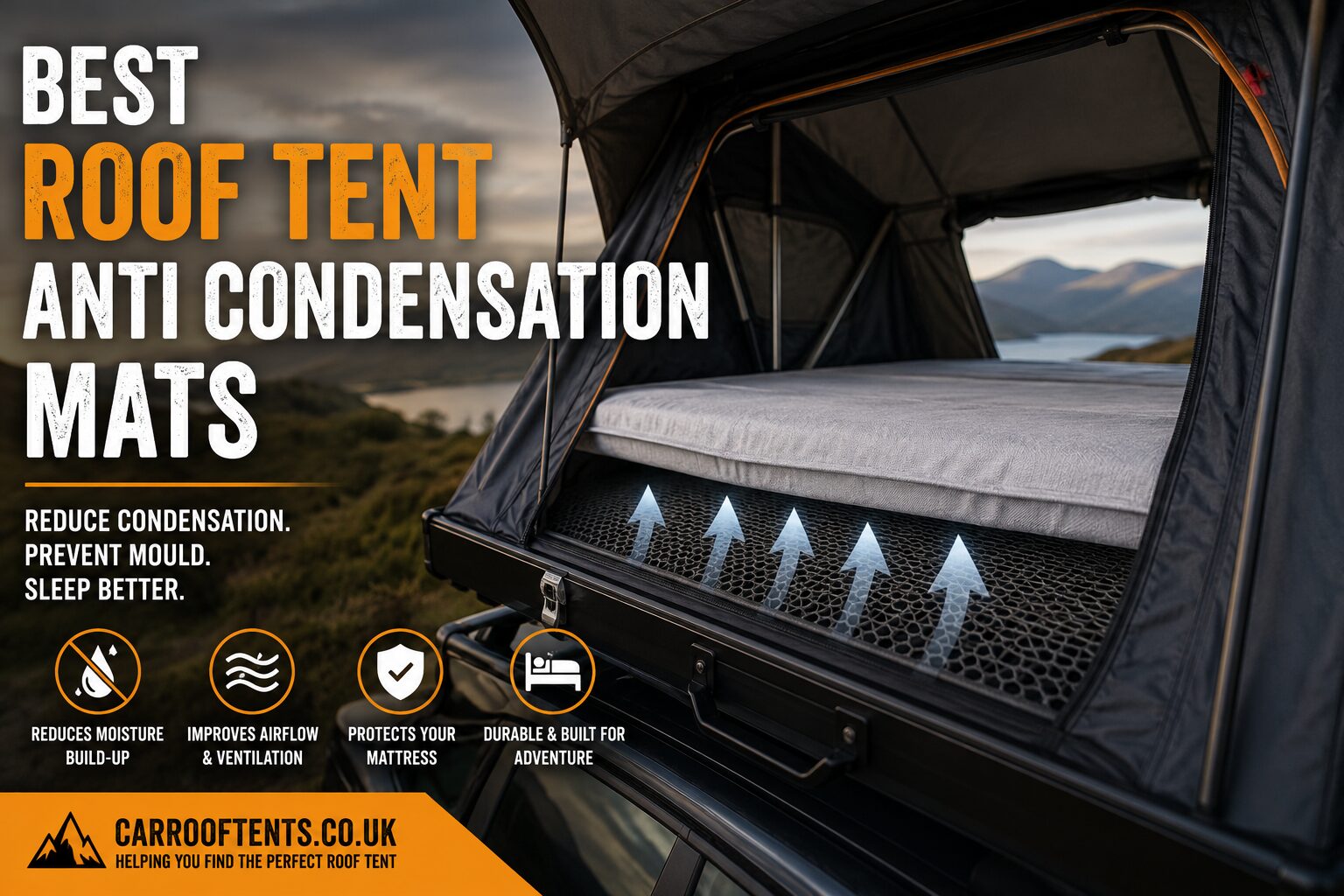
An anti-condensation mat is a breathable three-dimensional mesh placed underneath the mattress.
Instead of the mattress sitting directly on the tent floor, the mat creates thousands of tiny air channels.
These channels allow moisture to evaporate naturally while improving airflow beneath the mattress.
The result is:
- less trapped moisture
- faster drying
- reduced mould risk
- improved mattress longevity
- greater sleeping comfort
- less chance of waking to a damp mattress.
Think of it as raising the mattress only a few millimetres while dramatically increasing ventilation.
The concept is remarkably simple, yet it is one of the most effective upgrades available for regular UK roof tent camping.
Benefits Of Using An Anti-Condensation Mat
| Benefit | How It Helps |
|---|---|
| Improved airflow | Allows moisture to evaporate beneath the mattress. |
| Drier mattress | Reduces trapped condensation. |
| Better comfort | Many owners notice improved sleeping comfort. |
| Reduced mould risk | Helps prevent long-term damp damage. |
| Longer mattress life | Less moisture entering the foam. |
| Quicker drying after trips | Moisture disperses more easily. |
Do You Actually Need An Anti-Condensation Mat?
Not necessarily.
Some owners camp only during warm, dry summer weather and experience very little condensation.
Others may have excellent tent ventilation combined with favourable campsite conditions.
However, if you regularly camp in the UK, the answer is usually yes.
You are most likely to benefit if:
- two adults sleep in the tent regularly
- you camp during spring or autumn
- you use the tent throughout winter
- you leave bedding inside when folded
- you own a hard-shell aluminium tent
- you frequently camp in Scotland, Wales or coastal areas.
For occasional summer weekends you may decide to wait until after your first few trips before investing.
For frequent touring, most experienced roof tent owners consider an anti-condensation mat one of the best value upgrades available.
Hard Shell vs Soft Shell Roof Tents
Condensation affects both styles of roof tent, although it often behaves slightly differently.
Hard Shell Roof Tents
Hard shell tents commonly use aluminium or composite bases.
These materials can become cold overnight, encouraging condensation beneath the mattress.
The benefit is that many premium manufacturers already offer purpose-designed anti-condensation mats cut precisely to fit each model.
If you’re comparing roof tent styles, see our Hard Shell vs Soft Shell Roof Tents Guide.
Soft Shell Roof Tents
Soft shell tents often have different floor constructions but still suffer from moisture beneath the mattress.
Because the tent folds away with bedding inside, trapped moisture can sometimes remain enclosed until the next trip.
This makes drying the tent thoroughly after returning home particularly important.
Our Roof Tent Maintenance Guide explains the best drying procedures.
Quick Comparison Of Roof Tent Anti-Condensation Mats
| Manufacturer | Purpose Built | Model Specific | Official Website |
|---|---|---|---|
| TentBox | ✔ | ✔ | TentBox |
| Thule | ✔ | ✔ | Thule |
| iKamper | ✔ | ✔ | iKamper |
| Dometic | ✔ | ✔ | Dometic |
| James Baroud | ✔ | ✔ | James Baroud |
Buying Guide — What Should You Look For?
Not every breathable underlay is suitable for every roof tent.
Before purchasing, consider:
- exact mattress dimensions
- overall thickness
- whether bedding can still remain inside the tent
- manufacturer compatibility
- ease of cleaning
- replacement availability
- overall durability
Where possible we recommend buying the manufacturer’s own mat because it has been designed specifically around the folding mechanism, mattress dimensions and ventilation layout of that roof tent.
Generic alternatives can work well, but they often require trimming and may not fit around hinges or folding sections as neatly.
The Best Roof Tent Anti-Condensation Mats Available in the UK
Nearly every premium roof tent manufacturer now offers its own anti-condensation solution. While the underlying principle is usually similar, the size, thickness, materials and compatibility vary considerably between brands.
Wherever possible we recommend choosing the manufacturer’s own anti-condensation mat for your roof tent. These products are designed specifically around the dimensions of the mattress and floor, ensuring they fit neatly without interfering with hinges, gas struts or folding mechanisms.
The products below are listed alphabetically rather than ranked. The best choice depends entirely on the roof tent you own.
TentBox Anti-Condensation Mats
TentBox was one of the first companies to actively promote anti-condensation mats as an essential accessory rather than an optional extra.
The company’s mats are designed specifically for each TentBox model and use a breathable three-dimensional mesh that allows air to circulate beneath the mattress.
This airflow helps moisture evaporate naturally instead of remaining trapped between the mattress and the tent floor.
Best suited for
- TentBox Classic
- TentBox Lite
- TentBox Lite XL
- TentBox Cargo
- TentBox GO owners
Advantages
- Exact factory fit.
- No trimming required.
- Maintains airflow beneath the mattress.
- Designed alongside the roof tent.
- Excellent UK availability.
Possible drawbacks
- Generally more expensive than universal alternatives.
- Cannot easily be transferred between different brands.
Official information:
Thule Anti-Condensation Mats
Thule has a long history of designing vehicle-mounted outdoor equipment and produces anti-condensation mats specifically for several of its rooftop tents.
Rather than trying to produce a universal solution, Thule manufactures mats that match individual mattress sizes and floor layouts.
This provides an excellent fit while allowing the roof tent to continue folding and latching correctly.
Ideal for
- Owners wanting a genuine Thule accessory.
- Regular UK touring.
- Cool-weather camping.
- Long-distance travellers.
Advantages
- Purpose designed.
- High quality construction.
- Excellent manufacturer support.
- Designed to work with Thule bedding.
Possible disadvantages
- Premium pricing.
- Specific to Thule models.
Official website:
iKamper Anti-Condensation Mats
iKamper has built a reputation for premium hard-shell roof tents, particularly the Skycamp range.
The company offers anti-condensation mats designed specifically around the dimensions of each mattress.
Because many iKamper owners travel throughout the year, condensation management becomes particularly important during spring, autumn and winter camping.
Advantages
- Excellent airflow.
- Designed specifically for Skycamp models.
- Works alongside premium mattresses.
- Good build quality.
Best for
- Frequent campers.
- Cold-weather touring.
- Long expeditions.
Official website:
Dometic Anti-Condensation Mats
Dometic produces a wide range of camping equipment including rooftop tents and accessories.
Its anti-condensation mats are designed to improve airflow beneath the mattress while maintaining compatibility with the manufacturer’s folding systems.
Dometic products are particularly popular with touring campers who also use the company’s fridges, awnings and portable power solutions.
Strengths
- Excellent brand support.
- Designed around Dometic tents.
- Good quality materials.
- Widely available.
Official website:
James Baroud Anti-Condensation Mats
James Baroud roof tents are known for premium construction and expedition capability.
The company also produces dedicated anti-condensation mats to complement its insulated mattress systems.
These are particularly worthwhile for owners using their tents throughout the year.
Advantages
- Premium quality.
- Excellent fit.
- Designed specifically for James Baroud tents.
- Ideal for colder climates.
Official website:
ARB Anti-Condensation Mats
ARB is one of the world’s best-known overlanding manufacturers.
Its roof tents are designed for demanding travel, making moisture control especially important on long expeditions.
Although availability varies between individual models, ARB accessories are generally engineered to integrate neatly with the company’s tents.
Ideal for
- Expedition vehicles.
- 4×4 touring.
- Extended off-grid camping.
Official website:
Tuff-Trek Accessories
Tuff-Trek is a well-established UK roof tent specialist.
Depending on the roof tent purchased, suitable anti-condensation solutions may be available directly through the company.
Because Tuff-Trek supplies numerous roof tent manufacturers, compatibility should always be checked before ordering.
Official website:
Should You Buy A Universal Anti-Condensation Mat?
Universal anti-condensation mesh is becoming increasingly common.
Many products can simply be cut to size using scissors before being placed beneath the mattress.
They can represent excellent value, particularly for older roof tents where manufacturer accessories are no longer available.
Advantages
- Lower cost.
- Suitable for older tents.
- Can fit unusual mattress sizes.
- Easy to replace.
Disadvantages
- Requires trimming.
- May not fit folding sections perfectly.
- Quality varies considerably.
- Not specifically tested with every tent.
If your roof tent manufacturer produces a purpose-built mat, we would normally recommend choosing that first.
Can You Make Your Own Anti-Condensation Mat?
Some experienced campers make their own using specialist breathable mesh sold for marine mattresses or campervan beds.
While this can work well, it is important to remember that:
- the material must remain breathable;
- the mattress must still lie flat;
- the roof tent must still close correctly;
- nothing should obstruct hinges or locking mechanisms;
- additional thickness may prevent the tent from closing safely.
For premium roof tents costing several thousand pounds, a genuine manufacturer accessory is often worthwhile for the reassurance of guaranteed compatibility.
Our Independent Recommendations
| Situation | Recommendation |
|---|---|
| You own a current TentBox | Buy the official TentBox anti-condensation mat. |
| You own a Thule rooftop tent | Choose the matching Thule mat. |
| You own an iKamper Skycamp | Use the official iKamper solution. |
| You own an older roof tent | A quality universal breathable mesh may be the best option. |
| You camp regularly throughout the UK | An anti-condensation mat is strongly recommended regardless of tent brand. |
| Summer-only occasional camping | Try the tent first before deciding whether one is necessary. |
Quick Comparison Scorecard
If you’re looking for the short answer, the table below summarises our independent assessment of the leading manufacturer anti-condensation mats currently available in the UK. Rather than attempting to rank every product from “best to worst”, we’ve scored them against the areas that matter most to roof tent owners.
Every roof tent is designed differently, so the best anti-condensation mat is almost always the one engineered specifically for your tent model.
| Manufacturer | Factory Fit | Ventilation | Ease of Cleaning | UK Availability | Overall Recommendation |
|---|---|---|---|---|---|
| TentBox | ★★★★★ | ★★★★★ | ★★★★★ | ★★★★★ | Excellent for TentBox owners |
| Thule | ★★★★★ | ★★★★★ | ★★★★★ | ★★★★★ | Excellent manufacturer option |
| iKamper | ★★★★★ | ★★★★★ | ★★★★☆ | ★★★★☆ | Excellent premium choice |
| Dometic | ★★★★★ | ★★★★★ | ★★★★☆ | ★★★★☆ | Excellent touring accessory |
| James Baroud | ★★★★★ | ★★★★★ | ★★★★☆ | ★★★☆☆ | Premium expedition option |
| ARB | ★★★★★ | ★★★★★ | ★★★★☆ | ★★★☆☆ | Ideal for overlanding |
| Universal Mesh Mats | ★★★☆☆ | ★★★★☆ | ★★★★☆ | ★★★★★ | Good budget alternative |
Our conclusion: if your roof tent manufacturer produces a dedicated anti-condensation mat, we would normally recommend purchasing that version. Universal breathable mesh can work very well, particularly for older tents, but a purpose-built product generally offers the best fit, easiest installation and greatest long-term convenience.
How To Look After An Anti-Condensation Mat
Anti-condensation mats require very little maintenance, but like any camping equipment they perform best when kept clean and dry.
The mesh structure works by allowing air to circulate beneath the mattress. If this structure becomes clogged with dirt, sand, mud or mould, airflow is reduced and the mat becomes less effective.
Fortunately, maintenance is straightforward.
After Every Camping Trip
- Lift the mattress whenever practical.
- Allow the anti-condensation mat to air dry.
- Brush away loose dirt.
- Remove leaves, insects and debris.
- Check for trapped moisture.
- Leave the roof tent open at home until everything is completely dry.
This routine only takes a few minutes but can dramatically increase the lifespan of both the mattress and the mat.
Cleaning The Mat
Most anti-condensation mats can simply be cleaned using:
- clean water
- a soft brush
- mild soap if recommended by the manufacturer
- a garden hose
Avoid:
- pressure washers
- bleach
- solvents
- strong detergents
- abrasive brushes
These products may damage the mesh or shorten its service life.
Always allow the mat to dry naturally before reinstalling it beneath the mattress.
How Long Should An Anti-Condensation Mat Last?
Unlike mattresses, anti-condensation mats contain no foam that gradually loses its support.
Provided they are cleaned occasionally and allowed to dry after use, a quality mat should last for many years.
The exact lifespan depends upon:
- frequency of use
- UV exposure
- how often it remains damp
- storage conditions
- compression during transport
- overall build quality.
Many owners replace their roof tent before needing to replace the anti-condensation mat.
When Should You Replace One?
Replacement is rarely required unless the mesh has become physically damaged.
Consider replacing the mat if you notice:
- flattened mesh that no longer allows airflow
- permanent mould staining
- broken sections
- tears
- persistent odours that cannot be removed
- damage caused by rodents or pets.
If the mat is simply dirty, cleaning is usually sufficient.
Can An Anti-Condensation Mat Prevent Mould?
Not entirely.
This is perhaps the biggest misconception surrounding these accessories.
An anti-condensation mat reduces the conditions that encourage mould growth.
It does not eliminate the need to:
- dry the tent properly
- ventilate overnight
- remove wet bedding
- clean the tent occasionally
- store the tent completely dry.
If a roof tent is folded away soaking wet for several weeks, mould may still develop regardless of whether an anti-condensation mat is fitted.
For complete maintenance advice, see our Roof Tent Maintenance Guide.
Common Mistakes Roof Tent Owners Make
Buying One Too Late
Many owners wait until mould or damp appears before purchasing a mat.
Ideally, it should be fitted from the very beginning if you expect to camp regularly in the UK.
Closing The Tent Whilst Damp
An anti-condensation mat is not a substitute for drying your roof tent properly.
Always dry the tent thoroughly after returning home whenever possible.
Blocking Ventilation
Keeping every window tightly closed may reduce draughts, but it also traps moisture.
Even small ventilation openings can significantly reduce condensation.
Assuming Expensive Tents Don’t Condense
Premium roof tents suffer from condensation too.
The quality of construction has little influence on the basic laws of physics.
Warm, humid air meeting a colder surface will always create condensation.
Leaving Wet Bedding Inside
Many hard shell roof tents are designed so bedding can remain inside when closed.
However, damp sleeping bags, pillows and blankets should always be dried before long-term storage.
Ignoring Mattress Checks
Even if an anti-condensation mat is fitted, it is worth lifting the mattress occasionally.
This simple inspection can reveal moisture before it develops into mould.
Are Anti-Condensation Mats Worth The Money?
In our opinion, for most UK roof tent owners the answer is yes.
Compared with the cost of a quality roof tent, an anti-condensation mat is a relatively inexpensive upgrade that helps protect one of the tent’s most expensive components—the mattress.
It also improves day-to-day comfort by reducing dampness beneath the sleeping surface, particularly during spring, autumn and winter camping.
If you only camp occasionally during warm summer weekends, you may decide to wait until you’ve completed a few trips before purchasing one.
However, for frequent touring, family camping or year-round adventures, we would class an anti-condensation mat as one of the first accessories worth buying after your roof tent itself.
Our Independent Verdict
★★★★★ Recommended for most UK roof tent owners.
If your manufacturer offers a dedicated anti-condensation mat, that should normally be your first choice. It provides the best fit, requires no trimming and has been designed specifically around your roof tent’s floor, mattress and folding mechanism.
Universal breathable mesh remains an excellent alternative where genuine accessories are unavailable or for older roof tents no longer supported by the manufacturer.
Frequently Asked Questions About Roof Tent Anti-Condensation Mats
Below are answers to some of the questions we’re most frequently asked by roof tent owners. Whether you’re buying your first anti-condensation mat or replacing an existing one, these answers should help you make an informed decision.
Do all roof tents suffer from condensation?
Yes. Every roof tent can experience condensation because it is caused by warm, moisture-laden air meeting cooler surfaces. Premium tents may reduce the effects through improved ventilation or insulation, but none are completely immune.
Will an anti-condensation mat completely stop condensation?
No. An anti-condensation mat helps reduce moisture beneath the mattress by improving airflow, but it cannot eliminate condensation entirely. Good ventilation and drying your tent properly remain essential.
Are anti-condensation mats worth buying?
For most UK campers, yes. They are one of the simplest and most effective upgrades available and can significantly reduce dampness beneath the mattress while helping to extend its lifespan.
Can I use a universal anti-condensation mat?
Absolutely. Universal breathable mesh can work very well, particularly for older roof tents where genuine accessories are no longer available. However, factory-made mats generally offer a neater fit.
Should I buy the manufacturer’s own mat?
Where one is available, we usually recommend it. Manufacturer mats are designed specifically for the mattress dimensions, folding mechanism and ventilation system of your roof tent.
Can I leave the mat inside the tent when it’s closed?
In most cases, yes. Dedicated anti-condensation mats are designed to remain beneath the mattress permanently. Always check the manufacturer’s recommendations for your specific model.
Do hard shell roof tents need anti-condensation mats more than soft shell tents?
Both styles can benefit. Hard shell tents often have aluminium bases that cool quickly overnight, while soft shell tents may retain trapped moisture when folded away. The need depends more on your camping conditions than the tent style.
Will an anti-condensation mat make my mattress more comfortable?
Many owners report a slight improvement in comfort thanks to the cushioning effect of the breathable mesh, although its primary purpose is moisture management rather than added softness.
Can I cut a universal mat to size?
Most universal mesh products can be trimmed with sharp scissors or a craft knife. Measure carefully and ensure the finished mat does not interfere with hinges or locking mechanisms.
Do I still need to ventilate my roof tent?
Yes. Even with an anti-condensation mat installed, opening roof vents or windows slightly allows humid air to escape and significantly reduces condensation.
How often should I clean the mat?
Inspect it after every trip and clean it whenever dirt or debris begins to block the mesh. Regular maintenance helps maintain airflow and prolongs its life.
Can mould still develop?
Unfortunately, yes. If a wet roof tent is stored for extended periods without drying, mould can still form. An anti-condensation mat reduces the risk but does not replace proper maintenance.
How long do anti-condensation mats last?
A quality mat should last many years if cleaned occasionally and allowed to dry after use. Many owners never need to replace theirs during the life of the roof tent.
Can I use one with an inflatable mattress?
Yes. Breathable mesh can improve airflow beneath inflatable mattresses just as effectively as beneath foam mattresses.
Will pets damage the mesh?
Sharp claws may snag some materials over time, particularly if dogs frequently jump into the tent. Inspect the mat occasionally for damage.
Is it suitable for winter camping?
Yes. In fact, winter camping is when anti-condensation mats often prove most valuable due to the greater temperature differences between inside and outside the tent.
Can children sleeping in the tent increase condensation?
Yes. Every additional occupant produces moisture through breathing, increasing humidity inside the tent overnight.
Do insulated roof tents still need anti-condensation mats?
Insulation may reduce condensation but does not remove it completely. Many insulated tents still benefit from improved airflow beneath the mattress.
Should I remove the mattress after every trip?
Not usually. However, lifting it occasionally to allow everything to dry thoroughly is excellent practice, particularly after damp weather.
Can condensation damage my mattress?
Repeated exposure to moisture may eventually lead to mould, unpleasant odours and deterioration of the foam. Preventing trapped moisture helps maximise mattress life.
Can I fit one to an older roof tent?
Yes. Universal breathable mesh products make excellent upgrades for older roof tents where dedicated accessories may no longer be available.
Will an anti-condensation mat increase the packed height?
Only slightly. Most mats are designed to be thin enough to remain permanently beneath the mattress without affecting how the tent closes.
Can I use household underlay instead?
We wouldn’t recommend it. Purpose-made anti-condensation mats are designed specifically to promote airflow while remaining durable in outdoor conditions.
Which campers benefit the most?
Frequent travellers, families, year-round campers and anyone touring throughout the UK are likely to notice the greatest benefit.
Should anti-condensation mats be one of my first accessories?
In our opinion, yes. Alongside quality roof bars, suitable bedding and good lighting, an anti-condensation mat is one of the most worthwhile upgrades for improving comfort and protecting your investment.
Our Final Verdict
Condensation is simply part of camping, especially in the UK’s unpredictable climate. Even the most expensive roof tents cannot escape the basic physics of warm, humid air meeting cooler surfaces.
Fortunately, managing that moisture doesn’t have to be complicated or expensive.
A well-designed anti-condensation mat improves airflow beneath your mattress, helps reduce trapped moisture and contributes to a drier, healthier sleeping environment. While it won’t eliminate condensation completely, it is one of the simplest upgrades you can make to improve comfort and protect your roof tent over the long term.
If your roof tent manufacturer offers a dedicated anti-condensation mat, we believe that’s usually the best option. It’s designed specifically for your tent, requires no trimming and is likely to provide the best fit and performance.
Universal breathable mesh remains an excellent alternative for older tents or where genuine accessories are unavailable, provided it’s installed carefully and doesn’t interfere with the tent’s operation.
Combined with sensible ventilation, regular drying and good maintenance, an anti-condensation mat should provide years of reliable service and help keep your mattress in excellent condition.
Our Recommendation
If you regularly camp in the UK, we consider an anti-condensation mat to be one of the best value accessories you can buy.
It’s a relatively inexpensive upgrade that can improve sleeping comfort, reduce dampness and help protect one of the most important components of your roof tent.
Continue Your Roof Tent Research
If you found this guide useful, you may also enjoy these in-depth resources:
- Best Roof Tent Accessories UK – our complete guide to the accessories worth buying.
- Roof Tent Maintenance Guide – keep your tent in excellent condition.
- Roof Tent Safety Guide – practical advice for safer camping.
- Compare Roof Tents UK – compare specifications from leading brands.
- Roof Tent Brands UK – discover the major manufacturers available in Britain.
- Hard Shell vs Soft Shell Roof Tents – understand the advantages of each design.
- Complete Roof Tent Buying Guide UK – everything you need to know before buying your first roof tent.
Editorial Policy
This guide has been written independently to help UK roof tent owners understand the causes of condensation and the accessories available to manage it.
At the time of publication, CarRoofTents.co.uk does not use affiliate links within this article. Any manufacturer links are provided solely to help readers find official product information and compatibility details.
Our recommendations are based on manufacturer specifications, product design, practical camping knowledge and suitability for typical UK conditions rather than commercial relationships.
Choosing Your Next Roof Tent?
Once you’ve decided which accessories you’ll need, our free comparison tool makes it easy to compare roof tent dimensions, weights, capacities and features from many of the leading brands available in the UK.