
Last Updated on 3 days ago by admin
That extra shelter is particularly valuable in the UK, where a dry morning can quickly become a wet and windy afternoon. However, roof tent awnings vary enormously. Some zip directly to one specific tent, some mount independently to roof bars or a roof rack, and others create a fully enclosed room beside the vehicle.
The best roof tent awning is therefore not simply the largest or most expensive model. It is the one that matches your roof tent, vehicle, camping style, usual pitch conditions and willingness to spend time setting up camp.
This independent guide explains the main types of roof tent awning, compares leading manufacturer options, highlights compatibility and safety considerations and helps you decide whether an awning, annex or simpler shelter is the right next addition to your setup.
If you are still choosing the tent itself, start with our Complete Roof Tent Buying Guide UK or use the roof tent comparison tool. For a wider look at useful upgrades, see our Best Roof Tent Accessories UK guide.
Quick Verdict
For most owners, the safest and simplest choice is a model-specific awning supplied or approved by the roof tent manufacturer. It should connect more neatly, fit the intended entrance and avoid much of the guesswork surrounding brackets and packed clearances.
A universal vehicle side awning can be the better choice when you want fast shade without attaching anything to the tent itself, while a full awning room suits longer stays, families, dogs and campers who value privacy.
What Is a Roof Tent Awning?
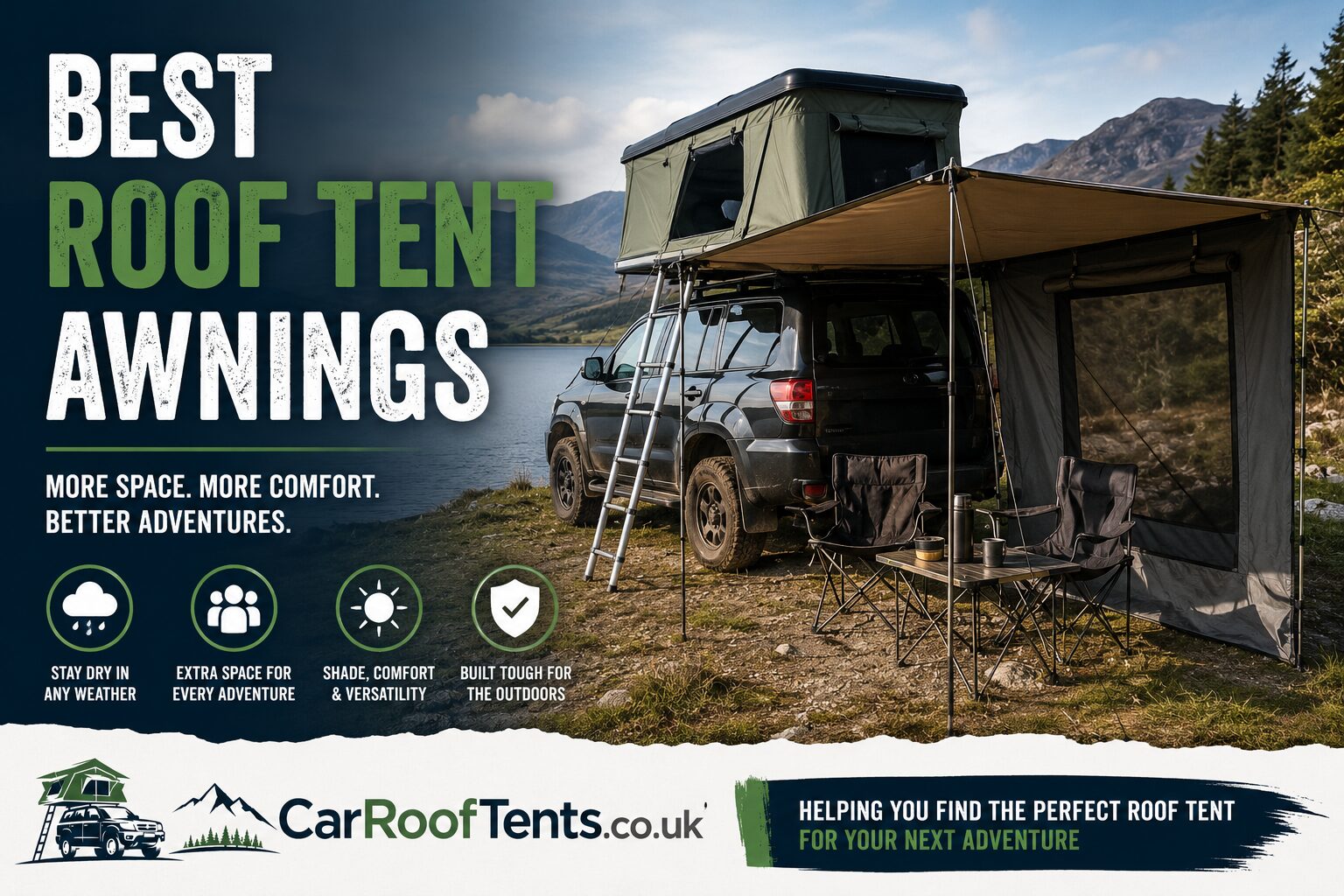
A roof tent awning is a fabric shelter that extends from the roof tent, roof rack, roof bars or side of the vehicle to create covered living space at ground level.
Depending on the design, it may provide:
- shade from strong sun;
- shelter from light or moderate rain;
- a dry entrance beneath the roof tent ladder;
- space for cooking and seating;
- privacy for changing clothes;
- an enclosed room for dogs, children or equipment;
- a protected transition between the vehicle and roof tent.
Some products are essentially simple canopies. Others include sidewalls, front panels, doors, windows, groundsheets or a connecting tunnel. This is why the word awning can describe several quite different products.
Before ordering, look beyond the product name and establish exactly what is included. A photograph may show optional walls, poles, a groundsheet or an adaptor that is sold separately.
Roof Tent Awning vs Annex: What Is the Difference?
The terms are sometimes used interchangeably, but they usually describe different levels of enclosure.
| Feature | Awning | Annex or awning room |
|---|---|---|
| Main purpose | Open-sided shelter and shade | Enclosed or partly enclosed living space |
| Setup time | Usually quicker | Usually longer |
| Privacy | Limited unless walls are added | Good |
| Wind exposure | Air can pass through more easily | Larger enclosed surfaces can catch more wind |
| Pack size | Generally smaller | Generally larger and heavier |
| Best for | Touring, quick stops and daytime shelter | Families, pets, changing and longer stays |
A basic awning is normally best when speed matters. An annex or awning room is more useful when you remain on one pitch for several nights and want a genuine ground-level living area.
Some systems are modular. You can begin with a canopy and later add a front panel, sidewalls or a complete room. This can be a sensible way to spread the cost and avoid carrying the full enclosure on every trip.
The Main Types of Roof Tent Awning
Model-Specific Tunnel Awning
A tunnel awning connects directly to the roof tent entrance or shell and extends down towards the ground. It may cover the ladder and create a sheltered route into the sleeping compartment. Compatibility is critical because the connection points, ladder position and vehicle height must all work together.
Roof-Tent-Mounted Canopy
This type attaches directly to the tent and opens outward to create a roof over the entrance or side of the vehicle. It is usually designed for one tent range and may use a zip, rail or dedicated mounting points.
Universal Vehicle Side Awning
A universal side awning mounts to roof bars, a platform rack or suitable brackets rather than relying on the roof tent. It normally rolls or folds out horizontally and is supported by poles and guy lines.
This can be a flexible option because the awning may remain with the vehicle even if the roof tent changes.
270-Degree Awning
A 270-degree awning wraps around the side and rear of the vehicle, creating a large sheltered area. It is popular on touring 4x4s and expedition builds but is typically heavier, more expensive and more demanding to mount than a basic pull-out awning.
Awning Room
An awning room adds walls, doors and sometimes a groundsheet beneath a side awning. It can create a changing room, daytime lounge, pet area or additional sleeping space where the manufacturer approves it for that purpose.
Roof Tent Annex
An annex generally hangs beneath the extended section of a soft-shell roof tent and encloses the ladder area. It is usually specific to the tent model and may provide more direct integration than a separate side awning.
Quick Comparison: Which Awning Style Is Best?
| Awning type | Setup speed | Shelter | Privacy | Best use |
|---|---|---|---|---|
| Model-specific tunnel | Fast to moderate | Very good around entrance | Moderate to good | Integrated roof tent camps |
| Pull-out side awning | Fast | Good overhead cover | Low | Touring and short stops |
| Side awning with room | Moderate | Very good | High | Families, dogs and longer stays |
| 270-degree awning | Fast to moderate | Excellent coverage | Low unless walls added | 4×4 touring and base camps |
| Roof tent annex | Moderate | Very good below tent | High | Soft-shell tents and multi-night stays |
- Best for easy compatibility: the official awning made for your exact roof tent.
- Best for quick weekends: a compact pull-out side awning.
- Best for families: a model-specific awning room or annex.
- Best for dogs: an enclosed room with ventilation and secure lower edges.
- Best for overlanding: a robust side or 270-degree awning mounted to a suitable rack.
- Best for small cars: a lightweight tunnel or compact side awning, subject to mounting compatibility.
Best Roof Tent Awnings Available to UK Buyers
The products below are not presented as a universal ranking. Each system is designed around a particular tent, vehicle or camping style, so a product that is excellent for one owner may be unsuitable for another.
We have linked to official manufacturer or official UK product pages rather than affiliate retailers. Check current availability, exact compatibility, included components and fitting requirements before purchasing.
TentBox Tunnel Awning
The official TentBox Tunnel Awning is designed to connect to compatible TentBox models and provide shelter from sun and rain, along with useful space for sitting or storing equipment.
Its main appeal is integration. Rather than mounting a separate cassette to the side of the vehicle, the shelter works with the TentBox setup. Owners must choose the correct variation and check whether an adaptor or other component is required.
- Purpose-designed for compatible TentBox models.
- Creates shelter close to the entrance.
- Useful for chairs, boots, bags and dogs.
- More integrated than a generic tarp.
Best for: TentBox owners who want a connected shelter without designing a universal mounting system.
TentBox Universal Side Awning and Room
TentBox also offers a Universal Side Awning that mounts using brackets rather than connecting as a tunnel. A compatible Side Awning Room turns the canopy into a more enclosed living area.
Best for: owners wanting a quick roll-out shelter with the option to add walls for longer stays.
Thule Approach Awning
The Thule Approach Awning S/M is designed specifically for Thule Approach rooftop tents. It provides shade and rain shelter while extending the usable space around the vehicle.
- Purpose-built for the Thule Approach range.
- Designed to allow movement in and out of the tent.
- Height-adjustable support poles.
- Documented manufacturer compatibility.
Best for: Thule Approach owners wanting a clean manufacturer-designed extension.
iKamper Awning
The iKamper Awning is a large shelter designed to zip directly to compatible iKamper roof tents. The manufacturer supplies variations for different tent families, so model selection is essential.
- Large sheltered footprint.
- Direct connection to compatible iKamper tents.
- Useful for family seating and meal preparation.
- Creates a coherent campsite rather than a separate shelter.
Best for: iKamper owners wanting substantial covered living space for longer trips and family camps.
Dometic RT Awning
The Dometic RT Awning S is designed for the Dometic TRT 140 AIR roof tent and lower passenger vehicles. It can function as both an open awning and a privacy room.
- Can be configured as shade or an enclosed privacy area.
- Designed around the Dometic roof tent system.
- Relatively compact packed size.
- Breathable polycotton construction.
Best for: Dometic TRT owners wanting one accessory that provides both open shelter and privacy.
James Baroud Awnings and Connecting Tunnels
James Baroud offers premium shelter systems, including the Evolution Tunnel, which connects compatible James Baroud tents to an awning arrangement so occupants can move between them under cover.
- Premium integrated campsite concept.
- Sheltered access between awning and tent.
- Suitable for serious touring and longer stays.
- Works well with larger vehicle or expedition builds.
Best for: James Baroud owners building a premium weather-protected touring setup.
ARB Touring Awnings
ARB produces a broad range of vehicle-mounted awnings for 4×4 and touring use. These normally attach to a suitable rack or mounting system rather than depending on one roof tent model.
The official ARB awnings, rooms and accessories range includes several sizes, cases and wall options.
- Multiple sizes for different vehicles.
- Strong overlanding and touring heritage.
- Accessories include windbreaks and rooms.
- Independent of the roof tent entrance.
Best for: 4×4 owners, overlanders and touring vehicles with a properly engineered rack system.
Before combining a heavy awning with a roof tent, revisit our Roof Bars for Roof Tents guide.
Front Runner Easy-Out Awning and Room
Front Runner’s rack ecosystem includes pull-out awnings and enclosures. The Front Runner Easy-Out Awning Room adds four walls to a compatible two-metre Easy-Out Awning.
- Part of a broad rack and accessory system.
- Room provides privacy and increased weather protection.
- Useful for changing, daytime living or organised storage.
- Modular, so the room need only be carried when required.
Best for: owners using Front Runner racks who want a modular touring shelter.
Tuff-Trek Roof Tent and Overland Awnings
Tuff-Trek is a UK specialist supplying roof tents, awnings and overland accessories from its own ranges and other established manufacturers.
The main advantage is access to compatibility advice across different tents, racks and vehicles.
Best for: UK buyers who value specialist advice, particularly when combining products from several overland brands.
Roof Tent Awning Buying Guide
Start With Compatibility, Not Appearance
Establish the exact tent model and generation, opening side, ladder position, available rack space, vehicle height and whether adaptors are included. Never assume two tents with similar dimensions use the same zip, rail or mounting points.
Decide Whether You Want Shelter or a Room
A simple canopy is quicker and lighter. A room gives privacy and more protection but takes longer to pitch, packs larger and catches more wind.
Measure the Complete Campsite Footprint
Consider vehicle width, tent projection, ladder space, awning depth, guy lines and room to open doors and the tailgate. A complete setup can occupy far more space than the vehicle alone.
Check Mounting Weight and Rack Capacity
A side awning adds weight to the roof-carrying system and may place leverage on brackets while open. Confirm the limits of the vehicle roof, rails, bars, rack, brackets, tent channels and fixings.
Our guide to whether a roof tent can go on any car explains why the lowest-rated component governs the usable capacity.
Consider Setup Time Honestly
Real setup may include poles, walls, height adjustment, pegs, guy lines and a groundsheet. If you move daily, a fast pull-out awning may give more value than a full room you rarely pitch.
Examine Fabric and Weather Protection
Look for fabric specification, water resistance, UV protection, ventilation, mesh windows, pole material and replacement-parts availability. Do not treat an awning as a storm shelter unless the manufacturer specifically rates it for those conditions.
Check Drainage and Roof Shape
Water must run off rather than pool. Adjustable poles allow one corner or edge to be lowered. Pooling water adds substantial weight and can damage fabric, poles or connection points.
Plan Doors, Tailgates and Cooking
A pole can block a door, while a low canopy may clash with a tailgate. Cooking beneath fabric requires ventilation, safe clearance and strict compliance with appliance instructions. Never use unsuitable fuel-burning appliances inside a sealed room.
Think About Wet Storage
A wet awning is bulky and heavy. After returning home, open and dry it completely. Our Roof Tent Maintenance Guide explains how to avoid mould and damp damage.
Review Warranty and Spare Parts
Pole sections, bags, brackets and panels can become damaged or lost. A supported system with obtainable parts can be better value than a cheaper product that must be replaced completely after one failure.
Using a Roof Tent Awning in UK Weather
Rain
Pitch with a clear slope so water runs away from the entrance and vehicle doors. Keep fabric tensioned without overloading seams, zips or rails.
Wind
Wind is the biggest operational risk for most awnings. Use every required peg and guy line, choose anchors for the ground, check tension and pack the awning away before conditions exceed manufacturer guidance.
Read our Roof Tent Safety Guide before camping in exposed conditions.
Strong Sun
An awning reduces direct sun but heat can still build beneath dark fabric or inside rooms. Maintain airflow and never leave children or pets unattended in a hot enclosure.
Cold Conditions
An enclosed room can reduce wind exposure but is not automatically insulated. Ventilate it and keep wet clothing away from bedding. See our guide to the Best Roof Tent Anti-Condensation Mats.
Installation and Mounting Considerations
Manufacturer-Connected Awnings
These may use a zip, sail track, clips or a dedicated adaptor. Follow the supplied sequence carefully. Forcing an incompatible connection can damage both awning and tent.
Roof-Bar or Rack-Mounted Awnings
Check that brackets are approved, fit the rack profile, clear the vehicle body, do not interfere with the roof tent mounts and are tightened correctly. Inspect fixings after the first journey and periodically thereafter.
Which Side of the Vehicle?
Consider the tent opening, campsite layout, doors, prevailing wind, privacy and UK roadside safety. Avoid creating a setup that encourages people to stand in live traffic.
When Professional Fitting Makes Sense
Professional fitting is sensible when the awning is heavy, custom brackets are required, the rack already carries several accessories or you are uncertain about load paths and clearances.
Best Roof Tent Awning for Different Camping Styles
| Camping style | Best awning type | Why |
|---|---|---|
| One-night touring | Fast pull-out side awning | Minimal setup and pack-down |
| Family holidays | Large model-specific awning or room | More living and storage space |
| Camping with dogs | Ventilated enclosed room | Sheltered ground-level area |
| Solo travel | Compact one-person awning | Lower weight and easier handling |
| Small cars | Lightweight tunnel or compact side awning | Lower mounting demand |
| 4×4 overlanding | Robust side or 270-degree awning | Large shelter and rack integration |
| Festival camping | Awning room | Privacy and daytime space |
| Winter and shoulder seasons | Enclosed ventilated room | Reduced wind exposure |
Cleaning and Maintaining a Roof Tent Awning
- Remove mud and debris after each trip.
- Inspect poles, pegs, zips, rails and brackets.
- Dry the fabric fully.
- Check the storage bag for trapped moisture.
- Replace bent pegs and damaged guy lines.
Follow the manufacturer’s care instructions. In general, use clean water, a soft brush and only a mild approved cleaner. Avoid bleach, aggressive detergents, pressure washing and hard scrubbing unless explicitly permitted.
Do not automatically coat a new awning with aftermarket waterproofing. Use the treatment recommended by the manufacturer when water resistance genuinely declines.
Common Roof Tent Awning Mistakes
- Buying before checking the exact tent generation.
- Assuming all brackets are universal.
- Ignoring the roof tent opening direction.
- Choosing the largest awning rather than the most practical.
- Failing to peg it because the weather appears calm.
- Allowing rainwater to pool.
- Cooking too close to fabric.
- Packing it wet and forgetting to dry it.
- Leaving it deployed unattended in changeable weather.
Frequently Asked Questions
Is a roof tent awning worth buying?
For regular UK camping, yes. It provides sheltered ground-level space that the roof tent itself cannot offer.
What is the best roof tent awning?
Usually the official product designed for your exact tent. Universal vehicle awnings depend on rack compatibility, weight and intended use.
Can any awning fit any roof tent?
No. Direct-connect awnings are normally model-specific. Universal side awnings still need suitable brackets and clearance.
Do I need an awning or an annex?
Choose an awning for quick overhead shelter. Choose an annex or room for privacy and enclosed living space.
Can I leave an awning attached while driving?
Only if it is specifically designed to remain packed in its travel case and all fittings are correctly installed.
Can a roof tent awning be used in rain?
Most provide rain shelter, but drainage, anchoring and stated weather limits must be respected.
Can an awning withstand strong wind?
Do not assume it can. Use all anchors and pack it away before conditions exceed manufacturer guidance.
Do I need to peg an awning?
Normally yes, even when the awning appears self-supporting.
Can I use an awning on hardstanding?
Potentially, with suitable anchoring equipment and campsite permission.
Can I cook under an awning?
Only with safe clearances, ventilation and compliance with both appliance and awning instructions.
Does an awning count towards roof load?
A roof- or rack-mounted awning adds weight and forces to the carrying system and must be included in the assessment.
Can I mount an awning directly to a roof tent?
Only where the tent manufacturer supplies or approves the connection points and brackets.
Which side should the awning go on?
That depends on the tent opening, doors, campsite use and roadside safety.
Are 270-degree awnings suitable for cars?
Some may be, but many are intended for substantial 4×4 racks and are too heavy for ordinary car systems.
Is a side awning better than a tunnel awning?
A side awning is often quicker and more independent. A tunnel awning offers better integration with the tent entrance.
Can an awning room be used for sleeping?
Only when the manufacturer states it is suitable and ventilation and ground conditions are appropriate.
Is an awning room suitable for dogs?
It can provide shade and shelter but may not be escape-proof and must not become dangerously hot.
Can I use a freestanding awning with a roof tent?
Yes. A gazebo or drive-away shelter may be better when you want to drive away while leaving camp set up.
What size awning should I buy?
Measure mounting length, projection, pitch space, doors and guy-line area. Bigger is not always better.
Can one person set up an awning?
Many compact designs can be managed alone. Large rooms and panels may be difficult in wind.
Do awnings include poles and pegs?
Often, but not always. Check the contents list, adaptors, brackets, walls and groundsheet carefully.
Can I add walls later?
Many modular awnings accept rooms or windbreaks, but only use components designed for the exact model.
Will an awning stop roof tent condensation?
No. It can keep wet gear outside the sleeping area, but condensation still requires ventilation and moisture management.
How should I store a wet awning?
Only temporarily for transport, then reopen and dry it completely as soon as possible.
How long should an awning last?
A quality awning can last many years if correctly pitched, dried, cleaned and stored.
Can an awning damage my roof tent?
Yes, if it is incompatible, mounted incorrectly or overloaded by wind or pooled water.
Final Verdict: Which Roof Tent Awning Should You Choose?
For most roof tent owners, the best starting point is the awning specifically designed for their tent. TentBox, Thule, iKamper and Dometic provide integrated options for compatible models, removing much of the uncertainty surrounding fit and connection.
Owners with platform racks, 4x4s or more complex touring builds may prefer an independent side or 270-degree awning from a specialist range such as ARB, Front Runner or those supplied by Tuff-Trek. This gives greater flexibility but demands more careful mounting and load planning.
- Choose a simple side awning for fast shade and rain cover.
- Choose a tunnel awning for integrated shelter around the roof tent entrance.
- Choose an awning room or annex for privacy, family space, pets and longer stays.
- Choose a 270-degree awning only when the vehicle and rack can safely support it and you will use the extra coverage.
The best awning is not the one that creates the biggest campsite. It is the one you can mount safely, pitch confidently, dry properly and use often enough to justify carrying it.
Our Independent Recommendation
Choose the official model-specific awning first whenever a suitable one exists. If it does not provide enough coverage, consider a properly mounted universal side awning or modular room from an established manufacturer.
Editorial Disclosure
This guide has been produced independently by CarRoofTents.co.uk to help UK campers understand and compare roof tent awnings.
We do not currently use affiliate links in this article. External links lead to official manufacturer or official distributor pages so readers can check current specifications, compatibility and availability.
No awning is recommended solely because of its price, popularity or commercial relationship. Suitability depends on the exact roof tent, vehicle, mounting system and intended use.
Product ranges and compatibility can change. Always verify current details with the manufacturer and follow the latest fitting, weather and safety instructions supplied with the product.
Still Choosing Your Roof Tent?
Compare dimensions, weights, capacities, opening styles and features from leading roof tent brands using our free UK comparison resource.