
Last Updated on 3 days ago by admin
The difficult part is choosing the right size. A small 250–300Wh unit may be ideal for an overnight trip but disappointing if you expect it to run a compressor fridge for several days. A large 1,000Wh or 2,000Wh model offers far more capacity, but it also costs more, occupies valuable boot space and may be unnecessarily heavy for simple weekend camping.
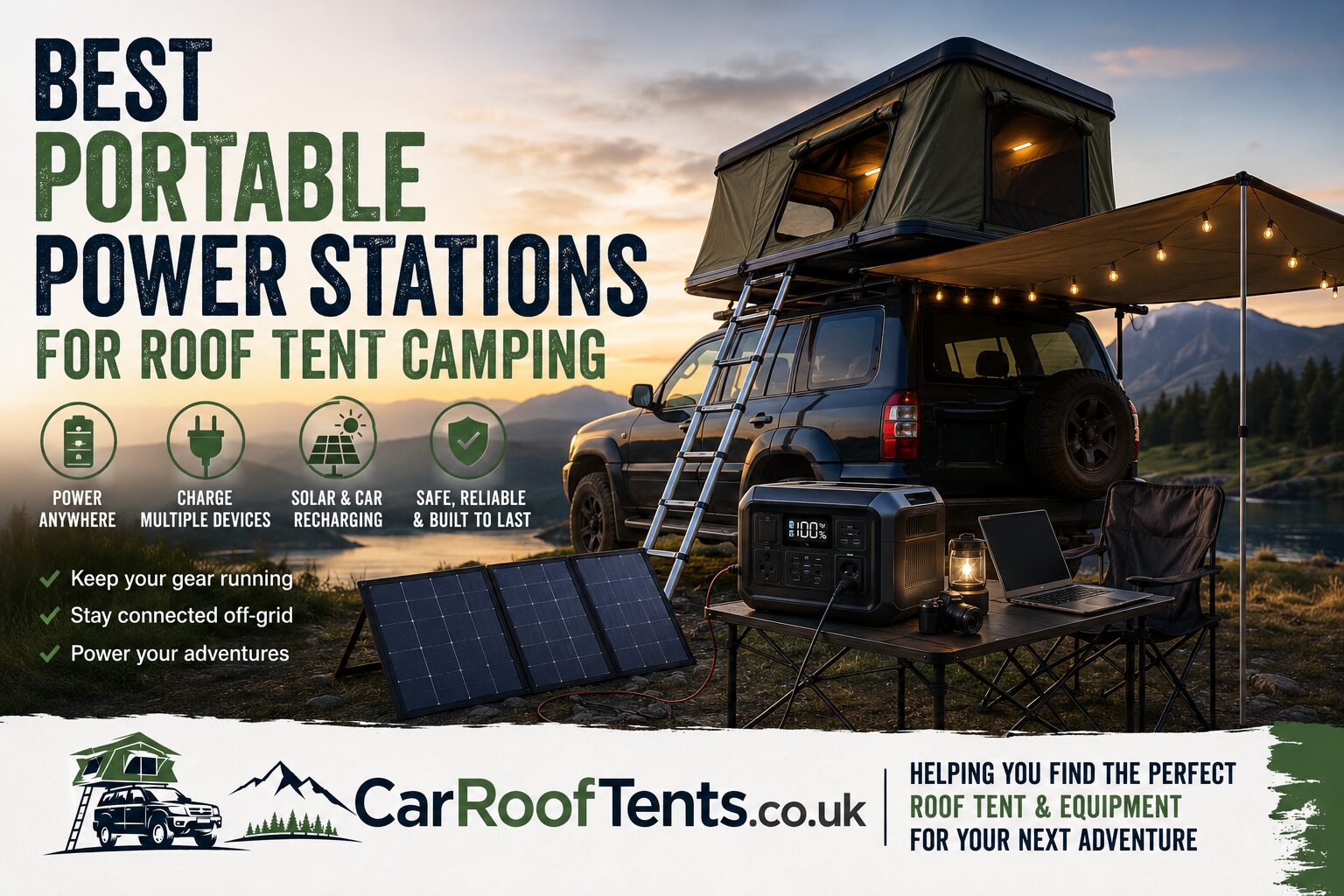
This independent UK guide explains how portable power stations work, what capacity and output you actually need, which current models are most suitable for different roof tent camping styles and how to recharge them safely from mains electricity, a vehicle or portable solar panels.
For a wider look at useful upgrades, visit our Best Roof Tent Accessories UK guide. If you are still choosing the tent itself, start with our Complete Roof Tent Buying Guide UK or use the roof tent comparison tool.
Quick Verdict
For most couples taking two- or three-night roof tent trips, a modern 500–800Wh LiFePO4 power station is the best balance of capacity, portability and price.
Choose around 250–300Wh for phones, lights and occasional laptop use; around 500Wh for weekend trips and modest fridge use; and around 1,000Wh when you regularly run a compressor fridge, charge several devices or stay away from mains power for longer.
Do not choose on watt-hours alone. Check continuous output, USB-C capability, 12V socket performance, charging speed, low-temperature limitations, weight and whether the unit can be recharged conveniently from your vehicle or a solar panel.
What Is a Portable Power Station?
A portable power station is a rechargeable battery housed in a protective case with built-in charging electronics and several output ports. Depending on the model, these may include:
- 230V UK mains sockets;
- USB-A ports;
- USB-C Power Delivery ports;
- a 12V vehicle-style socket;
- DC barrel outputs;
- specialist high-current or manufacturer-specific ports;
- wireless charging on selected units.
Unlike a petrol generator, a battery power station produces no exhaust fumes and is usually quiet enough for campsite use. It can be charged at home before travelling, topped up from the vehicle while driving or connected to compatible solar panels when camping.
The term solar generator normally describes a portable power station supplied or used with a solar panel. The power station itself is still a battery system; the panel provides one method of recharging it.
Portable power stations are particularly well suited to roof tent camping because they require no permanent wiring. You can place the unit in the boot, under a vehicle awning or inside a dry storage area, then remove it when the trip is over.
Portable Power Station vs Power Bank
A power bank is the better choice when you only need to charge phones, head torches or small USB devices. It is lighter, cheaper and easier to carry.
A portable power station becomes worthwhile when you need one or more of the following:
- a 230V mains socket;
- a powered coolbox or compressor fridge;
- high-output USB-C laptop charging;
- several days of device charging;
- camera or drone battery charging;
- portable lighting around an awning or annex;
- backup power for essential equipment;
- the ability to recharge from solar panels.
| Feature | Power bank | Portable power station |
|---|---|---|
| Typical capacity | 10,000–30,000mAh USB-focused capacity | Approximately 250Wh to several kWh |
| 230V socket | Usually no | Usually yes |
| 12V fridge support | No | Often yes |
| Weight | Very light | Roughly 4kg to more than 25kg |
| Best for | Phones and small electronics | Fridges, laptops, lighting and longer trips |
Quick Capacity Guide for Roof Tent Camping
| Capacity band | Typical use | Best suited to | Main limitation |
|---|---|---|---|
| 200–300Wh | Phones, lights, cameras and occasional laptop charging | Solo campers and one-night trips | Limited fridge runtime |
| 450–600Wh | Weekend device charging, laptops and modest fridge use | Couples and two-night trips | May need recharging on longer stays |
| 700–850Wh | Fridge, lighting and several devices for a weekend | Frequent campers and small families | Heavier and more expensive |
| 1,000–1,100Wh | Extended fridge use, cameras, drones and higher-power appliances | Families, photographers and longer touring | Usually 11–15kg or more |
| 1,500Wh+ | Long off-grid stays and demanding appliances | Overland builds and base camps | High cost, bulk and weight |
Our general recommendation: do not automatically buy the largest unit you can afford. Choose enough capacity for your normal trips, with a modest reserve, and make sure you can lift, store and recharge it easily.
How Much Portable Power Station Capacity Do You Need?
Power station capacity is normally shown in watt-hours, written as Wh. This gives a useful indication of how much energy the battery stores.
In simple terms:
- a 300Wh station stores roughly 300 watt-hours of energy;
- a 500Wh station stores roughly 500 watt-hours;
- a 1,000Wh station stores roughly 1,000 watt-hours or 1kWh.
You cannot normally use every stated watt-hour at the output socket. The inverter and internal electronics consume energy, and manufacturers preserve a small battery reserve. Real usable energy may therefore be lower than the headline figure.
For Phones, Lights and Cameras
A 200–300Wh power station is often plenty for:
- several phone charges;
- LED campsite lighting;
- head torch charging;
- camera batteries;
- a small fan;
- occasional USB-C laptop charging.
This capacity band is attractive for small cars because the units are compact and often weigh around 4–6kg.
For Weekend Camping With a Fridge
A 500–800Wh station is a stronger starting point if you use a compressor fridge. Fridge energy use varies significantly with temperature, insulation, ventilation, set temperature and how often the lid is opened.
A quality 12V compressor fridge does not usually draw its rated wattage continuously. It cycles on and off, which makes real runtime difficult to predict from the label alone.
For Families and Longer Trips
A 1,000Wh station offers more flexibility when several people are charging devices, a fridge runs continuously and you also use laptops, cameras, pumps or drone batteries.
It may also accept higher solar or vehicle-charging input, making it easier to replace energy during the trip.
How to Estimate Portable Power Station Runtime
A simple first estimate is:
Estimated runtime in hours = usable battery capacity in Wh ÷ appliance consumption in watts.
For example, a nominal 500Wh station powering a constant 50W load might appear to offer ten hours. In practice, conversion losses and battery reserves mean the real result will usually be lower.
A cautious planning figure for AC appliances is to assume around 80–85% of the stated capacity is available after losses. Direct USB or regulated 12V use can sometimes be more efficient than converting battery power to 230V AC and then back down through an appliance charger.
Example Only
A 512Wh power station with an assumed 85% usable allowance provides around 435Wh.
A device averaging 40W could therefore run for approximately 10.9 hours:
435Wh ÷ 40W = 10.9 hours.
Actual results vary with temperature, inverter efficiency, appliance cycling, cable losses and the power station’s operating limits.
Why Fridge Runtime Is Harder to Calculate
A fridge marked 45W may only draw close to that figure while its compressor is running. Once cool, the compressor switches off and the average consumption may be considerably lower.
The most reliable method is to measure the fridge’s energy use over a complete day in realistic conditions, then size the power station around that daily Wh figure.
Best Portable Power Stations for Roof Tent Camping
The models below cover the capacity ranges most relevant to ordinary UK roof tent campers. They are not presented as a universal ranking because the best choice depends on the devices you run, the space in your vehicle and how you intend to recharge.
All links lead to official manufacturer pages. Prices, bundles and availability can change frequently, so we recommend comparing current specifications rather than relying on temporary sale prices.
EcoFlow RIVER 3 Plus
The EcoFlow RIVER 3 Plus is a compact 286Wh power station with a 600W rated AC output. EcoFlow states that it can be expanded with compatible additional batteries and supports mains, vehicle and solar charging.
Why It Suits Roof Tent Camping
- Compact enough for smaller vehicles.
- Useful 600W output for a unit in this capacity class.
- Fast mains charging before a last-minute trip.
- Up to 220W solar input according to the manufacturer.
- Expandable capacity for owners who may need more energy later.
- Suitable for phones, cameras, lights and modest laptop use.
Limitations
- 286Wh is not generous for multi-day fridge use.
- Expansion batteries increase total cost and packed space.
- High-output claims do not increase the stored energy available.
Best for: solo campers, small cars, overnight trips and owners prioritising portability over long fridge runtime.
Jackery Explorer 500 v2
The Jackery Explorer 500 v2 provides 512Wh of capacity and a 500W rated output. It includes AC, USB-C, USB-A and 12V connections intended for common camping equipment and personal electronics.
Why It Suits Roof Tent Camping
- A useful middle ground between small 300Wh units and heavier 1kWh stations.
- Enough capacity for a typical weekend of device charging.
- Suitable for a small compressor fridge when expectations are realistic.
- Modern USB-C support for laptops and phones.
- Simple, established camping-focused product ecosystem.
Limitations
- The 500W continuous output may not suit demanding heating or cooking appliances.
- Fridge runtime depends heavily on ambient temperature and duty cycle.
- Owners requiring several days off-grid may prefer a larger model or solar input.
Best for: couples, ordinary weekend trips and campers wanting a straightforward 500Wh-class station.
DJI Power 500
The DJI Power 500 combines a 512Wh battery with a stated maximum continuous output of 1,000W. DJI highlights quiet operation, fast mains charging, LFP battery cells and specialist fast-charging support for selected DJI drone batteries through compatible accessories.
Why It Suits Roof Tent Camping
- Strong AC output for a 512Wh-class unit.
- Particularly attractive to drone users and content creators.
- Dual USB-C connections for modern electronics.
- Relatively portable at approximately 7.3kg according to DJI.
- Solar and vehicle-charging options through compatible cables and modules.
- Quiet charging mode is useful on campsites.
Limitations
- Specialist DJI charging accessories may add cost.
- 512Wh remains a medium capacity despite the high output.
- Some features provide the greatest benefit only to DJI equipment owners.
Best for: photographers, drone owners, laptop users and campers wanting higher AC output without moving to a full 1kWh unit.
BLUETTI AC70
The BLUETTI AC70 offers 768Wh of capacity and a 1,000W continuous AC output. It sits in a useful position between compact weekend units and larger 1kWh stations.
Why It Suits Roof Tent Camping
- More capacity than most 500Wh-class models.
- 1,000W output covers a wider range of moderate appliances.
- Fast AC charging.
- Solar charging support.
- Suitable for a fridge, lighting and several personal devices over a weekend.
- LiFePO4 chemistry is designed for a long cycle life.
Limitations
- Heavier and bulkier than a 300–500Wh station.
- Still not intended to run high-power heating appliances for long periods.
- The extra capacity is only worthwhile if you regularly use it.
Best for: regular couples, small families and campers who use a fridge but still want reasonable portability.
Anker SOLIX C800 Series
The Anker SOLIX camping range includes C800-series power stations around the 768Wh class. Selected models combine approximately 768Wh of storage with 1,200W rated output, while the C800 Plus has also been sold with integrated or detachable camping-light features.
Why It Suits Roof Tent Camping
- Strong output for the capacity.
- Useful capacity for weekend fridge operation and personal electronics.
- Camping-focused design and accessory range.
- Fast mains charging on supported models.
- Multiple ports for family or group use.
Limitations
- Check the exact C800 model because features vary.
- Integrated accessories may not matter to every owner.
- Official range pages can include changing bundles and generations.
Best for: campers wanting a high-output mid-sized station and families who value multiple ports.
Best 1kWh Portable Power Stations for Longer Trips
Around 1,000Wh is the point where a portable power station becomes a much more capable off-grid energy store. It can make sense for families, serious photographers, drone users, extended road trips and owners running a compressor fridge every day.
EcoFlow DELTA 3 Series
The official EcoFlow DELTA 3 series is built around approximately 1,024Wh capacity, fast AC charging and higher continuous output than the compact RIVER range. Selected models support extra batteries and several charging methods.
Best for: users who value rapid charging, app control and the option to expand later.
BLUETTI Elite 100 V2
The BLUETTI Elite 100 V2 combines approximately 1,024Wh capacity with a stated 1,800W output, high solar input and a relatively compact body for its class.
Best for: campers wanting substantial output and solar capability without moving to a 2kWh system.
Anker SOLIX C1000 Gen 2
The Anker SOLIX portable power station range includes the C1000 Gen 2 with 1,024Wh capacity and a stated 2,000W output.
Best for: families and users who want high output, fast charging and a mainstream UK-supported brand.
DJI Power 1000 V2
The DJI Power 1000 V2 has 1,024Wh capacity and a stated continuous output of 2,600W. It is particularly relevant to users carrying DJI drones or professional camera equipment, although it also functions as a general camping power station.
Best for: drone-heavy trips, content production and users requiring unusually high output from a 1kWh-class unit.
DJI Power 1000 Mini
The DJI Power 1000 Mini is a newer compact 1kWh option designed around camping, road trips and content creation. DJI states that it includes integrated 400W car-charging and 400W MPPT solar capability.
Best for: campers wanting 1kWh capacity with integrated vehicle and solar charging features in a smaller package.
Do You Really Need 1kWh?
A 1kWh station is worthwhile when you regularly use a fridge, charge several high-draw devices or remain away from mains electricity for more than a weekend.
For phones, lights and occasional laptop charging, it may be an expensive and heavy solution to a small problem.
Portable Power Station Buying Guide
1. Battery Capacity in Watt-Hours
Capacity determines broadly how long the station can power your equipment. Compare watt-hours rather than relying on vague terms such as “all weekend power”.
2. Continuous AC Output
Continuous output is the amount of power the inverter can provide steadily. It must exceed the normal running wattage of the appliance.
Do not confuse continuous output with surge output or manufacturer-specific boost modes. A boost feature may allow certain resistive appliances to operate at reduced voltage, but it does not mean every high-power device will work normally.
3. Surge Output
Motors and compressors can briefly draw more power when starting. A fridge, pump or small power tool may therefore need a higher surge allowance than its ordinary running wattage suggests.
4. Battery Chemistry
Most current camping-focused models use lithium iron phosphate, often written as LiFePO4 or LFP. This chemistry is popular because it generally offers a long cycle life and good thermal stability.
Older lithium nickel manganese cobalt batteries may be lighter for a given capacity, but they often have a shorter quoted cycle life. Chemistry alone does not determine overall product safety or quality; the battery-management system and physical construction also matter.
5. Weight and Shape
A power station described as portable may still weigh 14kg or more. Check:
- whether you can lift it safely;
- where it will sit in the vehicle;
- whether the handle is comfortable;
- if cables can remain connected in the chosen position;
- whether ventilation openings remain clear.
Never place the power station inside the roof tent unless the tent manufacturer and power station instructions allow the intended use and the unit can be kept dry, stable and adequately ventilated. In most cases, secure vehicle-level storage is more practical.
6. USB-C Output
A high-output USB-C port can charge a compatible laptop without switching on the AC inverter. This may improve efficiency and reduce cable clutter.
Check both the maximum port output and whether the cable supports the required USB Power Delivery standard.
7. 12V Output
For a compressor fridge, a regulated 12V output is highly desirable. Some power stations shut down their DC output when the load becomes very low, which can cause problems with appliances that cycle on and off.
Check fridge compatibility, socket current limits and any automatic power-saving settings before relying on the setup during a trip.
8. AC Socket Layout
UK plugs are bulky. Two sockets placed too closely together may not accept large chargers at the same time. Look at the actual layout rather than counting socket numbers alone.
9. Mains Charging Speed
Fast charging is useful when you arrive home late or have only a short break between trips. Slower charging may be quieter and gentler for routine use where the manufacturer provides selectable modes.
10. Solar Input
Check maximum solar wattage, voltage range, current limit and connector type. A panel with the correct wattage but an incompatible open-circuit voltage can damage equipment or trigger protection.
11. Vehicle Charging
Standard 12V sockets often provide relatively modest charging power. Higher-power alternator chargers can replenish a battery much faster but require correct installation and may not suit every vehicle.
12. Low-Temperature Charging
Lithium batteries should not normally be charged below their specified minimum temperature. Some stations include low-temperature protection or internal heating, while others simply stop accepting charge.
This matters for winter roof tent camping. Read the operating and charging temperature limits before leaving the unit in a cold vehicle overnight.
13. App Control
Apps can display input, output and estimated runtime, change charging speed and update firmware. They are convenient but should not be essential for basic operation in an area without mobile data.
14. Warranty and UK Support
Confirm the warranty period, registration requirements, return arrangements and where warranty service is handled. Batteries can be subject to special shipping restrictions, making UK support particularly valuable.
Using a Portable Power Station With a Camping Fridge
A compressor fridge is often the appliance that determines the required battery capacity.
Choose 12V Where Practical
Running the fridge directly from a suitable 12V output is normally more efficient than using the 230V socket, because the power station does not need to operate its AC inverter.
Pre-Cool at Home
Cool the fridge and its contents using mains electricity before leaving. Asking a battery to bring warm food and drinks down to temperature consumes far more energy than maintaining an already cold interior.
Improve Ventilation
A compressor fridge uses more energy when heat cannot escape. Do not pack it tightly against luggage or cover its ventilation openings.
Reduce Lid Opening
Every opening introduces warm air. Organise food so you can find items quickly.
Use Realistic Temperature Settings
Setting a fridge unnecessarily cold increases power consumption. Use a safe food-storage temperature rather than treating the fridge as a freezer unless that is genuinely required.
Test Before the Trip
Run the fridge and power station together at home for at least 24 hours in similar ambient conditions. Check whether the 12V output remains active and note the actual percentage used.
Solar Charging for Roof Tent Camping
A portable solar panel can extend off-grid time, but it does not guarantee unlimited energy. UK weather, shade, panel angle and the time of year all affect output.
Folding Portable Panels
Folding panels are easy to store and can be positioned away from the vehicle in direct sunlight. They are well suited to roof tent camping because no permanent installation is required.
Rigid Vehicle-Mounted Panels
A rigid panel can charge while you travel or remain parked, but roof space may already be occupied by the tent. Any permanent panel, rack or bracket also adds weight to the roof system.
Review our Roof Bars for Roof Tents guide before adding equipment to the same rack or bars as the tent.
How Much Solar Do You Need?
A 100W panel may be suitable for a small station and light daily use. A 200W or larger array is more useful when replacing the energy consumed by a fridge and several devices.
Real output is often lower than the panel’s rated wattage. A nominal 200W panel might produce much less in cloud, partial shade or poor orientation.
Check Electrical Compatibility
The panel’s voltage and current must remain within the power station’s solar input limits. Use the correct cable and connector specified by the manufacturer.
Protect the Power Station From Weather
A solar panel may be weather-resistant while the power station is not. Keep the battery unit sheltered from rain, standing water, condensation and direct intense heat.
Charging a Portable Power Station From Your Vehicle
Standard 12V Socket Charging
This is the simplest approach. The power station connects to a suitable 12V vehicle socket using the manufacturer’s cable. Charging is normally slow but can be useful during a long drive.
Use the socket only as instructed and avoid flattening the starter battery. Many manufacturers recommend charging while the engine is running.
Alternator Chargers
Higher-power chargers connect more directly to the vehicle electrical system and can charge several times faster than an ordinary accessory socket. Examples include manufacturer systems from EcoFlow, BLUETTI and DJI.
These products should be installed correctly, with suitable cable protection, fusing and consideration for the vehicle’s alternator and battery-management system.
Hybrid and Electric Vehicles
Do not assume a charger suitable for a conventional alternator can be connected to a hybrid or electric vehicle. Follow the vehicle and charger manufacturer’s guidance and obtain professional installation advice where required.
Secure the Unit While Driving
A 10kg power station becomes a dangerous projectile in a collision. Store it low in the vehicle and restrain it using a method that does not block ventilation or damage the casing.
Portable Power Station Safety at a Roof Tent Campsite
- Keep the unit dry and away from standing water.
- Do not operate it inside a sealed bag or box.
- Keep ventilation openings clear.
- Do not cover the station with bedding or clothing.
- Use only compatible chargers, panels and cables.
- Inspect cables for cuts, crushed insulation and damaged plugs.
- Do not exceed the continuous output or port limits.
- Keep the unit away from naked flames and cooking heat.
- Do not leave it unsecured on a vehicle roof, ladder or tent platform.
- Stop using a unit that is swollen, damaged, unusually hot or producing an abnormal smell.
Can a Power Station Be Used Inside an Awning?
It may be used beneath a suitable dry, ventilated shelter where the manufacturer permits outdoor use, but it must remain protected from rain, condensation, mud and accidental impact.
An awning is not automatically waterproof in wind-driven rain. See our Best Roof Tent Awnings UK guide for shelter and weather-management advice.
Do Power Stations Produce Carbon Monoxide?
A battery power station itself does not burn fuel and therefore does not produce carbon monoxide during ordinary battery operation. However, any fuel-burning heater, stove or generator used nearby creates separate combustion risks.
Never use a petrol generator, charcoal appliance or unsuitable fuel-burning heater inside a roof tent, vehicle or enclosed awning room.
Emergency and Medical Equipment
Do not rely on a consumer power station for critical medical equipment without obtaining professional advice and confirming the required backup, transfer time, runtime and failure procedures.
For wider campsite precautions, read our Roof Tent Safety Guide.
Best Power Station Size for Different Roof Tent Campers
| Camper type | Suggested capacity | Typical priorities |
|---|---|---|
| Solo overnight camper | 200–300Wh | Phone, lights, camera and low weight |
| Couple on weekend trips | 450–700Wh | Two phones, lighting, laptop and occasional fridge use |
| Regular fridge user | 700–1,000Wh | Reliable 12V output and practical recharging |
| Family camper | 800–1,200Wh | Multiple ports, fridge, lights and device charging |
| Photographer or drone user | 500–1,100Wh | High-output USB-C, AC output and rapid recharging |
| Long off-grid tourer | 1,000Wh+ | Solar input, alternator charging and expandability |
| Small-car owner | 250–600Wh | Compact dimensions and low weight |
Best for Small Cars
Prioritise shape and weight. A compact 300–500Wh model can be easier to secure among luggage and may provide all the energy required for a short trip.
For broader setup advice, see our Best Roof Tents for Small Cars guide.
Best for Families
Look for several USB ports, at least two usable AC outlets, a strong 12V supply and enough capacity that children charging tablets do not compromise fridge runtime.
Best for Winter Camping
Choose a station with clearly documented low-temperature protection. Keep it within the permitted temperature range and do not attempt to charge a frozen battery.
Best for Festivals
A 500Wh-class unit is usually enough for phones, lights and modest personal electronics over a weekend. A power bank may still be the more sensible choice if you do not need AC or a fridge.
Common Portable Power Station Buying Mistakes
Buying on Output Instead of Capacity
A small station may deliver 1,000W but only for a short time. High output does not create additional stored energy.
Ignoring Appliance Startup Power
Compressors and motors can draw a brief surge. Check both continuous and startup requirements.
Expecting Rated Solar Output in UK Cloud
Panel ratings are measured under favourable test conditions. Real campsite production may be substantially lower.
Using AC When USB-C or 12V Is Available
Unnecessary conversion can waste energy. Use the most direct compatible output.
Running Electric Heaters
Electric heat consumes battery energy extremely quickly. Even a 1kWh station may run a 1,000W heater for less than an hour after losses.
Assuming a Power Station Is Waterproof
Many units are not rated for rain. Keep them sheltered even when used with outdoor solar panels.
Failing to Test the Fridge
Automatic shutdown, socket limits or a poor cable can spoil food. Test the complete system before travelling.
Buying Too Large
A large unit that remains at home because it is awkward to lift offers no camping benefit.
Buying Too Small
A 250Wh model may appear inexpensive but become frustrating if a fridge empties it during the first day.
Storing It Fully Discharged
Follow the manufacturer’s storage instructions and recharge schedule. Long-term storage at an unsuitable state of charge can reduce battery health.
Frequently Asked Questions
What is the best portable power station for roof tent camping?
For most couples, a reputable 500–800Wh LiFePO4 model with a regulated 12V socket, good USB-C output and practical mains, vehicle and solar charging is the most balanced choice.
How many watt-hours do I need for a weekend?
Approximately 250–300Wh may be enough for phones and lights. Around 500–800Wh is more suitable when adding a laptop or fridge. Your actual requirement depends on measured daily consumption.
Can a 500Wh power station run a camping fridge?
Usually yes, provided the fridge’s startup and running demands remain within the output limits. Runtime may range from part of a day to several days depending on fridge efficiency, temperature and compressor duty cycle.
Is 1,000Wh too much for camping?
Not for families, longer trips or regular fridge use. It may be excessive for simple overnight camping with only phones and lights.
What does LiFePO4 mean?
LiFePO4 is lithium iron phosphate battery chemistry. It is widely used in modern power stations because it generally provides a long cycle life and good thermal stability.
Can I use a portable power station inside a roof tent?
Vehicle-level storage is usually safer and more practical. Do not place a heavy battery where it could fall, block ventilation, become wet or overload the tent floor. Follow both manufacturers’ instructions.
Can I leave a power station in the car overnight?
Only within its permitted storage and operating temperatures and where it is secure, dry and ventilated. Extreme heat or freezing conditions can affect safety and performance.
Can I charge it while driving?
Many models support vehicle-socket charging. Faster alternator chargers are also available for selected systems but may require professional installation.
Will charging flatten the vehicle battery?
It can if charging continues with the engine off or the setup is incorrectly installed. Follow the manufacturer’s instructions and use low-voltage protection where provided.
Can I use any solar panel?
No. The panel voltage, current, wattage, connector and polarity must be compatible with the power station’s solar input.
Is a 100W solar panel enough?
It may be enough for light use and a small power station in good sun. It may struggle to replace the daily energy consumed by a fridge in cloudy UK weather.
How long does solar charging take?
It depends on battery size, panel output and conditions. Divide the energy required by realistic panel output, then allow for losses. A nominal 100W panel rarely produces 100W continuously all day.
Can I use the power station while it is charging?
Many models support pass-through use, but restrictions may apply. Check the manual, particularly for high-power AC loads and vehicle charging.
Can it run a kettle?
Only if the inverter output exceeds the kettle’s wattage. Most domestic kettles draw 2,000–3,000W and consume a significant amount of battery energy, making them a poor match for many camping stations.
Can it run an electric blanket?
Possibly, depending on the blanket’s wattage and the station’s output. Check compatibility carefully and follow all bedding and electrical safety instructions.
Can it run a hairdryer?
Only larger high-output models can operate many hairdryers, and runtime will be short. A lower-wattage travel dryer may be more realistic.
Can it power a diesel heater?
Some can, but diesel heaters may draw a high startup current. Confirm 12V socket current, startup demand, connector quality and low-voltage behaviour.
Can it charge an e-bike?
Potentially, if the charger wattage is within the AC output and enough capacity remains. Compare the e-bike battery’s Wh capacity with the usable station capacity and allow for conversion losses.
Can it charge a drone?
Yes. Models with strong USB-C or AC output can charge drone batteries. DJI Power products also support specialist fast-charging accessories for selected DJI batteries.
How noisy are portable power stations?
They are quiet at low loads, but cooling fans may run during rapid charging or high-output use. Manufacturer decibel figures are measured under specified conditions.
Do they need ventilation?
Yes. Keep all air vents clear and do not operate the station inside a sealed bag, bedding compartment or closed box.
Are portable power stations waterproof?
Most are not fully waterproof. Some battery packs or accessories may have an IP rating, but the complete main unit often still requires protection from rain.
How long do power stations last?
Modern LiFePO4 units are often rated for several thousand cycles before reaching a stated percentage of original capacity. Actual life depends on temperature, charging habits, storage and load.
Should I fully discharge it?
Usually no. Follow the manufacturer’s calibration and storage advice rather than deliberately deep-discharging the battery after every trip.
How should I store it?
Store it dry, secure and within the recommended temperature range. Check and recharge it at the intervals stated in the manual.
Can I take a large power station on a plane?
Airline lithium battery limits generally prevent ordinary passenger carriage of large portable power stations. Check current airline and aviation rules before travel.
Can it be used as a home backup?
Many can power selected appliances during an outage. Do not connect a portable station to household wiring without an approved transfer system and qualified professional installation.
Is an app necessary?
No. Essential functions should remain accessible from the unit. An app is useful for monitoring, settings and firmware updates.
Should I buy a solar generator bundle?
A bundle can simplify compatibility, but check whether the panel size matches your actual energy use. A discounted small panel may still be inadequate for a fridge-heavy trip.
Are cheap unbranded power stations safe?
Price alone does not determine safety, but established manufacturers generally provide clearer specifications, tested protection systems, warranty support and replacement accessories. Avoid products with vague ratings or no traceable support.
What size is best for a small car?
A compact 250–600Wh unit is usually easiest to store and secure. Choose based on actual appliance needs rather than vehicle size alone.
What size is best for a family?
Approximately 800–1,200Wh is a practical starting range when running a fridge and charging several devices, provided the weight and cost are acceptable.
Final Verdict
A portable power station is one of the most useful roof tent accessories when it is sized around real energy needs rather than marketing claims.
For basic overnight camping, a compact 250–300Wh unit can handle phones, lights and cameras without occupying much space. For most couples, the 500–800Wh class offers the best all-round balance. For families, regular fridge use and longer off-grid trips, a well-chosen 1kWh station provides a more comfortable reserve and usually supports faster solar or vehicle recharging.
Our strongest practical advice is to list every device, note its wattage or daily Wh consumption and test the complete setup before travelling. Then choose a power station with enough usable capacity, the correct ports and a realistic recharging method.
Our Independent Recommendation
Choose a 500–800Wh LiFePO4 model for ordinary weekend roof tent camping unless your measured energy use shows that you need more.
Move to approximately 1,000Wh when you run a compressor fridge continuously, travel as a family, charge drone batteries or spend several days away from mains electricity.
Do not use high output as a substitute for adequate capacity, and never assume a portable power station is waterproof simply because it is marketed for outdoor use.
Editorial Disclosure
This guide has been produced independently by CarRoofTents.co.uk to help UK campers compare portable power stations and understand the capacity, output and charging features that matter in real use.
We do not currently use affiliate links in this article. External links lead to official manufacturer pages so readers can verify current specifications, prices, bundles, compatibility and warranty information.
No product is recommended solely because of a sale price, popularity or commercial relationship. The best option depends on your measured energy use, vehicle space, charging arrangements and camping style.
Product ranges and specifications can change. Always check the current manufacturer documentation and safety instructions before purchasing, charging or operating a portable power station.
Planning Your Complete Roof Tent Setup?
Compare roof tent weights, capacities, opening styles and key features from leading brands using our independent UK comparison resource.