
Last Updated on 2 days ago by admin
This independent UK guide explains which roof tent accessories are most useful for families, which should be prioritised first and how to avoid creating a setup that becomes too heavy, too bulky or too complicated to use.
If you are still choosing the tent itself, start with our Best Family Roof Tents UK guide or compare models using our roof tent comparison tool. For a complete overview of add-ons, visit Best Roof Tent Accessories UK.
Quick Verdict
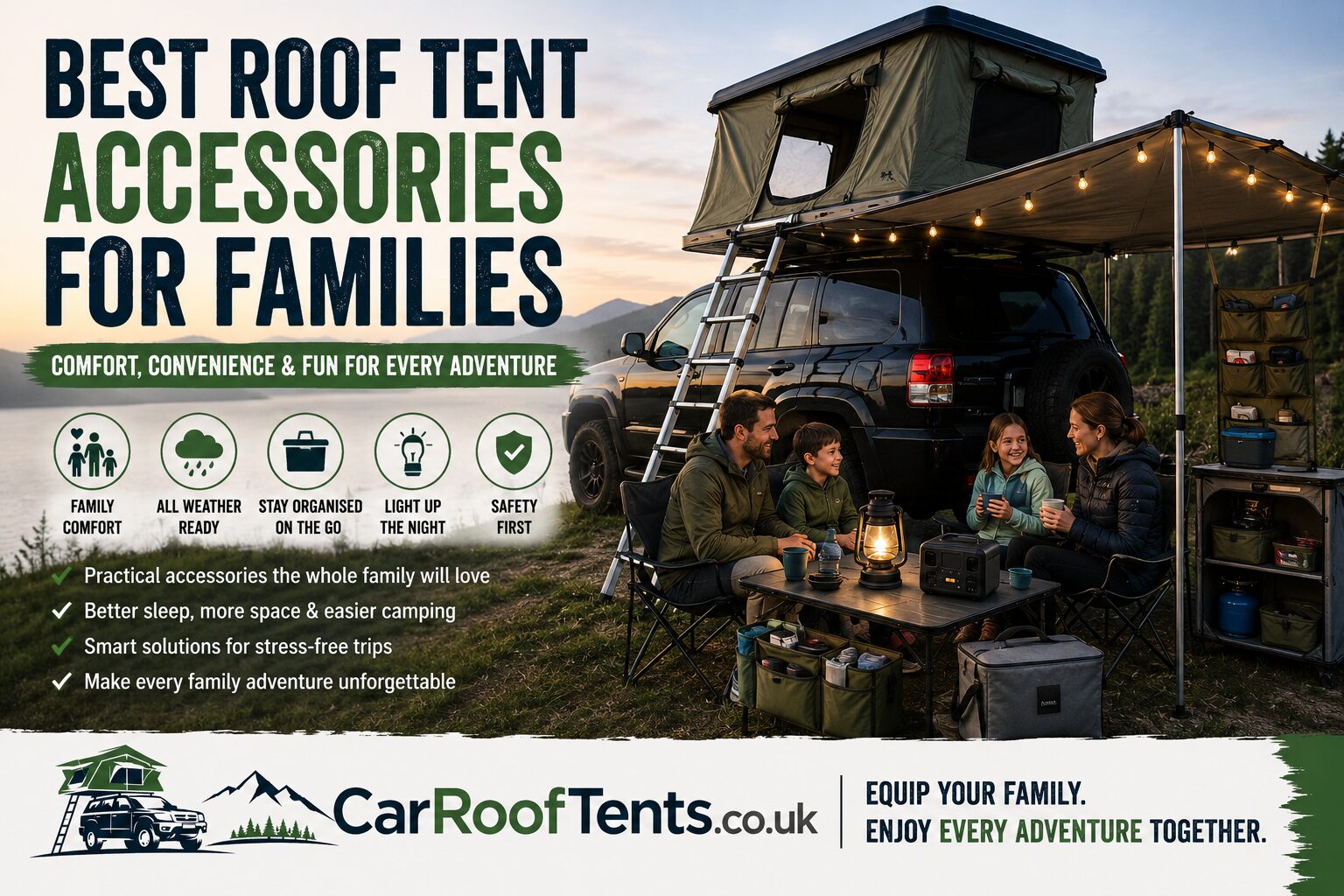
The most useful family upgrades are an awning or annex, safe lighting, organised storage, a comfortable mattress setup, an anti-condensation mat and reliable food or power storage.
Families should prioritise accessories that make the ladder safer, provide sheltered ground-level space and prevent the sleeping area becoming a storage room.
Do not add every accessory at once. Build the setup around the ages of the children, normal trip length, vehicle capacity and the amount of equipment you can realistically pack and deploy.
What Families Need From Roof Tent Accessories
A family setup must work at three different times:
- while travelling;
- while living around the vehicle;
- while sleeping in the roof tent.
An accessory that improves only one part of the trip but causes problems elsewhere may not be worthwhile. A thick mattress topper may improve sleep but prevent the tent closing. A large awning room may create excellent living space but dominate the boot. A heavy fridge may be useful at camp but difficult to lift and secure.
For most families, the main priorities are:
- safe ladder use;
- enough sleeping width;
- a dry changing area;
- somewhere for shoes and wet clothing;
- easy access to lights and water;
- food storage;
- charging for several devices;
- simple pack-down in bad weather;
- keeping total roof and vehicle loads within limits.
Age matters too. A setup for two adults and teenagers is different from one used with a preschool child. Families should never assume that a child can use the ladder or sleep safely in the tent simply because the advertised capacity includes several people.
Quick Comparison: Best Family Roof Tent Accessories
| Accessory | Main family benefit | Priority | Main caution |
|---|---|---|---|
| Awning or annex | Ground-level living and changing space | Very high | Bulk and wind exposure |
| Ladder lighting | Safer night-time access | Essential | Avoid glare and trip hazards |
| Storage organiser | Keeps shoes and small items off the bed | High | Respect attachment limits |
| Mattress topper | Improves comfort for multiple sleepers | High | Check packed clearance |
| Anti-condensation mat | Reduces moisture beneath the mattress | High | Does not replace ventilation |
| Portable power | Charges several devices and runs lighting | Medium to high | Weight and waterproofing |
| Coolbox or fridge | Keeps family food safely chilled | High | Power use and boot space |
| First-aid kit | Deals with minor injuries | Essential | Check contents and expiry dates |
| Dry bags | Separates wet and clean gear | High | Not all are immersion-proof |
| Compact chairs | Creates a usable family camp | Medium | Bulky when multiplied by four |
| Security system | Protects a valuable family setup | Medium | No lock is theft-proof |
1. A Roof Tent Awning, Annex or Living Pod
For family camping, an awning or annex is often the single most transformative accessory. It creates a ground-level space where children can change, adults can prepare food and everyone can shelter when the weather turns.
A family awning can be used for:
- removing muddy shoes;
- storing bags and coats;
- changing clothes privately;
- seating during rain;
- keeping wet equipment away from bedding;
- providing a sheltered route to the ladder;
- creating daytime space while the roof tent remains the sleeping area.
The official TentBox Living Pod is designed for compatible TentBox models and provides sheltered space around the ladder area. TentBox’s own family guidance also identifies the Living Pod and Tunnel Awning as ways to create more family space.
Thule’s official rooftop tent accessory range includes Approach awnings and wall systems for compatible tents.
Why Families Benefit More Than Couples
Two adults can often manage inside the vehicle during rain. A family quickly runs out of room. A sheltered annex prevents the roof tent becoming cluttered with damp clothes, shoes, toys and bags.
What to Check
- exact roof tent compatibility;
- vehicle-height range;
- ladder position;
- included walls and groundsheet;
- setup time;
- packed dimensions;
- wind and rain guidance;
- whether children can move safely around poles and guy lines.
Read our complete Best Roof Tent Awnings UK guide before choosing a shelter.
2. Safe Ladder and Campsite Lighting
Families are more likely to have people climbing in and out at different times. A child may need the toilet after dark, while an adult may still be organising the vehicle below.
A useful lighting system includes:
- a head torch for each capable user;
- a low-level lantern near the ladder;
- soft interior lighting;
- a torch stored in the same place every night;
- spare battery or charging capacity.
A bright light aimed directly into the tent can destroy night vision and disturb sleepers. Use diffused or red lighting around the sleeping area.
Ladder Safety
Lighting does not make an unsuitable child safe on a ladder. The ladder must be correctly extended, stable and used in accordance with the tent manufacturer’s instructions. Younger children may need direct adult assistance every time.
Do not wrap unapproved powered lighting around ladder rungs where cables can create trip or snag hazards.
See our Roof Tent Safety Guide for wider family precautions.
3. Roof Tent and Ladder Storage Organisers
Organisation matters more as the number of campers increases. Phones, glasses, keys, torches and water bottles should not be scattered across the mattress.
The official Thule Rooftop Tent Organizer provides multiple compartments for shoes and equipment and uses waterproof fabric for outdoor storage.
Thule also offers the Thule Outset Organizer for compatible setups, with several compartments designed to remain mounted when empty.
A Good Family Storage System
Assign a predictable place for:
- each person’s shoes;
- head torches;
- vehicle keys;
- toiletries;
- charging cables;
- water bottles;
- wet clothing;
- first-aid supplies.
Colour-coded pouches or dry bags can make it easier for children to manage their own belongings.
Do Not Overload Tent Loops
Interior loops may be intended only for light items. Do not suspend heavy bags, water containers or power stations from fabric attachment points.
4. Mattress Toppers and Sleeping Comfort
A mattress that feels comfortable for two adults may feel very different when three or four people share the sleeping platform. More bodies increase compression, heat and movement.
A model-specific mattress topper can:
- reduce hip and shoulder pressure;
- improve comfort for side sleepers;
- add warmth;
- reduce the feeling of the hard tent base;
- make a family roof tent feel more like a proper bed.
TentBox offers official toppers for several models, while Thule’s accessory range includes model-specific mattress toppers. iKamper also offers model-specific self-inflating comfort mattresses.
Read our detailed Best Roof Tent Mattress Toppers UK guide.
Family Warning: Packed Height
Family setups often include more pillows, sleeping bags and blankets. Adding a topper may prevent the tent closing even when the topper alone appears to fit.
Test the complete packed arrangement and never force latches, covers or straps.
5. An Anti-Condensation Mat
Each sleeping person releases moisture through breathing. A family can therefore create much more overnight humidity than one or two occupants.
An anti-condensation mat creates airflow beneath the main mattress and can help:
- reduce trapped moisture;
- protect mattress foam;
- speed drying;
- reduce mould risk;
- improve long-term comfort.
It does not eliminate the need to ventilate the tent or dry wet bedding.
Thule identifies anti-condensation mats as a popular comfort and airflow accessory, while several current TentBox models include a mesh layer beneath the mattress.
Read our complete guide to the Best Roof Tent Anti-Condensation Mats.
6. A Simple Family Bedding System
Family bedding can consume more vehicle space than the tent itself. A simple system is usually easier than carrying several bulky household duvets and pillows.
Possible Approaches
- individual sleeping bags;
- double sleeping bags for adults;
- compact camping pillows;
- colour-coded pillowcases;
- lightweight blankets for temperature adjustment;
- waterproof storage bags for damp weather.
Some tents allow bedding to remain inside when closed. TentBox’s official FAQs explain that this varies by model, so check the exact tent and do not assume all bedding can stay inside.
Children and Temperature
Children may not regulate temperature in the same way as adults. Choose age-appropriate bedding and check them during cold or hot conditions.
A topper or extra blanket does not make an unsuitable sleeping bag safe for low temperatures.
7. Portable Power and Multi-Device Charging
Families can quickly accumulate phones, watches, tablets, cameras, lanterns and head torches. A well-planned charging system avoids cable confusion and arguments over the last USB socket.
For Short Trips
A quality 20,000mAh power bank and multi-port USB charger may be enough.
For Fridge Use or Longer Trips
A 500–800Wh portable power station is often a practical starting point for a family weekend, depending on actual appliance use.
Useful Features
- several USB-A and USB-C ports;
- a regulated 12V output for a fridge;
- clear battery indication;
- vehicle charging;
- solar compatibility;
- low-temperature protection;
- a weight that one adult can lift safely.
Read our detailed Best Portable Power Stations for Roof Tent Camping guide.
Keep Power at Vehicle Level
Do not place a heavy power station in the roof tent simply to keep it close to devices. Store it securely, dry and ventilated at vehicle level.
8. A Family Coolbox or Compressor Fridge
Keeping food cold becomes more important when camping with children. Milk, prepared meals, snacks and medication may all require dependable temperature control.
Passive Coolbox
A quality insulated coolbox is simple, silent and requires no electrical system, but it depends on ice or frozen packs and becomes less convenient on longer trips.
Compressor Fridge
A 12V compressor fridge offers more reliable temperature control but needs a suitable power source and adequate ventilation.
Dometic’s official UK site includes coolers, portable refrigeration and outdoor equipment. Product size and power requirements vary considerably.
Family Buying Considerations
- capacity in litres;
- weight when fully loaded;
- 12V power consumption;
- safe food temperature;
- lid access inside the vehicle;
- ventilation around a compressor;
- how easily children can open it;
- space for medication where relevant.
Pre-cool the fridge and food at home rather than using battery energy to cool warm contents after arrival.
9. A Family-Sized First-Aid Kit
A small personal first-aid kit may not be sufficient for a family. More people and more activity increase the chance of cuts, grazes, insect bites, burns and blisters.
A family kit should be chosen according to:
- number and ages of campers;
- planned walking or cycling;
- distance from help;
- known allergies or medical needs;
- trip duration.
Check expiry dates before each season and replenish used items immediately.
Personal medication, prescriptions and emergency plans should be managed separately from a generic kit.
10. Waterproof Dry Bags and Wet-Gear Storage
Wet clothing can create chaos in a family roof tent. A few clearly labelled dry bags prevent damp items contaminating bedding and clean clothes.
A Simple Colour System
- one bag for clean bedding;
- one for wet coats and trousers;
- one for electrical equipment;
- one for dirty laundry;
- one small bag for documents and keys.
Do not put wet clothing into a sealed bag for long-term storage. The bag is for temporary separation until the items can be dried.
Keep bedding in the vehicle until the tent is fully opened and checked for damp after heavy rain.
11. Compact Family Seating and a Small Table
Four full-size camping chairs can occupy a large proportion of the boot. Choose seating according to children’s ages and the length of time spent at camp.
Options
- compact folding chairs;
- lightweight stools;
- a family bench;
- chairs that pack into narrow bags;
- a small roll-top table.
Children’s chairs should be stable and used on level ground. Avoid placing them beside guy lines, cooking areas or the ladder.
A table helps keep food and hot drinks away from the ground and reduces the temptation to use the vehicle bonnet or roof tent ladder as an improvised surface.
12. Water Storage and Individual Bottles
Each family member should have an identifiable drinking bottle. This reduces sharing, spills and confusion.
A separate water container at vehicle level is useful for:
- drinking;
- hand washing;
- basic cleaning;
- filling bottles;
- cooking where the water is suitable.
Secure heavy water containers low in the vehicle. Ten litres of water weighs approximately 10kg before the container itself is included.
Do not carry heavy water containers in the roof tent.
13. Roof Tent Security Locks and Tracking
A family roof tent setup may represent a substantial investment once the tent, awning, bars and accessories are combined.
A layered security approach can include:
- manufacturer-approved security nuts or brackets;
- locked roof bars;
- security marking;
- a movement alarm;
- a hidden tracker;
- secure parking and storage.
Read our Best Roof Tent Security Locks UK guide for compatible systems and fitting cautions.
Teach older children not to share the location of spare keys or trackers online.
14. Family Weather-Protection Accessories
Weather management becomes more important when several people depend on the same shelter.
Useful Items
- waterproof jackets accessible without unpacking everything;
- spare towels and microfibre cloths;
- a boot mat;
- weatherproof storage boxes;
- spare guy lines and suitable pegs;
- a soft brush for mud;
- sunshade or awning walls;
- insect mesh where supplied for the tent.
Do not use an awning or annex outside its stated wind limits. More wall area usually means more wind loading.
Best Roof Tent Accessories for Younger Children
Younger children require supervision rather than simply more equipment.
Useful Additions
- soft low-level lighting;
- a predictable sleeping position away from the entrance;
- individual water bottles;
- easy-access warm layers;
- a ground-level changing area;
- colour-coded storage;
- a suitable travel potty where required;
- a clear night-time toilet plan.
What Not to Add
Do not use improvised bed guards, ladder modifications or safety nets unless specifically approved for the tent. Unverified accessories can create entrapment or structural risks.
Parents should assess whether a rooftop sleeping arrangement is appropriate for the child’s age, behaviour and ability.
Best Roof Tent Accessories for Teenagers
Teenagers are more likely to value personal charging, privacy and separate sleeping space.
Useful accessories include:
- individual USB charging leads;
- separate storage pouches;
- earplugs and eye masks;
- an annex or ground tent for additional privacy;
- compact camping chairs;
- individual head torches;
- a larger awning for social space.
Teenagers may be capable of using the ladder independently, but they should still follow the same footwear, lighting and access rules as adults.
How to Pack a Family Roof Tent Setup
Keep Heavy Items Low
Power stations, water, food boxes and heavy tools should be secured low in the vehicle.
Use Categories
Pack by function:
- sleeping;
- clothing;
- food;
- lighting and power;
- wet weather;
- first aid;
- tent setup.
Create a First-Night Bag
For late arrivals, pack one accessible bag containing:
- head torches;
- sleepwear;
- toothbrushes;
- essential medication;
- the next morning’s clothes;
- water bottles.
Do Not Overfill the Roof Tent
Bedding and lightweight approved items may remain inside some tents, but extra equipment adds roof load and may prevent proper closure.
Read our Roof Tent Weight Limits Explained guide and Roof Bars for Roof Tents page.
Family Roof Tent Accessory Buying Guide
Prioritise Safety and Shelter
Before entertainment or decorative equipment, buy reliable lighting, first aid, dry storage and suitable shelter.
Check Sleeping Capacity
An accessory cannot make a two-person roof tent suitable for four sleepers. Capacity, dimensions and static-load limits still apply.
Consider Setup Time
A complicated annex, several beds and extensive furniture can make overnight touring exhausting. Choose equipment that matches your travel style.
Check Combined Weight
Calculate the weight of the tent, bars, topper, anti-condensation mat, bedding and any equipment stored inside during travel.
Think About Rainy Pack-Down
Ask where wet walls, bedding and clothing will go when the family needs to leave quickly.
Buy Model-Specific Accessories Where It Matters
For awnings, mattress systems, brackets and security hardware, manufacturer-approved products reduce compatibility risks.
Use Generic Equipment Where It Makes Sense
Water bottles, first-aid kits, dry bags and lanterns do not necessarily need roof-tent branding.
Plan for Growth
Children become larger, heavier and more independent. A setup that works this year may need another sleeping space later.
Common Family Roof Tent Accessory Mistakes
- Buying a large awning without checking boot space.
- Leaving all shoes and bags inside the sleeping area.
- Adding a thick topper and forcing the tent closed.
- Ignoring increased condensation from extra occupants.
- Allowing children to use the ladder without suitable supervision.
- Putting heavy power stations or water containers in the roof tent.
- Using bright lights that disturb sleepers and neighbouring pitches.
- Overloading interior storage loops.
- Failing to test the full setup at home.
- Assuming advertised capacity guarantees comfort for every family.
- Buying more equipment than the family can pack efficiently.
- Forgetting a wet-weather storage plan.
Frequently Asked Questions
What is the most useful family roof tent accessory?
For many families, an awning or annex provides the biggest improvement because it creates sheltered ground-level living and changing space.
Do families need an anti-condensation mat?
It is strongly recommended because more sleepers create more overnight moisture.
Is a mattress topper worth buying?
Yes, when the original mattress is firm or thin, provided the tent still closes safely.
Can four people sleep in any family roof tent?
No. Check the stated capacity, mattress dimensions, static-load limit and actual space required by the occupants.
Are roof tents safe for young children?
Suitability depends on age, behaviour, supervision, ladder access and the tent design. Parents must make an individual assessment.
Can I add a child safety rail?
Only use a product specifically approved for the tent. Improvised rails can create entrapment or structural hazards.
Should children sleep near the tent entrance?
Families often place younger children away from the entrance, but follow the tent layout and maintain safe emergency access.
Do we need a portable power station?
Not necessarily. A power bank may be enough for phones and lights. A power station becomes useful for a fridge and longer trips.
What size power station suits a family?
Around 500–800Wh is a common weekend starting point, while 1,000Wh may suit longer fridge-heavy trips. Measure actual consumption.
Is a compressor fridge worth it?
It can be very useful for reliable family food storage, but it adds cost, weight and power demand.
What size fridge does a family need?
It depends on family size, trip length and shopping frequency. Check internal usable space rather than litres alone.
Can bedding remain inside the tent?
Some models allow it, while others have limited clearance. Follow the exact manufacturer guidance.
How do we keep the tent organised?
Use assigned storage pouches, shoe organisers, labelled dry bags and one fixed location for keys and lights.
How can we reduce muddy bedding?
Use an awning or changing area, shoe organiser, compact mat and a strict no-shoes rule inside.
What lighting is safest?
Battery LED head torches and diffused lanterns are preferable to open-flame lighting.
Should every child have a head torch?
Older responsible children may benefit from one. Younger children should remain closely supervised.
Can a family use one large duvet?
Possibly, but individual sleeping bags often provide better temperature control and simpler packing.
How do we manage wet clothes?
Place them temporarily in a labelled waterproof bag, then dry them as soon as possible.
Can we store water in the roof tent?
Heavy water containers should remain secured low in the vehicle.
Do we need a first-aid kit?
Yes. Choose one suitable for the group size and activities, and carry personal medication separately.
Are roof tent organisers universal?
No. Check attachment points, dimensions and load limits.
Can we use a ground tent as extra family space?
Yes. A small separate tent may provide privacy and flexibility without overloading the rooftop sleeping area.
Is an annex suitable for sleeping?
Only when the manufacturer states that it is suitable and the campsite conditions, ventilation and ground setup are appropriate.
How can we keep devices charged?
Use labelled cables, a multi-port charger and a power bank or station sized to actual demand.
Do children increase condensation?
Yes. Every additional sleeper adds moisture to the air through breathing.
How should we practise before the first trip?
Set up the complete tent, awning, bedding, lighting and storage system at home and complete a trial night if practical.
What should go in a first-night bag?
Head torches, sleepwear, toothbrushes, medication, water and clothes for the next morning.
How do we protect the tent from theft?
Use approved locking hardware, secure bars, marking, tracking and sensible parking.
Can accessories overload the roof?
Yes. Toppers, mats, bedding and equipment stored inside all contribute to travelling roof load.
What accessories should families buy first?
Safe lighting, first aid, dry storage, anti-condensation protection and an awning or shelter are strong priorities.
Final Verdict
The best family roof tent accessories are the ones that create space, maintain safety and keep the sleeping area dry and uncluttered.
An awning or annex usually provides the greatest improvement. Good lighting, organised storage, an anti-condensation mat and a comfortable mattress setup make daily use easier, while reliable food storage and charging become increasingly valuable on longer trips.
Families do not need every accessory on the first trip. Begin with the essentials, test the setup at home and add equipment only when a genuine need becomes clear.
Our Independent Recommendation
Prioritise sheltered living space, safe night-time access, moisture control and simple organisation.
For most families, the first major purchase after the tent should be a compatible awning or annex, followed by lighting, storage and sleep-comfort improvements.
Keep heavy equipment at vehicle level and check the complete roof-load calculation whenever accessories or bedding are added.
Editorial Disclosure
This guide has been produced independently by CarRoofTents.co.uk to help UK families choose practical roof tent accessories.
We do not currently use affiliate links in this article. External links lead to official manufacturer or official product pages so readers can verify current compatibility, specifications and availability.
No product is recommended solely because of price, popularity or a commercial relationship. Suitability depends on the exact tent, vehicle, family, ages of the children and normal camping conditions.
Product designs and compatibility can change. Always check current manufacturer instructions before buying, fitting or using any accessory.
Still Choosing a Family Roof Tent?
Compare sleeping capacities, mattress sizes, weights, opening styles and key features from leading brands using our independent UK comparison resource.