
Last Updated on 2 days ago by admin
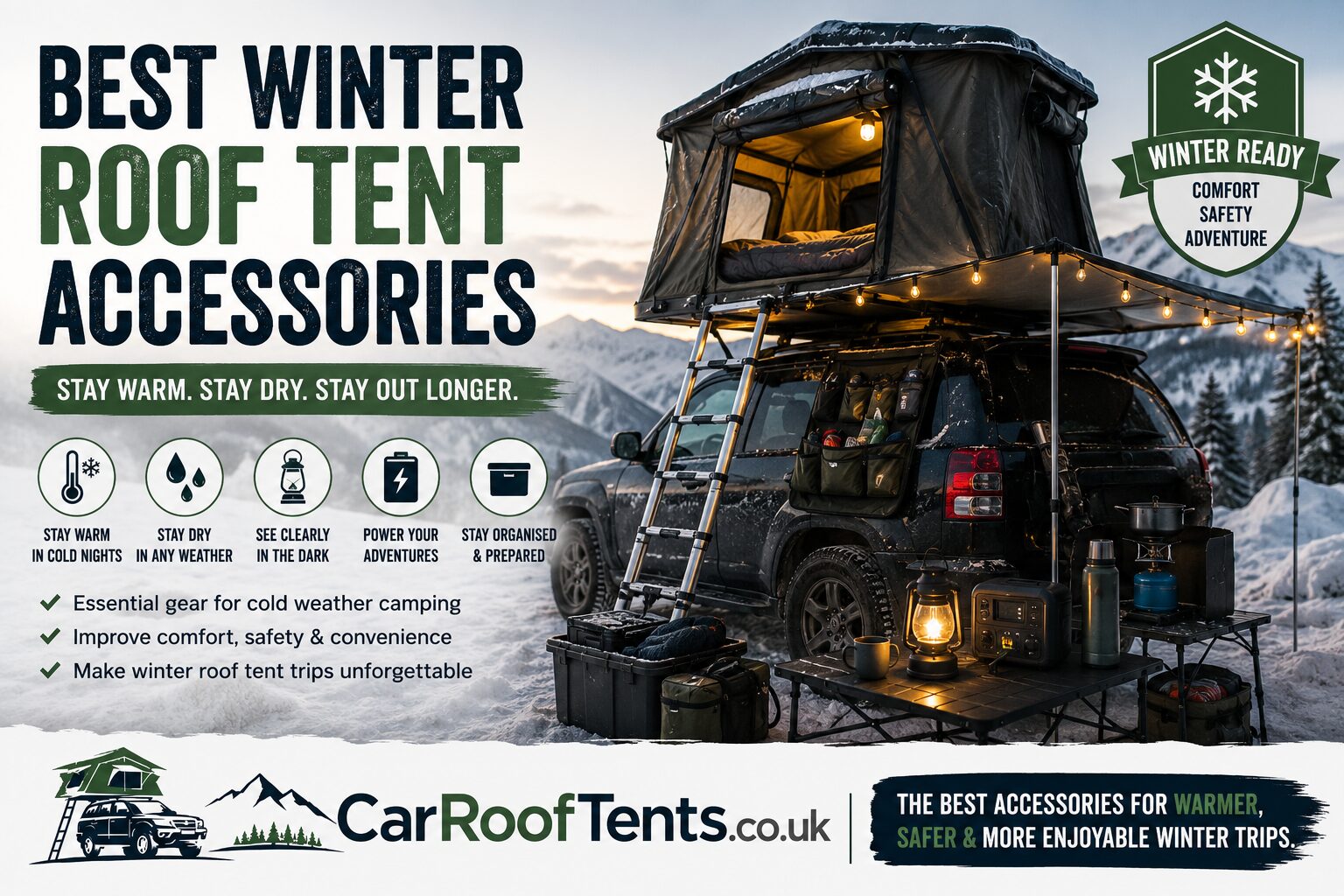
The most important winter accessories are not simply products that produce heat. A good setup focuses first on insulation, dry bedding, moisture control, weather protection, reliable lighting and a sleep system suited to the expected temperature.
This independent UK guide explains which roof tent accessories are genuinely useful in winter, which official insulation systems are currently available, how to manage condensation and what to avoid when temperatures fall.
For the complete accessories overview, visit our Best Roof Tent Accessories UK guide. You should also read our Roof Tent Safety Guide before planning cold-weather trips.
Quick Verdict
The best winter setup combines a model-specific insulated liner, a sleeping bag with a genuine comfort rating below the expected overnight temperature, an anti-condensation mat, dry base layers, reliable lighting and a sheltered changing area.
Do not rely on a portable heater to compensate for inadequate bedding or poor planning. Insulation and sleep-system performance matter more than short bursts of warm air.
Why Winter Roof Tent Camping Is Different
UK winter conditions often combine short days, wet and windy weather, frost, ice, slow drying, reduced battery performance and large temperature differences between the warm tent interior and cold outer surfaces.
Warm humid air from breathing condenses when it meets a cold floor, mattress base or tent wall. This is why winter campers may wake to damp fabric even when no rain has entered.
The UK Met Office describes winter as the coldest season with the shortest days and notes that conditions can include rain, frost, snow, fog and some of the strongest winds of the year.
Winter preparation should focus on four priorities: staying warm, staying dry, maintaining safe access and being able to leave quickly if conditions deteriorate.
Quick Comparison: Best Winter Accessories
| Accessory | Main benefit | Priority | Main caution |
|---|---|---|---|
| Insulated liner | Reduces heat loss and cold surfaces | Very high | Model-specific fit |
| Rated sleeping bag | Primary overnight warmth | Essential | Use comfort rating |
| Mattress topper | Comfort and extra insulation | High | Check closing clearance |
| Anti-condensation mat | Improves airflow beneath mattress | Very high | Still requires ventilation |
| Awning or annex | Sheltered wet-gear area | High | Wind loading |
| Head torch and lantern | Safe access during long nights | Essential | Cold affects batteries |
| Portable power station | Lighting and charging | Medium | Low-temperature limits |
| Hot-water bottle | Simple pre-bed warmth | Useful | Leak and burn risk |
| Dry bags | Separates wet and dry equipment | High | Wet items still need drying |
1. A Model-Specific Insulated Roof Tent Liner
An insulated liner creates another layer inside the tent, reducing direct exposure to cold fabric and helping retain warmth produced by the occupants.
The official Thule Approach Insulator S and Approach Insulator M are quilted liners for compatible Approach tents.
The Thule Insulator-Foothill attaches to the internal frame and provides zipped access to windows, doors and sky panels.
Advantages
- Exact fit for the tent.
- Access panels align with doors and vents.
- Less risk of loose insulation obstructing zips.
- Usually removable in warmer months.
Limitations
- Model-specific compatibility.
- Additional packed weight and storage.
- May need removing before closure.
- Does not replace suitable bedding.
Do Not Improvise With Heavy Blankets
Heavy blankets suspended from tent loops can overload attachment points, obstruct ventilation and fall onto sleepers.
2. A Sleeping Bag With an Appropriate Comfort Rating
The sleeping bag is the main source of overnight warmth. Use the comfort rating as your principal guide rather than an extreme or survival rating.
Decathlon’s official sleeping bag guide explains the relationship between expected temperatures and bag choice.
Its MT500 5°C sleeping bag, for example, carries a comfort rating of 5°C and a lower limit of 0°C. This illustrates why a bag suitable for cool weather may still be inappropriate below freezing.
Look For
- a comfort rating below the expected overnight low;
- a hood and draught collar;
- a suitable size and shape;
- insulation that suits likely moisture;
- a manageable packed size;
- clear washing and storage instructions.
Synthetic insulation generally handles damp better, while down offers excellent warmth for its weight but requires careful moisture management.
3. Mattress Toppers and Under-Body Insulation
Cold can be conducted through the mattress and tent base. A suitable topper or replacement mattress can improve comfort and insulation.
Useful options include model-specific memory-foam toppers, self-inflating mattresses and high-density foam systems approved by the tent manufacturer.
Read our Best Roof Tent Mattress Toppers UK guide before adding thickness.
Check Packed Height
Winter campers often use thicker sleeping bags and blankets. The combined depth can prevent the shell or cover closing. Test the complete arrangement at home and never force latches or straps.
4. An Anti-Condensation Mat
An anti-condensation mat is particularly valuable in winter because the tent base becomes much colder than the humid air above the mattress.
- It creates airflow beneath the mattress.
- It helps moisture evaporate.
- It protects mattress foam.
- It reduces mould risk.
- It assists drying after a trip.
It does not eliminate condensation. Vents must remain appropriately open and bedding must be dried.
Read our Best Roof Tent Anti-Condensation Mats guide.
5. A Winter-Suitable Awning or Annex
An awning or annex creates somewhere to remove wet boots and clothing before climbing into the sleeping area.
It can provide a changing space, protected storage, a covered route to the ladder and somewhere to organise equipment in rain.
Enclosed walls create greater wind loading, so pack the awning away before conditions exceed the manufacturer’s limits.
Read our Best Roof Tent Awnings UK guide.
6. Reliable Winter Lighting
Short days mean more setup and pack-down in darkness. Carry a head torch, a soft lantern, a backup torch and spare batteries or charging capacity.
Cold temperatures reduce battery performance. Red-light modes can reduce glare inside the tent and around nearby pitches.
Keep cables clear of ladder access and never use candles or flame lanterns inside the tent.
7. A Portable Power Station With Cold-Weather Protection
A power station can support lighting, phones and a 12V fridge, but lithium batteries have operating and charging temperature limits.
Useful Winter Features
- clear charging temperature limits;
- low-temperature protection;
- reliable 12V output;
- vehicle and mains charging;
- a display readable in poor light;
- manageable weight.
Read our Best Portable Power Stations for Roof Tent Camping guide.
Keep the station dry and ventilated at vehicle level. An awning is not guaranteed to keep out wind-driven rain or melting snow.
8. Hot-Water Bottles, Hand Warmers and Heated Accessories
Hot-Water Bottle
A hot-water bottle can pre-warm a sleeping bag without using electricity. Inspect it for deterioration, close it securely and avoid direct skin contact that could cause burns.
Hand Warmers
Rechargeable or chemical hand warmers can improve comfort during setup. Do not leave high-temperature devices pressed against skin while sleeping.
Heated Blankets
A low-wattage heated blanket may be more efficient than heating the tent air, but it must be dry, undamaged and compatible with the power source.
9. Waterproof Storage and Dry Clothing
Dry clothing is a safety item in winter. Use separate waterproof bags for sleepwear, wet outer clothing, gloves, electrical equipment and emergency spare layers.
Change out of damp clothing before entering the sleeping area. Do not leave wet gear sealed for long periods; dry it as soon as practical.
Roof Tent Heater Safety
A roof tent is a small fabric enclosure with limited clearances and combustible materials.
Never Use Inside a Roof Tent
- charcoal heaters or barbecues;
- petrol generators;
- unapproved gas heaters;
- open-flame stoves;
- candles;
- improvised exhaust-fed systems.
Carbon monoxide is colourless and odourless. A carbon monoxide alarm is an additional warning layer, not permission to use unsuitable combustion appliances.
Diesel Heaters
Some experienced users employ externally installed diesel heaters with properly routed exhaust and ducting. This requires a designed installation, suitable clearances, secure fuel storage and compatible heater ports. Do not improvise ducting through a window.
Electric Heaters
Electric fan heaters draw very high power. A 1,000W heater can consume about 1kWh in one hour before losses, making it impractical for many portable batteries.
Insulation, sleeping bags and hot-water bottles are generally safer and more efficient.
Winter Roof Tent Packing Strategy
- Keep head torches, gloves, dry layers and first aid accessible.
- Pack sleeping bags and night clothing in a waterproof container.
- Separate wet boots and coats.
- Secure power stations, water and tools low in the vehicle.
- Carry a backup light and charging method.
- Plan a fast departure if the forecast deteriorates.
Winter Roof Tent Accessory Buying Guide
Choose Compatibility First
Insulated liners, awnings, toppers and heater ports are model-specific.
Use Real Temperature Ratings
Choose sleeping bags by comfort rating, not a vague “four-season” label.
Plan for Moisture
Every insulation upgrade should be matched by ventilation and drying.
Check Packed Weight
Winter liners and bedding add weight. Read our Roof Tent Weight Limits Explained guide and Roof Bars for Roof Tents.
Test With Gloves
Zips, clips and valves should remain manageable in cold conditions.
Carry Redundancy
Bring backup lighting, dry emergency clothing and more than one charging method where practical.
Frequently Asked Questions
Can you use a roof tent in winter?
Yes, when the tent, weather, bedding and user experience are suitable.
What is the most important winter accessory?
A sleeping bag with a comfort rating appropriate for the forecast.
Do I need an insulated liner?
It is highly useful for regular cold-weather use where a compatible liner exists.
Will a liner stop condensation?
No. Ventilation and under-mattress airflow remain necessary.
Do I need an anti-condensation mat?
It is strongly recommended for winter camping.
Should I close all vents?
No. Some airflow is needed to release moisture.
Can I use a portable gas heater?
Do not use unsuitable fuel-burning heaters inside a roof tent.
Is a diesel heater safe?
Only as a properly designed external system with safe exhaust routing and suitable installation.
Can I use an electric heater?
Possibly, but it consumes battery energy very quickly and may exceed inverter limits.
Is a heated blanket more practical?
Often, but it must be compatible, dry and used exactly as instructed.
Can a hot-water bottle be used?
Yes, if it is in good condition, securely closed and not placed directly against skin.
Do batteries work in freezing weather?
Performance falls and many lithium systems prevent low-temperature charging.
Will solar panels work in winter?
Yes, but shorter days, cloud and low sun angle reduce daily output.
Can snow damage a roof tent?
Heavy accumulation can overload fabric, poles or the shell. Follow the manufacturer guidance.
How do I prevent icy ladder rungs?
Keep them dry where possible and inspect for frost before every climb.
How should I dry the tent after a trip?
Open it fully, remove bedding and mats, lift the mattress and dry every layer.
Can children winter camp in a roof tent?
Only with suitable supervision, bedding and temperature monitoring.
What if the forecast worsens?
Pack early, relocate or cancel. Accessories should never justify remaining in dangerous conditions.
Final Verdict
The best winter accessories retain body heat, keep bedding dry and make the setup safer in darkness and poor weather.
A fitted insulated liner, correctly rated sleeping bag, anti-condensation mat and suitable mattress system form the foundation. A sheltered awning, reliable lighting and dry storage make the trip easier to manage.
Our Independent Recommendation
Build the winter setup around insulation, a correctly rated sleep system and moisture control.
Add a model-specific liner where available, maintain ventilation and carry dry emergency clothing and backup lighting.
Never use unsafe fuel-burning appliances inside the roof tent, and leave or cancel when conditions exceed the equipment or your experience.
Editorial Disclosure
This guide has been produced independently by CarRoofTents.co.uk.
We do not currently use affiliate links in this article. External links lead to official manufacturer, product or recognised weather-information pages.
Product specifications and conditions can change. Always check current manufacturer instructions and a reliable weather forecast.
Still Choosing Your Roof Tent?
Compare tent weights, mattress sizes, seasons, capacities and features using our independent UK comparison resource.